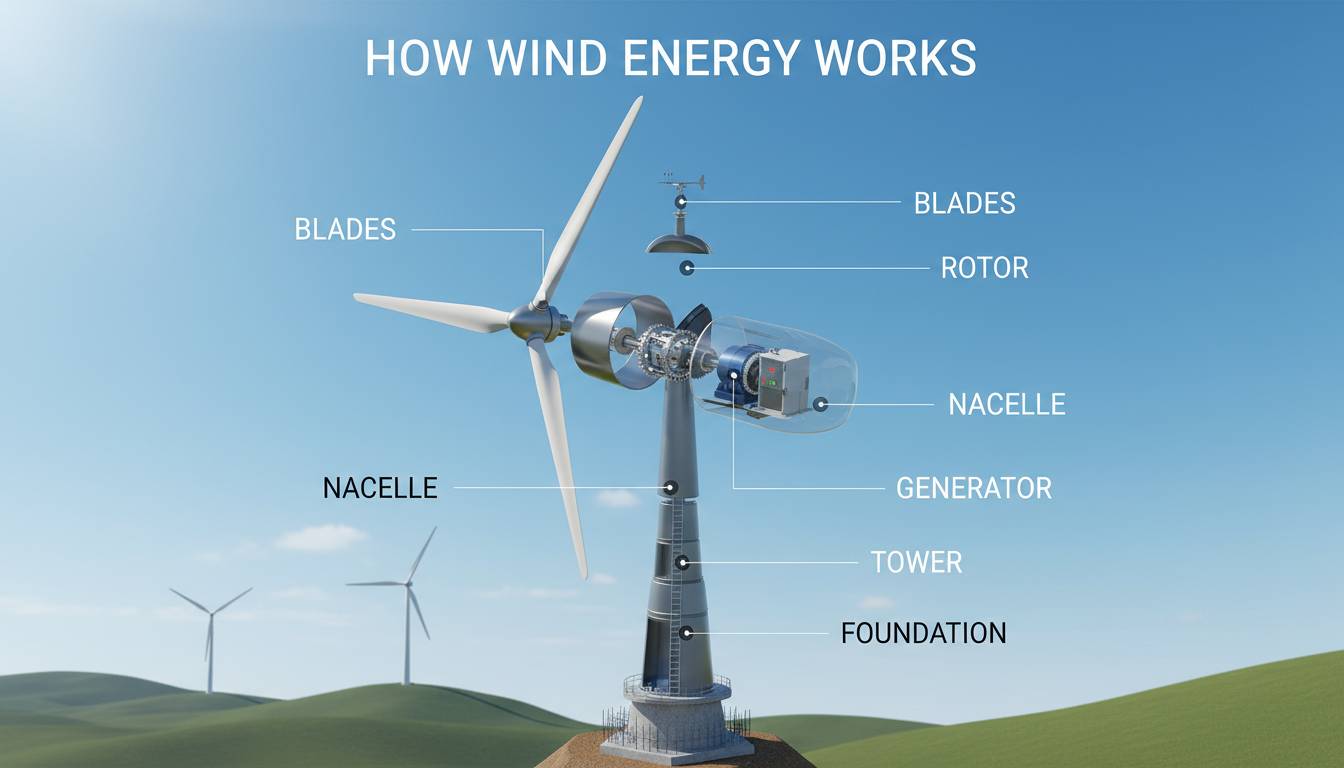
Wind energy harnesses the natural power of moving air to generate electricity, providing a clean and renewable alternative to fossil fuels. At its core, wind power converts the kinetic energy in wind into mechanical energy through turbine blades, then transforms that mechanical energy into electrical energy through a generator. This process produces no direct emissions, making wind one of the fastest-growing sources of renewable energy worldwide. Understanding how wind energy works involves exploring the technology behind turbines, the science of wind capture, and the infrastructure supporting modern wind farms.
📊 KEY STATS
- The United States has over 140 GW of installed wind power capacity
- Wind energy supplied approximately 9% of U.S. electricity generation in 2023
- Global wind capacity exceeded 900 GW in early 2024 (GWEC)
- Texas leads U.S. states with over 35 GW of installed wind capacity
Understanding Wind Energy: The Fundamentals
Wind energy refers to the process of creating electricity using wind—or more specifically, using the kinetic energy of moving air. This form of energy capture has existed for centuries in simpler forms like windmills grinding grain or pumping water, but modern wind energy represents a sophisticated technological advancement that converts natural air currents into reliable electrical power for homes, businesses, and entire grids.
The fundamental principle behind wind energy is straightforward: wind contains kinetic energy because it represents air in motion. When wind flows across a turbine’s blades, it transfers some of this kinetic energy to the blades, causing them to rotate. This rotation drives a generator that produces electricity. The process creates no combustion, emits no greenhouse gases during operation, and relies on an inexhaustible natural resource—the wind itself.
Key Components of Wind Energy Systems
| Component | Function | Importance |
|---|---|---|
| Rotor Blades | Capture wind energy and convert it to rotational force | Determines how much wind energy gets captured |
| Nacelle | Houses the gearbox, generator, and control systems | Protects internal machinery from weather |
| Tower | Elevates the rotor to access stronger, more consistent winds | Height directly impacts energy production |
| Foundation | Anchors the turbine to the ground | Must withstand extreme wind loads |
| Generator | Converts mechanical rotation into electricity | Output capacity measured in megawatts |
The science of capturing wind energy involves understanding wind patterns, turbine design, and site selection. Wind speed is particularly critical because power output increases dramatically with wind velocity—specifically, power is proportional to the cube of wind speed. This means a turbine operating in 15 mph winds produces roughly 2.4 times more power than one in 10 mph winds. This mathematical relationship explains why wind farm developers invest heavily in meteorological studies before selecting locations.
How Wind Turbines Generate Electricity
The electricity generation process in a wind turbine follows a carefully orchestrated sequence of energy conversions, each step optimized to maximize efficiency while maintaining reliability over decades of operation. Understanding this conversion chain reveals the engineering sophistication behind modern wind power technology.
The Energy Conversion Process
-
Wind Capture: Wind flows over the turbine’s blades, creating lift similar to an airplane wing. This aerodynamic phenomenon causes the blades to rotate.
-
Mechanical Transmission: The rotating blades connect to a main shaft through a gearbox. The gearbox increases rotational speed from roughly 10-20 revolutions per minute (RPM) to the 1,000-1,800 RPM required by the generator.
-
Electricity Generation: The high-speed shaft drives a generator, typically either a permanent magnet synchronous generator or an induction generator. These devices use electromagnetic induction to produce alternating current (AC) electricity.
-
Power Conditioning: The electricity passes through a transformer that increases voltage for transmission through the grid. Modern turbines also include power electronics to control frequency and ensure grid compatibility.
-
Grid Integration: The electricity feeds into transmission lines, traveling through the broader electrical grid to reach end users.
⚡ TECHNICAL INSIGHT: The theoretical maximum efficiency of a wind turbine is 59.3%, known as the Betz Limit. This figure represents the fraction of wind energy that can theoretically be captured. Modern commercial turbines typically achieve 35-45% efficiency, approaching practical limits.
The nacelle—the boxy structure behind the blades—contains the critical machinery making this conversion possible. Inside, a drivetrain comprising the main shaft, gearbox, and generator performs the mechanical-to-electrical conversion. Cooling systems prevent overheating during extended operation, while yaw motors rotate the entire nacelle to face changing wind directions, maximizing exposure to available wind resources.
Modern turbines also incorporate sophisticated control systems that optimize performance across varying conditions. These systems adjust blade pitch (the angle of the blades relative to the wind), monitor structural loads, and can even shut down turbines during extreme weather events to prevent damage.
Types of Wind Turbines Explained
Wind turbines come in several distinct configurations, each designed for specific applications, wind conditions, and installation environments. Understanding these variations helps explain why certain turbine types appear in different settings across the renewable energy landscape.
Horizontal-Axis vs. Vertical-Axis Turbines
Horizontal-axis wind turbines (HAWTs) dominate commercial wind energy production. These turbines feature a propeller-like rotor mounted on a horizontal shaft, with the entire assembly positioned atop a tall tower facing the wind direction. HAWTs offer superior efficiency and have become the standard for utility-scale wind farms worldwide.
Vertical-axis wind turbines (VAWTs) rotate around a vertical axis, with blades orbiting a central tower. These designs catch wind from any direction without requiring yaw mechanisms to reorient. While VAWTs are less efficient than HAWTs, they operate well in turbulent wind conditions and can be installed closer to the ground, making them suitable for distributed installations and urban environments.
Onshore vs. Offshore Wind
| Factor | Onshore Wind | Offshore Wind |
|---|---|---|
| Capacity Factor | 25-40% | 40-50% |
| Typical Turbine Size | 2-5 MW | 6-15+ MW |
| Installation Cost | $1,200-1,500/kW | $3,000-5,000/kW |
| Maintenance | Easier access | Requires specialized vessels |
| Wind Quality | More variable | Stronger, more consistent |
| Visual Impact | Land use concerns | Less visible from shore |
Onshore wind accounts for the vast majority of installed wind capacity in the United States. These installations are located on land, typically in rural areas with favorable wind resources. Onshore wind farms benefit from established supply chains, lower installation costs, and easier grid interconnection.
Offshore wind represents the fastest-growing segment of the wind energy industry. Floating offshore wind turbines—a relatively new technology—can be deployed in waters too deep for traditional fixed-bottom foundations, opening vast new areas of the ocean for energy development. The United States has significant offshore wind potential along both coasts and in the Great Lakes region.
Utility-Scale vs. Distributed Wind
Utility-scale wind turbines generate electricity that enters the transmission grid, serving millions of consumers through centralized power plants. These installations typically consist of dozens or hundreds of turbines spread across thousands of acres.
Distributed wind installations serve local loads directly, either feeding into local distribution grids or providing power to individual facilities. These smaller-scale projects can range from single turbines at farms or businesses to community wind projects serving local neighborhoods.
The Science Behind Wind Power
The physics governing wind energy capture involve fundamental principles of aerodynamics and fluid dynamics. Understanding these scientific foundations clarifies why turbines are designed as they are and how engineers optimize their performance.
Aerodynamics of Wind Turbine Blades
Wind turbine blades function according to the same aerodynamic principles that allow airplanes to fly. As wind flows across the curved surface of a blade, it travels faster over the top than the bottom. This speed difference creates lower pressure above the blade, generating lift that causes the blade to rotate. The blade’s twist (pitch) and shape (airfoil) determine how efficiently it captures wind energy.
Engineers carefully design blade shapes to maximize lift while minimizing drag—the aerodynamic resistance that reduces efficiency. Modern turbine blades can exceed 100 meters in length, allowing individual turbines to sweep areas larger than a football field with each rotation.
The Betz Limit and Real-World Efficiency
German physicist Albert Betz established in 1919 that no wind turbine can capture more than 59.3% of the wind’s kinetic energy. This limit, known as the Betz Limit, results from the fundamental physics of energy extraction—some wind must continue flowing through the turbine to maintain airflow.
Contemporary commercial turbines typically achieve 35-45% efficiency, with the most advanced designs approaching 50%. This efficiency gap between theoretical maximum and actual performance stems from mechanical losses, electrical conversion inefficiencies, and blade design constraints. Continuous improvements in materials, aerodynamics, and control systems steadily push actual efficiencies higher.
Wind Resource Assessment
Before constructing wind farms, developers conduct extensive wind resource assessments to quantify the energy available at potential sites. These studies typically involve:
- Meteorological measurements: Installing wind measurement equipment (anemometers, lidar) at various heights for one to three years
- Wind modeling: Using computer models to estimate long-term wind patterns based on historical data and geographic features
- Energy production estimates: Calculating expected electricity output using sophisticated software that accounts for wake effects, availability, and maintenance downtime
The resulting capacity factor—a measure of actual output relative to maximum potential—typically ranges from 25% to 50% depending on wind quality, turbine technology, and grid integration constraints.
Wind Energy in the United States
The United States possesses exceptional wind energy resources, particularly across the Great Plains, Midwest, and coastal regions. This abundant natural resource, combined with supportive policies and maturing technology, has driven rapid growth in American wind power over the past two decades.
Leading States in Wind Capacity
| State | Installed Capacity | % of State Electricity |
|---|---|---|
| Texas | 35+ GW | ~25% |
| Iowa | 12+ GW | 50%+ |
| California | 10+ GW | 15%+ |
| Oklahoma | 9+ GW | 30%+ |
| Kansas | 7+ GW | 25%+ |
Texas dominates U.S. wind energy production, possessing over one-quarter of the nation’s total installed capacity. The state’s vast wind resources, particularly in the Panhandle and West Texas regions, combined with substantial transmission infrastructure investment, have enabled remarkable growth. The Electric Reliability Council of Texas (ERCOT) grid now regularly sources over 25% of its electricity from wind during optimal conditions.
Iowa has achieved remarkable renewable energy penetration, with wind supplying over half of the state’s electricity generation in recent years. This achievement demonstrates that high wind penetration is technically feasible with appropriate grid planning and investment.
Major Wind Farms and Projects
The United States hosts several of the world’s largest wind energy installations:
- Roscoe Wind Farm (Texas): 781 MW capacity across nearly 4,000 acres
- Sheffield Solar (Texas): 650 MW facility in West Texas
- Alta Wind Energy Center (California): 1,320 MW across multiple phases
- Horse Hollow Wind Energy Center (Texas): 735 MW installation
These utility-scale installations demonstrate the scalability of wind energy technology while providing substantial clean electricity to regional grids.
Benefits and Challenges of Wind Energy
Wind energy offers significant advantages as a power source, but realistic assessment requires acknowledging the technical, economic, and social challenges that accompany its deployment. A balanced understanding supports informed policy discussions and technology development priorities.
Environmental Benefits
Wind energy’s primary environmental advantage is zero-emission electricity generation. Unlike fossil fuel power plants, wind turbines produce no direct greenhouse gas emissions during operation and require no combustion of carbon-based fuels. This characteristic positions wind as critical to decarbonizing electricity systems and addressing climate change.
The water savings associated with wind energy represent another significant benefit. Thermoelectric power plants—including natural gas, coal, and nuclear facilities—consume enormous quantities of water for cooling. Wind energy requires virtually no water input, relieving pressure on water resources in drought-prone regions.
Land use for wind farms is relatively modest compared to other energy facilities. While wind projects occupy substantial land areas, the actual footprint of turbine foundations and access roads represents only a small fraction of total lease area. Agricultural activities can often continue unchanged around wind installations.
Economic Considerations
The levelized cost of energy (LCOE) for wind has declined dramatically over the past decade, making wind competitive with—and often cheaper than—new fossil fuel generation. According to Lazard’s Levelized Cost of Energy Analysis, utility-scale wind’s LCOE ranges from $25-50 per megawatt-hour in favorable locations, rivaling or beating combined-cycle natural gas in many regions.
Wind energy creates substantial economic benefits for rural communities through lease payments to landowners, local employment during construction and operation, and increased tax revenues. A single large wind farm can generate millions of dollars annually for local economies.
Challenges and Limitations
Intermittency remains wind energy’s most significant challenge. Wind does not blow consistently, and electricity generation fluctuates with wind speed changes. This variability requires grid operators to maintain backup generation capacity and invest in grid flexibility resources like energy storage and demand response.
Transmission constraints limit wind energy development in many regions. The best wind resources often exist far from population centers where electricity demand concentrates. Building new transmission infrastructure requires substantial investment and faces permitting challenges.
Wildlife impacts, particularly on birds and bats, have drawn environmental concerns. While older turbine designs posed significant collision risks, modern turbines with slower rotation speeds and improved siting practices substantially reduce wildlife impacts. Ongoing research continues to refine mitigation strategies.
Visual and noise concerns affect local acceptance in some communities. While these are primarily aesthetic rather than environmental concerns, they represent legitimate community considerations that developers must address through community engagement and appropriate project design.
The Future of Wind Energy
Wind energy’s trajectory points toward continued growth and technological advancement. Industry projections and policy signals suggest wind will play an increasingly central role in America’s clean energy transition.
Technology Advancement
Turbine sizes continue increasing dramatically, with offshore machines now exceeding 15 megawatts—roughly three times the capacity of turbines deployed a decade ago. Longer blades capture more wind energy at lower wind speeds, expanding the geographic regions where wind power is economically viable.
Floating offshore wind represents a transformative development, enabling deployment in waters previously inaccessible to fixed-bottom turbines. The United States has particularly vast potential for floating offshore wind along its Pacific coast and in the Gulf of Maine, where water depths preclude traditional foundations.
Manufacturing innovations are reducing costs while improving performance. Advanced materials, automated production techniques, and economies of scale continue driving down capital costs. Digitalization enables predictive maintenance, reducing downtime and extending component lifespans.
Policy and Market Outlook
The Inflation Reduction Act (IRA) of 2022 established long-term policy certainty for wind energy through expanded tax credits and new programs. The Production Tax Credit (PTC) and Investment Tax Credit (ITC) provide substantial financial support for new wind installations, with bonus credits for projects meeting domestic content and energy community requirements.
State-level renewable portfolio standards (RPS) mandate increasing renewable energy procurement, creating sustained demand for wind power. Over half of U.S. states have established 100% clean energy targets, driving long-term market growth.
Grid operators are increasingly recognizing wind’s contribution to electricity system reliability. Advanced forecasting, improved grid planning, and expanding transmission infrastructure all support higher wind penetration levels. The convergence of wind energy with battery storage is particularly promising, enabling wind plants to provide dispatchable renewable generation.
Frequently Asked Questions
How efficient are wind turbines?
Modern commercial wind turbines achieve 35-45% efficiency in converting available wind energy to electricity, approaching practical limits defined by the laws of physics. This efficiency varies with wind speed, turbine design, and site conditions.
Do wind turbines work in low wind areas?
Wind turbines require minimum wind speeds (typically around 7-9 mph) to begin generating electricity, but they can operate across a wide range of wind conditions. Regions with average wind speeds below 12-14 mph may not support economically viable utility-scale projects, though smaller turbines can serve distributed applications.
How long do wind turbines last?
Most wind turbines are designed for 20-25 year operational lifespans, though many continue operating beyond original projections with proper maintenance. Component replacement (particularly blades and gearboxes) can extend operational life significantly.
Are wind turbines dangerous to wildlife?
Modern wind turbines pose substantially reduced risks to wildlife compared to earlier designs. Studies indicate that proper siting, turbine design improvements, and operational adjustments can minimize impacts on birds and bats. Wind energy’s climate benefits ultimately outweigh localized wildlife concerns when evaluated at ecosystem scales.
Can wind energy power my entire home?
Individual residential wind turbines can offset home electricity consumption in appropriate locations, but success depends on adequate wind resources, system sizing, and local regulations. Most homes rely on grid-connected systems that draw from or supply the broader electricity network.
Conclusion
Wind energy represents a mature, cost-competitive technology that provides substantial clean electricity to the U.S. power system. The fundamental process—converting wind’s kinetic energy through rotating blades into electrical power—has been refined over decades into highly efficient and reliable systems capable of powering millions of homes and businesses.
Understanding how wind energy works reveals both its remarkable potential and its genuine limitations. Wind’s variability requires complementary grid resources, yet continued technological advancement is addressing these challenges through larger turbines, floating offshore systems, and integration with energy storage. The combination of abundant domestic resources, proven technology, and supportive policies positions wind energy as a cornerstone of America’s clean energy future.
As the renewable energy transition accelerates, wind power will increasingly supply the electricity Americans need while reducing greenhouse gas emissions and enhancing energy independence. Whether you’re evaluating a small residential installation or seeking to understand broader energy policy, the fundamentals of wind energy capture explained in this guide provide a foundation for informed engagement with one of the 21st century’s most significant energy technologies.