
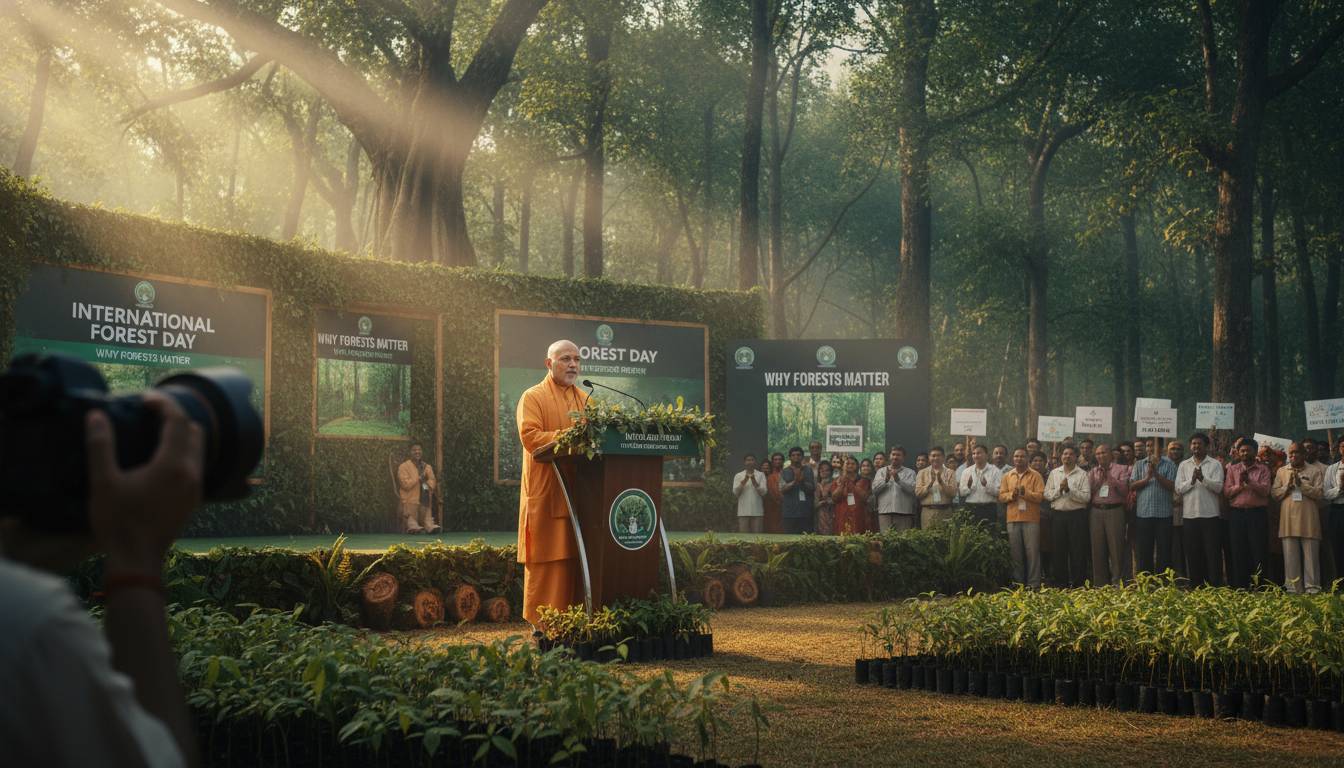
Uttar Pradesh Chief Minister Yogi Adityanath used International Day of Forests on March 21 to underline the role forests play in ecology, water security, wildlife protection and local livelihoods, according to recent public remarks and state government messaging tied to forest and wetland conservation in and around Lucknow. The issue matters beyond symbolism: Uttar Pradesh has reported a 559.19 square kilometer rise in forest cover in the India State of Forest Report 2023, while the state says its plantation drives have crossed 200 crore saplings in recent years.
ℹ️
March 21 is the UN-designated International Day of Forests.
It is observed every year on March 21, a date established by the United Nations General Assembly to highlight the importance of forests and sustainable forest management.
While publicly available search results did not surface a full official transcript from March 21, 2026 in the material reviewed, Adityanath’s recent statements in Lucknow and elsewhere in Uttar Pradesh show a consistent policy line: forests, wetlands and wildlife habitats are being framed not only as environmental assets, but also as economic and social infrastructure. In a February 2025 address on World Wetlands Day, he said wetlands support groundwater conservation, irrigation, drinking water availability, flood control and carbon storage. That framing closely matches the broader message associated with International Forest Day.
Uttar Pradesh Forest and Plantation Snapshot
| Metric | Figure | Context |
|---|---|---|
| Increase in forest cover | 559.19 sq km | Reported in India State of Forest Report 2023, cited in 2025 coverage |
| Saplings planted | 204 crore+ | State government figure cited for roughly eight years |
| Single-day plantation drive | 36.51 crore saplings | Reported for July 20, 2024 campaign |
| 2026 plantation target | 35 crore+ | State preparations reported in March 2026 coverage |
Source: Times of India, Free Press Journal, Indian Masterminds | accessed March 21, 2026.
559.19 sq km gain puts Uttar Pradesh’s forest push in focus
The strongest verifiable data point around Adityanath’s forest message is the reported increase in Uttar Pradesh’s forest cover. Multiple 2025 reports, citing the India State of Forest Report 2023, say the state added 559.19 square kilometers of forest cover. That is a significant jump for India’s most populous state, where land pressure from farming, housing and infrastructure is intense.
That figure also gives context to why International Forest Day messaging in Lucknow carries policy weight. Forest cover is not just a climate metric. In a state like Uttar Pradesh, it affects heat moderation, soil retention, biodiversity corridors and water recharge. Adityanath has repeatedly linked environmental protection to practical outcomes, including tourism, livelihoods and resilience against ecological stress.
The state’s plantation campaign is central to that narrative. In July 2024, Uttar Pradesh reported planting 36.51 crore saplings in a single day under a mass plantation drive launched by the chief minister in Lucknow. That followed earlier state claims that cumulative plantation numbers had crossed 200 crore saplings over several years. Plantation totals do not automatically equal mature forest cover, but they are the main operational metric the government uses to show scale.
Forest and Conservation Timeline Around Yogi Adityanath’s Messaging
March 28, 2023: Adityanath says new wetlands should be created around the Ganga and Yamuna and links conservation to rising forest and wildlife numbers in Uttar Pradesh.
October 6, 2023: He says the government is promoting ecotourism and wildlife protection, citing wetland development and tourism potential.
July 20, 2024: Uttar Pradesh reports 36.51 crore saplings planted in a day during a state campaign launched in Lucknow.
February 2, 2025: On World Wetlands Day, Adityanath says wetlands support groundwater, irrigation, flood control and carbon storage.
March 2026: Reports say the state is preparing a new plantation target of more than 35 crore saplings for 2026.
Why March 21 messaging in Lucknow centers on water, wildlife and heat
International Day of Forests is often treated as a ceremonial observance, but the policy substance in Uttar Pradesh is broader. Adityanath’s recent environmental speeches show three recurring themes.
First is water security. His February 2025 wetlands speech explicitly tied ecological conservation to groundwater recharge, irrigation and drinking water availability. That matters in north India, where water stress and erratic rainfall increasingly shape agriculture and urban planning. Forests and wetlands function together in watershed protection, so the state’s messaging tends to combine them.
Second is wildlife and habitat management. In March 2023, Adityanath spoke about creating special parks for species such as barasingha and sarus, while also calling for new wetlands. In September 2024, according to later coverage, he inaugurated what was described as Asia’s first newly built Jatayu Conservation and Breeding Centre in Campierganj, Gorakhpur. These examples show that forest policy in Uttar Pradesh is being presented as species recovery as well as tree planting.
Third is climate stress. In November 2024 remarks in Lucknow, Adityanath described global warming as a worldwide challenge caused by unplanned and unscientific development. That language places forests within a larger climate adaptation argument, not just a beautification campaign.
📊
Plantation scale and forest cover are related, but not identical.
Uttar Pradesh’s reported plantation totals exceed 200 crore saplings, while the cited forest-cover gain is 559.19 sq km in the India State of Forest Report 2023. The distinction matters because survival rates, species mix and land quality determine how plantation drives translate into long-term canopy and habitat gains.
How 204 crore saplings became a political and policy metric
For the Adityanath government, plantation numbers have become a signature environmental metric. Times of India reported in March 2025 that more than 204 crore saplings had been planted over eight years, while March 2026 coverage pushed that cumulative figure to 242 crore over nine years and said the state was preparing another 35 crore-plus plantation target for 2026.
Those numbers serve several purposes. They provide a simple public benchmark, they support claims of improved forest cover, and they fit mass-participation campaigns such as “Ped Lagao, Ped Bachao.” They also allow the government to connect environmental policy with rural participation, school campaigns and district-level administration.
Still, the more meaningful test is durability. Forest policy is strongest when plantation drives are paired with survival monitoring, native species planning, wetland restoration and protection against encroachment. Some of Adityanath’s own remarks point in that direction, especially when he links conservation with wetlands, biodiversity and ecotourism rather than only raw planting totals.
2026 target vs 2024 record: what the numbers suggest
The state’s reported single-day plantation record of 36.51 crore saplings in July 2024 is slightly above the 35 crore-plus target discussed for 2026 preparations. That suggests the government is trying to sustain a very high annual plantation pace rather than merely set symbolic goals.
In policy terms, that makes International Forest Day in Lucknow more than a commemorative event. It becomes a platform to reinforce a statewide administrative campaign already tied to measurable targets, forest-cover reporting and conservation branding. For readers outside India, the significance is straightforward: Uttar Pradesh is using forest policy as a combined climate, biodiversity and development agenda, and Adityanath’s March 21 message fits that pattern.
Frequently Asked Questions
What did Yogi Adityanath emphasize on International Forest Day?
He emphasized the importance of forests as ecological assets tied to water security, biodiversity, climate balance and public welfare. While a full March 21, 2026 transcript was not available in the reviewed material, his recent public remarks on wetlands, wildlife and global warming show a consistent conservation message.
Why are forests especially important in Uttar Pradesh?
Uttar Pradesh faces heavy land-use pressure because of its large population and agricultural intensity. Forests help with groundwater recharge, flood moderation, habitat protection and heat mitigation. The state has also reported a 559.19 sq km increase in forest cover in the India State of Forest Report 2023, making the issue politically and environmentally significant.
How many saplings has Uttar Pradesh planted under Yogi Adityanath?
Public reports cited more than 204 crore saplings planted over eight years as of March 2025, and about 242 crore over nine years in March 2026 coverage. The state also reported planting 36.51 crore saplings in a single day on July 20, 2024.
Is plantation the same as forest-cover growth?
No. Plantation totals measure saplings put into the ground, while forest-cover growth reflects broader land-cover outcomes captured in official assessments. Uttar Pradesh’s cited 559.19 sq km forest-cover increase and its 200 crore-plus plantation claims are related but not interchangeable metrics.
What is International Day of Forests?
It is a United Nations observance held every year on March 21 to raise awareness of the importance of all types of forests and sustainable forest management. The date was established by the UN General Assembly in 2012.
Disclaimer: This article is for informational purposes only. Information may have changed since publication. Always verify information independently and consult qualified professionals for specific advice.