Reducing your energy consumption doesn’t require dramatic lifestyle changes or expensive home renovations. By implementing a combination of quick behavioral adjustments and strategic upgrades, the average U.S. household can significantly lower utility bills while reducing environmental impact. Research from the U.S. Department of Energy indicates that households can save 10-30% on energy costs annually through conservation measures, representing hundreds to thousands of dollars in savings per year.
This guide provides actionable strategies backed by data and expert insights, organized so you can prioritize based on your budget, timeline, and comfort level. Whether you’re looking for instant habits or planning longer-term investments, these approaches deliver measurable results.
The Financial Case for Energy Conservation
Before diving into specific strategies, understanding the economics clarifies why conservation matters. The average U.S. household spends approximately $2,200 annually on utilities, with heating and cooling consuming nearly half of that amount, according to the U.S. Energy Information Administration. Electricity costs have risen 15% over the past five years, and this trend continues as grid infrastructure modernizes and demand grows.
Key Insights
– The typical American household wastes 10-30% of energy consumed through inefficiency
– Lighting accounts for 12% of home energy use—up to $200 per year for average households
– Phantom energy (devices consuming power while off) adds $100-200 annually to bills
– Weatherization improvements can reduce heating and cooling costs by 15-20%
Energy conservation represents one of the few expenses where reducing consumption directly translates to savings without sacrificing quality of life. Unlike price increases or inflation, you control this variable entirely.
Behavioral Changes That Deliver Immediate Savings
The fastest way to start saving involves no purchase whatsoever—simply adjusting how you use energy throughout daily routines. These changes take effect immediately and cost nothing to implement.
Thermostat Optimization
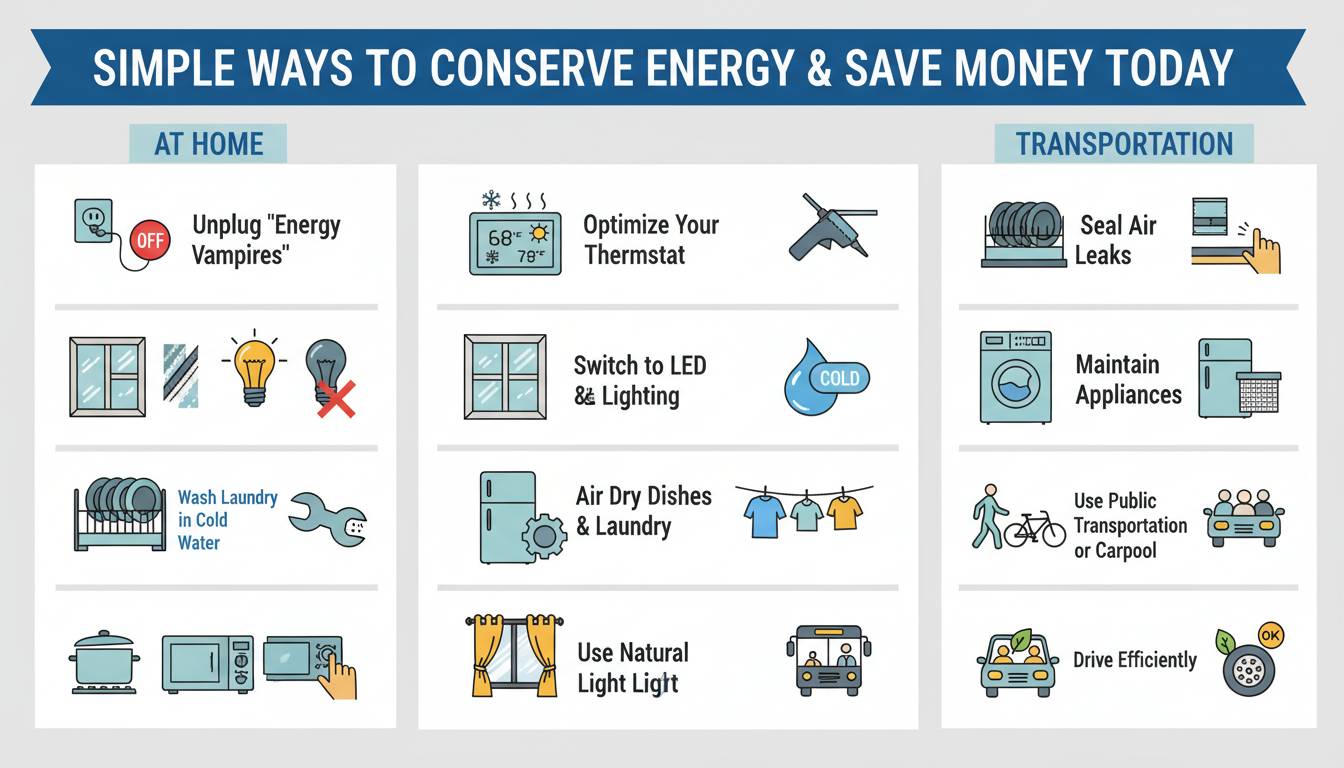
Heating and cooling represent the largest energy expense in most homes, making thermostat management the highest-impact behavioral change. The U.S. Department of Energy estimates that adjusting your thermostat by 7-10 degrees for 8 hours daily can save up to 10% annually on heating and cooling costs.
Recommended approach:
– Set heating to 68°F (20°C) while awake during winter
– Lower to 60-65°F (15-18°C) while sleeping or away
– Set cooling to 78°F (26°C) during summer months
– Use a programmable or smart thermostat to automate adjustments
Mark D. Lenson, energy efficiency program manager at the American Council for an Energy-Efficient Economy, explains: “The most underutilized resource in energy conservation is proper thermostat management. Most households set temperatures and forget them, missing easy savings opportunities that compound significantly over time.”
Lighting Habits
Lighting consumes 12% of household energy, but simple habits can cut this significantly without groping in darkness.
| Strategy | Potential Savings | Implementation |
|---|---|---|
| Turn off unoccupied lights | $50-100/year | Habit-based, immediate |
| Switch to LED bulbs | $75-150/year | One-time purchase |
| Utilize natural light | $20-40/year | Behavioral adjustment |
| Install motion sensors | $30-50/year | Bathroom, closets, garage |
Swapping just five frequently-used incandescent bulbs for LEDs saves approximately $75 annually—bulbs that pay for themselves within months while lasting 25 times longer.
Phantom Energy Elimination
Standby power, often called phantom or vampire energy, drains electricity from devices that appear off. The U.S. Department of Energy reports that standby power accounts for 5-10% of residential electricity use, costing the average household $100-200 per year.
Primary culprits include:
– Televisions and entertainment systems
– Computer equipment and gaming consoles
– Chargers left plugged in
– Smart home devices
– Kitchen appliances with digital displays
Using smart power strips that cut power to device clusters when not in use eliminates phantom draw automatically. For households with extensive electronics, this single intervention pays for itself within one to two years.
Home Efficiency Upgrades Worth Considering
While behavioral changes provide immediate returns, strategic equipment upgrades deliver larger long-term savings with reasonable investment horizons. These improvements also increase property values and home comfort.
Weatherization: Sealing the Envelope
Air leaks force heating and cooling systems to work harder, wasting energy and creating uncomfortable drafts. The U.S. Environmental Protection Agency’s ENERGY STAR program estimates that proper air sealing and insulation can save homeowners 15% on heating and cooling costs—potentially $200-400 annually.
Priority areas include:
– Weatherstripping around doors and windows
– Caulking gaps and cracks in exterior walls
– Insulating attics to recommended R-38 to R-60 levels
– Sealing ductwork in crawlspaces and basements
– Adding outlet and switch gaskets on exterior walls
The Department of Energy provides free home energy assessment tools, and many utilities offer subsidized energy audits that identify the highest-impact improvements for your specific home.
HVAC System Optimization
Heating, ventilation, and air conditioning systems consume more energy than any other household system. Even with behavioral adjustments, outdated or poorly maintained systems waste significant energy.
Maintenance priorities:
– Replace HVAC filters every 1-3 months (clogged filters restrict airflow, forcing systems to work harder)
– Schedule annual professional maintenance before heating and cooling seasons
– Clean vents and registers to ensure unobstructed airflow
– Consider upgrading to ENERGY STAR certified systems when replacement becomes necessary
The U.S. Department of Energy estimates that replacing a 10-15 year old HVAC system with an ENERGY STAR model can reduce cooling costs by 30% and heating costs by 10-20%.
Water Heating Efficiency
Water heating ranks as the third-largest energy expense in most homes, consuming 14-18% of household energy. Two strategies deliver the greatest returns:
Lower water heater temperature: Setting thermostats to 120°F (49°C) rather than the default 140°F (60°C) reduces energy consumption by approximately 10% while preventing scalding and reducing scale buildup in pipes.
Insulate the water heater and pipes: Foam pipe insulation costs less than $20 and reduces heat loss during distribution, while water heater blankets provide similar benefits for minimal investment.
For households considering replacement, heat pump water heaters use approximately 60% less energy than conventional electric resistance models, offering substantial long-term savings despite higher upfront costs.
Appliance and Electronics Decisions
Modern appliances carry significantly better efficiency ratings than those from even a decade ago, but understanding which upgrades deliver the best returns helps prioritize spending.
Appliance Replacement Priorities
When appliances fail, choosing energy-efficient replacements saves money over their operational lifespan. The ENERGY STAR program provides comparison data, but general guidance prioritizes:
| Appliance | Age to Replace | Potential Annual Savings |
|---|---|---|
| Refrigerator | 15+ years | $40-100 |
| Dishwasher | 12+ years | $20-40 |
| Washing machine | 12+ years | $25-60 |
| Dryer | 15+ years | $15-30 (consider heat pump) |
Refrigerators run continuously, making them the highest-impact appliance to upgrade when old. Modern ENERGY STAR refrigerators use approximately 40% less energy than models from 2001, with savings multiplying over their operational life.
Smart Home Integration
Smart thermostats, lighting controls, and energy monitors provide automation and insight that manual approaches cannot match. While requiring upfront investment, these devices pay for themselves within two to three years for most households.
High-value smart investments:
– Smart thermostats ($100-250): Learning algorithms optimize temperature schedules automatically
– Smart power strips ($20-40): Eliminate phantom energy from entertainment and office equipment
– Energy monitors ($30-100): Provide real-time feedback that typically reduces consumption 5-15% through awareness
Case Study: Real-World Savings
The Peterson Household, a family of four in suburban Ohio, implemented comprehensive energy conservation measures over 18 months. Their approach combined behavioral changes with strategic upgrades:
Year 1 Changes (minimal investment):
– Thermostat programming and behavioral adjustments: $380 saved
– LED bulb replacement throughout home: $165 saved
– Smart power strips for entertainment center: $95 saved
– Total: $640 savings on approximately $100 investment
Year 2 Upgrades (strategic investment):
– Attic insulation improvement: $295 saved
– Smart thermostat installation: $185 saved
– HVAC filter replacement schedule: $75 saved
– Total: $555 savings on approximately $1,400 investment
After two years, the Petersons achieved annual savings of approximately $1,200—reducing their utility costs by nearly 30%—with a cumulative return on investment expected within four years.
Common Energy Conservation Mistakes
Avoiding these frequent errors prevents wasted effort and ensures your conservation efforts deliver promised results.
| Mistake | Impact | Solution |
|---|---|---|
| Over-insulating in warm climates | Diminishing returns, wasted money | Match insulation to climate recommendations |
| Leaving HVAC filters too long | 5-15% efficiency loss | Check monthly, replace every 1-3 months |
| Sealing home too tightly | Indoor air quality problems | Balance with proper ventilation |
| Focusing only on visible savings | Missing bigger opportunities | Prioritize by percentage reduction, not dollar visibility |
| Ignoring phantom energy | $100-200 annual waste | Use smart strips, address always-on devices |
Critical distinction: Energy conservation differs from energy efficiency. Conservation involves using less energy through behavior; efficiency involves using technology to accomplish the same task with less energy. Both matter, but confusion between them leads to misallocated efforts.
Resources for Additional Savings
Government programs:
– ENERGY STAR rebates and certifications
– Utility company efficiency programs (often provide free assessments and equipment)
– State and local energy efficiency incentives (vary significantly by location)
– Federal tax credits for certain energy-efficient upgrades
Assessment tools:
– ENERGY STAR Home Energy Yardstick (free online comparison tool)
– Home Energy Saver (U.S. Department of Energy)
– SmartThings Energy Monitoring (for ongoing tracking)
Professional resources:
– Home energy auditors certified through the Building Performance Institute
– ENERGY STAR partner contractors
– State energy office directories
Frequently Asked Questions
How much can the average household save by conserving energy?
The average U.S. household can save $200-1,000 annually depending on current efficiency levels and implemented measures. Research from the U.S. Department of Energy indicates that households implementing comprehensive conservation strategies save 10-30% on utility bills, translating to $220-660 per year for the average $2,200 annual utility expenditure.
What is the quickest way to start saving on energy bills?
The fastest approach involves thermostat adjustments and lighting changes—two interventions requiring no purchases and delivering immediate results. Lowering your thermostat 7-10 degrees during sleeping hours saves 10% on heating costs, while switching to LED bulbs provides instant savings with rapid payback periods of months rather than years.
Do energy-efficient appliances really save money despite higher purchase prices?
Yes, ENERGY STAR certified appliances consistently deliver savings that exceed their price premiums within their operational lifespans. Refrigerators, dishwashers, and washing machines with ENERGY STAR ratings typically use 10-50% less energy than standard models, with lifetime savings far exceeding initial cost differences. The payback period typically ranges from 2-7 years depending on appliance type and usage patterns.
How much phantom energy does the average home waste?
Phantom energy typically costs households $100-200 annually, representing 5-10% of total electricity consumption. Modern homes with extensive electronics, smart devices, and entertainment systems often fall toward the higher end of this range. Smart power strips provide the simplest solution, automatically cutting power to device clusters when not in use.
Is it worth investing in a smart thermostat?
Smart thermostats typically cost $100-250 but save $150-250 annually through optimized heating and cooling schedules. This 1-2 year payback period makes them one of the highest-return energy investments available. Beyond direct savings, features like remote control, usage reports, and learning algorithms provide additional convenience and insight that reinforce conservation behaviors.
What should I prioritize for energy efficiency improvements?
Prioritize by impact-to-cost ratio: thermostat optimization and air sealing provide the best returns for modest investments, followed by lighting upgrades and filter maintenance. Major investments like HVAC replacement, insulation improvement, and appliance upgrades make sense when equipment fails or when longer payback periods align with renovation timelines. Energy audits through utilities or certified professionals identify the highest-impact improvements for your specific home.
Conclusion
Energy conservation offers one of the most accessible paths to reducing household expenses while contributing to environmental sustainability. The strategies outlined—thermostat optimization, lighting upgrades, phantom energy elimination, weatherization, and strategic equipment investments—deliver compounding returns that grow over time.
Start with zero-cost behavioral changes immediately, then layer in upgrades as equipment fails or budgets allow. The beauty of energy conservation lies in its flexibility: even modest efforts generate proportional savings, and every action contributes to both financial and environmental goals. Your first thermostat adjustment tonight begins the savings process—subsequent choices build from there.