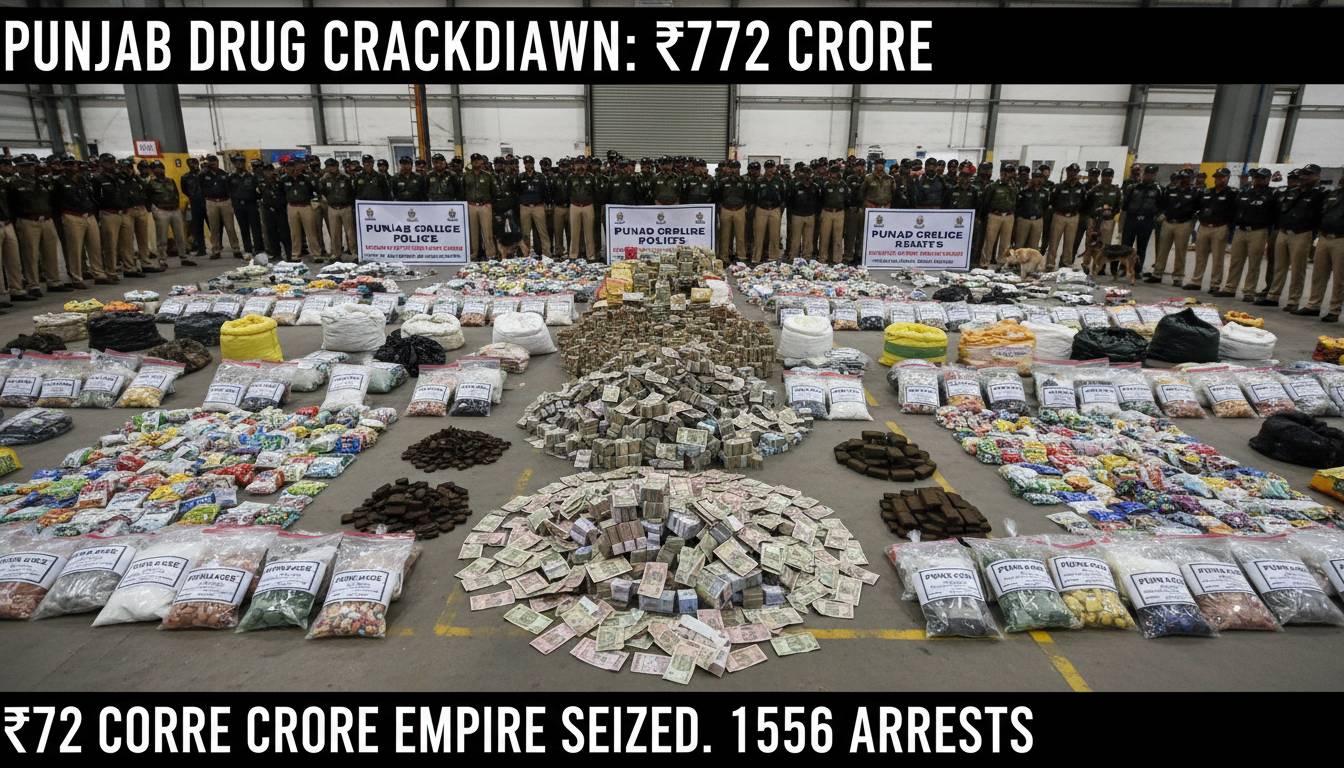
Punjab Chief Minister Bhagwant Singh Mann said the state has seized illegal assets worth ₹772 crore from drug traffickers and stripped 1,556 smugglers of properties built from narcotics proceeds, underscoring the scale of the state’s anti-drug campaign. The figures fit into a broader enforcement drive that Punjab Police has tied to “Yudh Nashian Virudh,” a campaign launched on March 1, 2025, with tens of thousands of arrests and large narcotics recoveries reported since then.
The headline numbers matter because they shift the focus from arrests alone to asset disruption. In Punjab’s current strategy, the state is not only pursuing alleged traffickers through FIRs and seizures of heroin, opium, synthetic drugs and cash, but also targeting houses, shops and other properties that authorities say were acquired through drug money. Earlier phases of the campaign included demolitions of illegal structures and confiscation proceedings in district-level cases, showing that property action has become a central enforcement tool rather than a side measure.
📊
Punjab’s anti-drug drive has moved beyond street-level seizures.
Punjab Police said in January 2026 that the campaign launched on March 1, 2025 had led to 45,028 arrests, 31,370 FIRs, 1,961 kg of heroin seized and ₹15.4 crore in drug money recovered. The new ₹772 crore asset figure indicates the state is emphasizing financial disruption alongside criminal prosecution. Source: Punjab campaign figures cited by Hindustan Times, January 2026; governor-backed summary, February 2026.
₹772 Crore in Illegal Assets Signals a Financial-Takedown Strategy
Mann’s claim that ₹772 crore worth of illegal drug-linked assets has been seized places the Punjab crackdown in a different category from routine policing. Asset seizure is designed to weaken trafficking networks by removing the economic base that sustains them. In practical terms, that means authorities are trying to prevent accused smugglers from recycling proceeds into real estate, vehicles and local influence.
Punjab has telegraphed this approach for more than a year. In March 2024, the state announced confiscation and demolition measures as part of a broader anti-drug push after Mann gave police a three-month deadline to intensify action. By April 2024, the government was publicly defending demolitions of drug peddlers’ houses, and district police units were separately reporting confiscations of specific homes and vehicles tied to narcotics cases.
That historical context matters. A district-level seizure of about ₹34.36 lakh in Jalandhar, reported in early 2024, looked significant at the time. Against that benchmark, a statewide cumulative figure of ₹772 crore suggests a much broader sweep, both geographically and administratively. It also indicates that the state is counting not just demolished structures but a larger pool of attached or confiscated assets.
Punjab Anti-Drug Campaign: Key Reported Figures
| Metric | Reported Figure | Time Reference |
|---|---|---|
| Illegal assets seized from drug networks | ₹772 crore | CM statement tied to current crackdown |
| Smugglers stripped of illegal assets | 1,556 | CM statement tied to current crackdown |
| Campaign launch date | March 1, 2025 | Punjab Police anti-drug drive |
| Drug smugglers arrested | 45,028 | As reported in January 2026 |
| FIRs registered | 31,370 | As reported in January 2026 |
| Heroin seized | 1,961 kg | As reported in January 2026 |
| Drug money recovered | ₹15.4 crore | As reported in January 2026 |
Source: Punjab Police campaign figures cited by Hindustan Times and campaign summary cited in February 2026 coverage.
How 1,556 Property Actions Expand the Punjab Enforcement Model
The figure of 1,556 smugglers stripped of illegal assets is notable because it points to scale, not symbolism. Property action against a handful of high-profile accused can generate headlines. Action against more than 1,500 individuals suggests a systematized process involving police, district administration, revenue records and municipal enforcement.
Punjab’s public messaging has repeatedly framed this as a zero-tolerance campaign. In February 2026, Mann directed police to escalate the crackdown on drugs and organized crime, while stressing that enforcement should remain central to restoring order. Separately, the governor publicly praised the campaign, citing nearly 50,000 arrests and asset seizures worth hundreds of crores.
The state has also linked narcotics enforcement to border security. In August 2025, Mann said Punjab was deploying anti-drone systems after 283 drones carrying heroin, weapons and ammunition were seized in 2024. That matters because cross-border supply routes can replenish local trafficking networks quickly. If the state is simultaneously disrupting supply channels and confiscating downstream assets, it is attempting a two-sided squeeze: stop inflows and strip profits.
Punjab Crackdown Timeline
February 28, 2024: Mann sets a deadline-driven anti-drug push and signals confiscation and demolition of properties linked to peddlers.
March 2024: Punjab Police conduct large-scale raids across hundreds of locations, arresting 290 smugglers in one statewide operation.
April 2024: The government reiterates that demolition of drug peddlers’ houses will continue.
March 1, 2025: Punjab Police say the “Yudh Nashian Virudh” campaign formally begins.
January 2026: Police report 45,028 arrests, 31,370 FIRs and 1,961 kg heroin seized since the campaign launch.
February 12, 2026: Mann orders police to escalate the final blow against drugs and gangsters.
What Is Driving Punjab’s Escalation in 2026?
Three forces appear to be driving the escalation. First is persistence of the drug trade despite repeated enforcement cycles. Punjab has been conducting raids, arrests and seizures for years, yet authorities continue to describe narcotics as a structural threat. Second is the state’s effort to show measurable outcomes through cumulative figures such as arrests, FIRs, heroin seizures and now asset values. Third is the political need to demonstrate that action is reaching both local peddlers and larger networks.
There is also evidence that the campaign is broadening beyond conventional narcotics cases. February 2026 coverage cited about ₹80 crore frozen in cybercrime cases linked to organized crime, suggesting overlap between drug proceeds, digital fraud and wider criminal financing. If that linkage holds across investigations, the ₹772 crore asset figure may reflect a more integrated enforcement lens than earlier anti-drug drives.
ℹ️
Why the asset number stands out:
Punjab Police’s January 2026 campaign update listed ₹15.4 crore in drug money recovered directly from smugglers, while the newer claim refers to ₹772 crore in illegal assets seized. That gap suggests the larger figure includes attached or confiscated property, not just cash recovered during raids.
Punjab’s 2024-2026 Numbers Show the Shift From Seizures to Asset Denial
In early 2024, public reporting centered on raid counts, kilograms of heroin and the number of arrests in a single day. By 2025 and 2026, the state’s narrative had widened to include campaign duration, cumulative FIRs, anti-drone deployments, cyber-linked freezes and large-scale property action. That progression suggests Punjab wants to present the crackdown as a sustained administrative campaign rather than a series of isolated police operations.
For readers outside India, the key point is that ₹772 crore is roughly 7.72 billion rupees, a scale that signals a major state-level enforcement claim. The number will likely draw scrutiny over how assets are valued, whether they are attached or fully confiscated, and how many cases lead to conviction. Those distinctions are important because seizure announcements and final legal forfeiture are not always the same thing.
What is verified from public reporting is narrower but still substantial: Punjab has run a long anti-drug campaign under the “Yudh Nashian Virudh” banner since March 1, 2025; police have reported tens of thousands of arrests and large heroin seizures; the government has repeatedly used demolition and confiscation language; and senior officials continue to frame asset disruption as a core tactic.
Frequently Asked Questions
What does the ₹772 crore figure refer to?
It refers to illegal assets that Punjab authorities say were seized from drug-linked networks during the state’s crackdown. Public reporting indicates Punjab has increasingly targeted property and other assets, not only narcotics and cash. The figure should be read as an enforcement claim tied to asset action, not just money recovered in raids.
How many smugglers have been affected by property action?
The reported figure is 1,556 smugglers stripped of illegal assets. That suggests a large-scale administrative effort involving confiscation, attachment or demolition measures across multiple districts, consistent with Punjab’s public anti-drug strategy since 2024.
When did Punjab’s “Yudh Nashian Virudh” campaign begin?
Punjab Police said the intensified campaign began on March 1, 2025. By January 2026, authorities said it had produced 45,028 arrests, 31,370 FIRs and 1,961 kg of heroin seizures, showing that the drive has been sustained for months rather than days.
How is this different from earlier anti-drug drives in Punjab?
Earlier reporting often emphasized raids, arrests and drug quantities seized in individual operations. The current phase places heavier emphasis on financial disruption, including demolition of illegal structures, confiscation of homes and vehicles, and cumulative asset values running into hundreds of crores.
Is the crackdown also linked to border smuggling?
Yes. Punjab has publicly connected the drug problem to cross-border trafficking. In August 2025, Mann said 283 drones carrying heroin, weapons and ammunition were seized in 2024, and the state launched anti-drone systems to counter that route.
Disclaimer: This article is for informational purposes only. Information may have changed since publication. Always verify information independently and consult qualified professionals for specific advice.