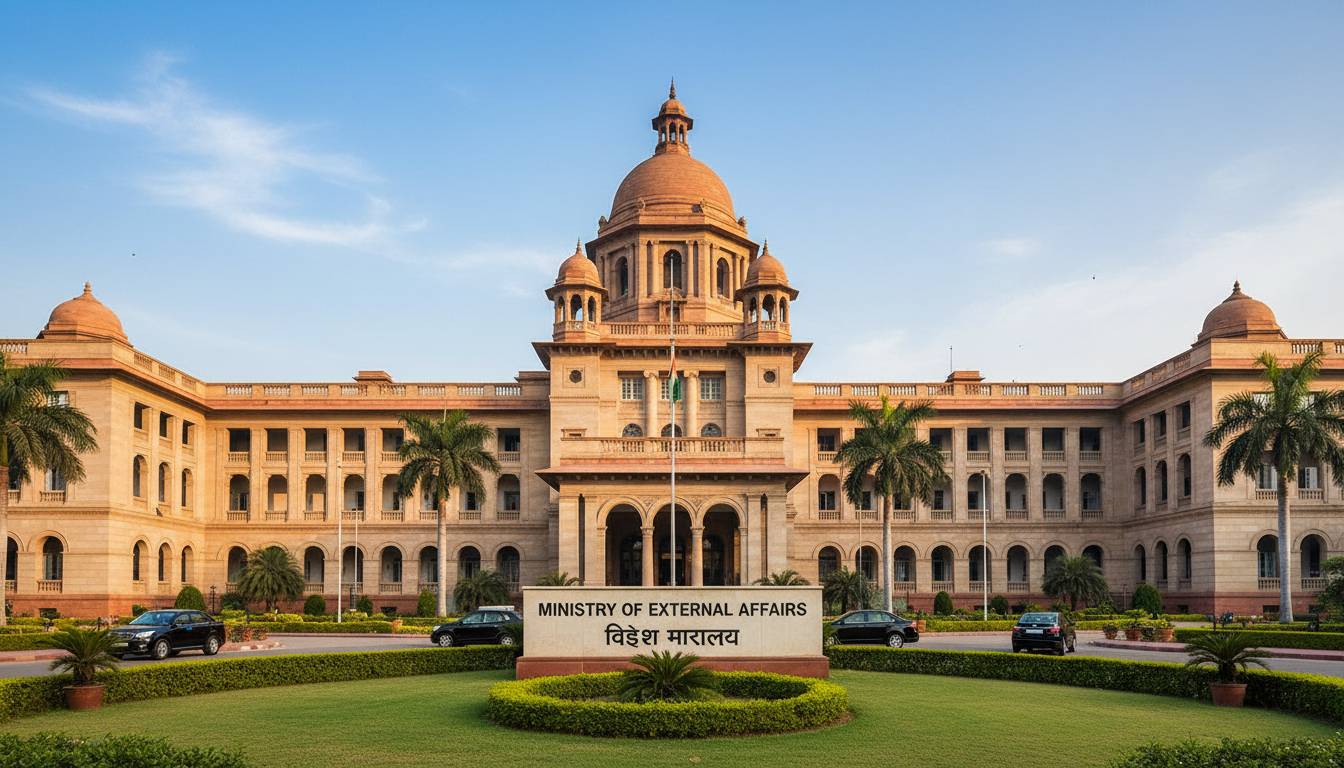
India’s Ministry of External Affairs has rejected claims that the United States sought or received Indian approval to use Indian territory, ports, or airspace for strikes linked to Iran, calling the reports false in public responses issued in early March 2026. The denial matters because it addresses a sensitive question at the center of India’s West Asia diplomacy: whether New Delhi’s strategic ties with Washington have crossed into operational support during a fast-moving regional conflict. Publicly available statements from India’s government and contemporaneous media reports show New Delhi moved to shut down that narrative while also stressing the safety of Indian nationals in the Gulf and Iran.
Reports and social-media claims circulated after the regional escalation involving the United States, Israel, and Iran in late February and early March 2026. India’s official response was categorical. Coverage by multiple Indian outlets, citing government responses, said New Delhi described the allegation that US forces used Indian facilities for attacks on Iran as “fake and false” or “baseless.” Those reports align with the government’s broader public messaging during the crisis, which focused on de-escalation, consular support, and distancing India from operational involvement.
🔴
India’s official line was a direct denial.
Indian media reports published on March 5 and March 6, 2026 said the MEA and government fact-check channels rejected claims that US forces used Indian territory, ports, or airspace for strikes on Iran. Source: The Economic Times, The Tribune, Business Standard; published March 5-6, 2026.
Verified Public Record on the Claim
| Item | What public sources show | Date |
|---|---|---|
| Claim | US sought or used Indian territory, ports, or airspace for strikes on Iran | Early March 2026 |
| India’s response | Rejected as false, fake, or baseless in public reporting citing official channels | March 5-6, 2026 |
| Government posture | Focus on monitoring West Asia crisis and assisting Indian nationals | March 2026 |
| Context | Regional conflict widened beyond Iran, raising scrutiny of transit routes and partner states | March 2026 |
Source: The Economic Times, The Tribune, Business Standard, PIB, MEA-related public releases | Accessed March 21, 2026
March 5-6, 2026 denials shaped the official narrative
The most important fact in this story is not the rumor itself but the speed and clarity of the rebuttal. The Economic Times reported on March 5, 2026 that India dismissed claims the US was using Indian ports for strikes on Iran as “fake and false.” The Tribune reported on March 6 that India denied claims of the US Navy using Indian ports to attack Iran. Business Standard separately reported that India debunked claims that US forces used Indian airspace in strikes against Iran. Across those accounts, the core point remained unchanged: New Delhi denied operational involvement.
That consistency matters because the allegations touched several possible vectors at once: ports, naval facilities, and airspace. In geopolitical crises, governments sometimes issue narrow denials that leave room for ambiguity. Here, the public record points in the opposite direction. The denials, as reported, were broad enough to cover the main versions of the allegation circulating online and in commentary. That reduced the space for interpreting India’s silence as tacit approval.
Timeline of the Public Rebuttal
February 28-March 2, 2026: Regional military escalation involving the US, Israel, and Iran intensifies, with governments across Asia issuing travel and security advisories.
March 5, 2026: Indian media reports say New Delhi rejects claims that US forces used Indian ports or territory for attacks on Iran, describing the claims as false.
March 6, 2026: Additional Indian coverage reiterates that claims involving Indian ports were denied by the government.
March 7, 2026: MEA-linked public communication emphasizes the government’s monitoring of the conflict and movement of Indian nationals from Gulf states.
Why the allegation mattered in a 10-million-diaspora region
India’s response cannot be separated from its exposure to West Asia. The MEA’s public messaging in March 2026 emphasized the welfare of Indian nationals as the conflict spread. A PIB release tied to the crisis said the government had issued advisories and was monitoring airstrikes in Iran and attacks in several Gulf countries. One report citing an official statement said more than 52,000 Indians traveled safely from Gulf countries to India between March 1 and March 7, 2026. Even where those movements were not formal evacuations, the scale underscored why India had strong incentives to avoid any perception that it had joined military operations.
India also has long-standing interests in Iran, including the Chabahar port project. The MEA’s own background material states that India Ports Global Limited signed a 10-year contract in May 2024 to equip and operate the Shahid Beheshti Terminal at Chabahar. That makes the allegation especially sensitive: any suggestion that Indian territory was used against Iran would have risked diplomatic and commercial fallout at a time when India was trying to preserve working ties with Tehran while maintaining strategic relations with Washington.
ℹ️
Chabahar is part of the context.
India’s official records show a 10-year operating contract at Shahid Beheshti Terminal in Chabahar was signed in May 2024, giving New Delhi a concrete stake in stable ties with Iran. Source: MEA materials, accessed March 21, 2026.
What public evidence supports the debunking claim?
The strongest support comes from convergence rather than a single leaked document. First, multiple Indian publications reported the same denial within a narrow time window on March 5-6, 2026. Second, the Press Information Bureau’s fact-check system exists specifically to address false claims involving the Government of India and says it verifies such information through multiple layers of cross-checking with the relevant government organization. Third, the MEA’s public crisis communication during the same period centered on citizen safety, advisories, and regional monitoring, not on any military coordination with the United States.
There is also no public primary-source evidence in the material reviewed showing India granted the United States permission to use Indian territory for strikes on Iran. In a story like this, that absence is not proof by itself. But when combined with explicit denials and the lack of any corroborating official US or Indian document, the available record supports the conclusion that the claim was publicly debunked by India rather than substantiated. That is a reporting conclusion based on the weight of the available evidence, not an inference beyond the record.
Why New Delhi moved quickly
| Factor | Why it mattered |
|---|---|
| Diplomatic balance | India maintains ties with both Washington and Tehran |
| Diaspora exposure | Large Indian population across the Gulf raises consular risk during conflict |
| Trade and connectivity | Projects such as Chabahar depend on stable India-Iran engagement |
| Strategic signaling | A delayed response could have been read as tacit acceptance of the allegation |
Source: MEA, PIB, contemporaneous media reports | Accessed March 21, 2026
How this fits India’s March 2026 West Asia posture
India’s broader posture in March 2026 was cautious and transactional. Public statements highlighted restraint, monitoring, and assistance to nationals affected by the conflict. Reuters reporting from the period documented the wider regional crisis and the sensitivity around foreign governments’ responses to US and Israeli strikes on Iran. Indian reporting also showed New Delhi pushing back against narratives that could place it inside the military coalition. Taken together, the pattern is consistent: India sought to limit escalation risk for its citizens and interests while avoiding a public breach with either side.
That does not settle every question analysts may ask about logistics, diplomacy, or intelligence sharing in a broader strategic sense. It does settle the narrower public claim in this story. On the evidence available as of March 21, 2026, India’s government has publicly rejected the allegation that the US sought or received Indian approval to use Indian territory for strikes on Iran, and no public documentary evidence reviewed here contradicts that denial.
Frequently Asked Questions
Frequently Asked Questions
Did India officially deny that the US used Indian territory for strikes on Iran?
Yes. Multiple Indian media reports published on March 5-6, 2026 said the Indian government, including the MEA in public-facing responses, rejected claims that US forces used Indian ports, airspace, or territory for strikes on Iran, describing those claims as false or baseless.
Was there any public evidence that India approved US military use of its territory?
In the publicly available material reviewed for this article, no official Indian or US document substantiated that claim. The available record instead shows denials from India and crisis communications focused on citizen safety and regional monitoring as of March 21, 2026.
Why was the allegation so sensitive for India?
India has major diplomatic and economic interests across West Asia, a large diaspora in Gulf states, and continuing ties with Iran, including the Chabahar port project. Any perception of direct operational support for strikes on Iran could have complicated those interests during an active regional conflict.
What was India publicly focused on during the crisis?
Public statements and reports in early March 2026 emphasized monitoring the conflict, issuing advisories, and assisting Indian nationals in the Gulf and surrounding region. A PIB-linked release and media reports highlighted government efforts tied to travel and emergency response.
Does the debunking mean India had no stake in the Iran situation?
No. India had clear stakes, including citizen safety, energy and shipping exposure, and connectivity interests such as Chabahar. The debunking addresses a specific allegation about military use of Indian territory; it does not mean India was unaffected by the conflict.
Disclaimer: This article is for informational purposes only. Information may have changed since publication. Always verify information independently and consult qualified professionals for specific advice.