The average U.S. household spends approximately $173 per month on electricity, according to the U.S. Energy Information Administration. For many families, this represents one of the largest monthly expenses—yet most people never actively try to reduce it. The truth is, lowering your electric bill doesn’t require dramatic lifestyle changes or expensive upgrades. Small, strategic adjustments to how you use and manage electricity can yield substantial savings over time.
This guide provides ten proven, actionable methods to lower your electric bill starting today. Each strategy is backed by real data and practical implementation steps you can apply immediately.
Understanding Your Electric Bill
Before diving into specific strategies, understanding what drives your electric costs is essential. Your bill primarily reflects two factors: the rate you pay per kilowatt-hour (kWh) and the total amount of electricity your household consumes.
Electricity rates vary significantly by location, with the national average hovering around 14 cents per kWh as of recent data. However, rates in some states exceed 20 cents, while others dip below 10 cents. Your consumption depends on your home’s efficiency, the appliances you use, your climate, and your daily habits.
📊 KEY STATS
– 40-50% of home energy use goes to heating and cooling (EIA)
– 5-10% of residential electricity is wasted on phantom loads
– $2,000+ is the average annual electricity cost for U.S. households
The most effective approach to lowering your bill combines both reducing consumption and optimizing when and how you use electricity. The strategies below address both angles.
1. Optimize Your Thermostat Settings
Heating and cooling represent the single largest portion of most household energy budgets. Adjusting your thermostat is the fastest way to see immediate savings.
Lower your thermostat by 7-10 degrees from your normal setting during hours you’re away from home or asleep. This can save up to 10% annually on heating and cooling costs, according to the U.S. Department of Energy. In winter, set the thermostat to 68°F while awake and lower it by 7-10 degrees when away or sleeping. In summer, aim for 78°F when home.
Smart thermostat investment: Upgrading to a programmable or smart thermostat automates these adjustments and typically saves 10-15% on energy bills. The payback period often ranges from two to four years depending on your current system and electricity rates.
| Thermostat Setting | Winter Savings | Summer Savings |
|---|---|---|
| 7-10° lower while away | 10% | 10-15% |
| 7-10° lower while sleeping | 10% | 10% |
| Combined approach | 15% | 20-25% |
2. Seal Air Leaks and Add Insulation
Air leaks around windows, doors, and penetrations in your home’s envelope force your HVAC system to work harder. Weatherstripping and caulking visible gaps typically costs under $50 in materials and can save 10-15% on heating and cooling costs.
Attic insulation is often the most cost-effective efficiency upgrade. The Department of Energy recommends most homes in the U.S. maintain R-38 to R-49 in attics (approximately 12-15 inches of insulation). If your insulation falls below R-30, adding more can reduce heating and cooling costs by 15-25%. Many utility companies offer rebates for insulation upgrades, reducing your out-of-pocket cost.
Quick fixes to start:
– Apply weatherstripping around door frames ($10-20)
– Caulk gaps around windows ($15-30)
– Seal electrical outlets and switches with foam gaskets ($5-10)
– Add door sweeps to block drafts under exterior doors ($10-15)
3. Switch to LED Lighting
Lighting accounts for about 10-15% of typical residential electricity use. Replacing incandescent bulbs with LEDs delivers immediate and substantial savings.
LED bulbs use 75% less energy than traditional incandescent bulbs and last 25 times longer. A single 60-watt incandescent replaced by an equivalent LED uses only 8-9 watts while producing the same light output. If you have 20 bulbs in frequent use, switching can save $150-200 annually.
Cost breakdown:
– LED bulb: $3-8 each
– Incandescent replacement cost: $1-2 each
– Annual energy savings per bulb: $6-8
– Payback period: 6-12 months
Focus on high-use areas first: kitchens, living rooms, and outdoor lighting. Motion-sensor switches for rarely-used spaces like closets and garages provide additional savings.
4. Combat Phantom Energy Drain
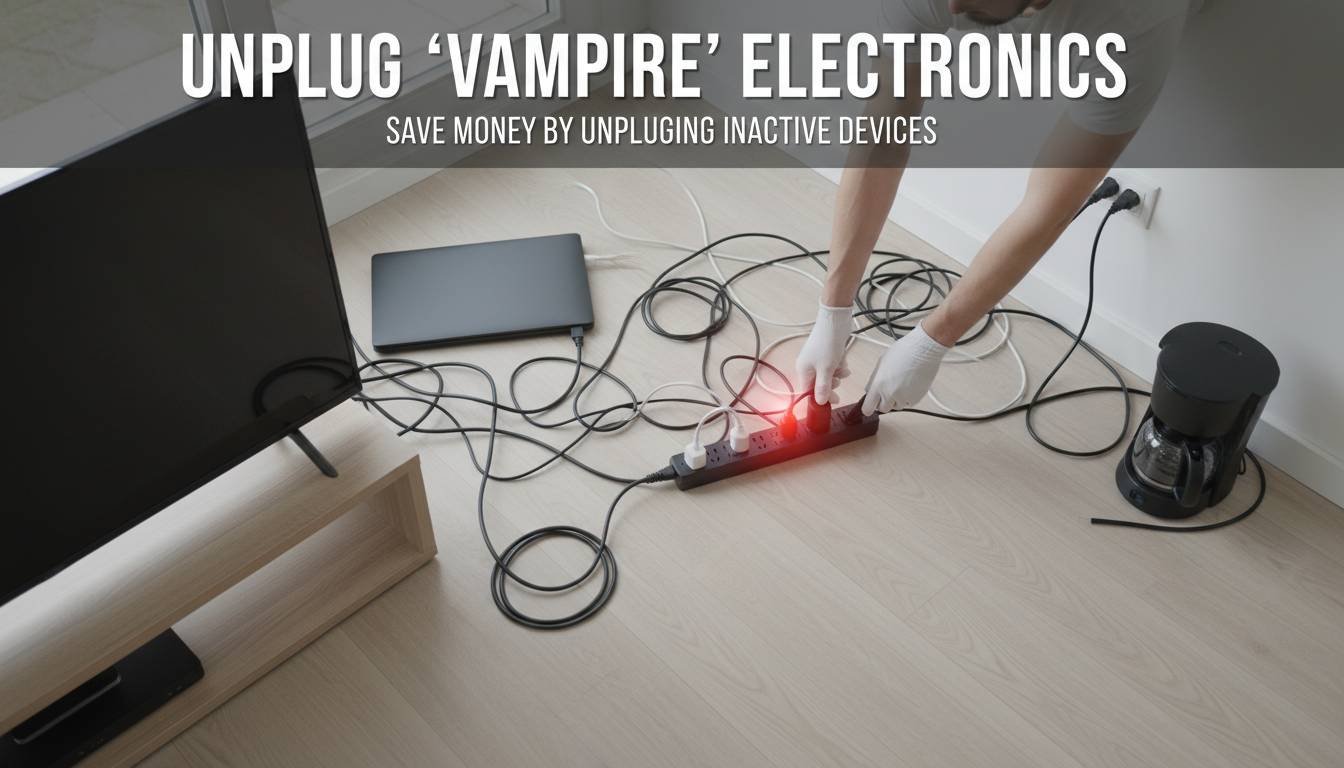
Phantom loads—also called vampire power or standby power—refer to electricity consumed by devices when they’re turned off but still plugged in. This accounts for 5-10% of residential energy use, representing $100-200 annually for the average household.
The biggest culprits include:
– televisions and entertainment systems
– computer equipment and chargers
– kitchen appliances with digital displays
– gaming consoles
– Smart home devices
Solution: Use smart power strips or unswitched outlets to cut power to multiple devices at once. Simply turning off a power strip eliminates standby power draw entirely for all connected devices. For frequently used items like televisions, smart strips with automatic shutoff timers prevent forgotten devices from draining power overnight.
5. Upgrade to Energy-Efficient Appliances
Older appliances, particularly those manufactured before 1990, consume significantly more electricity than modern equivalents. When replacing appliances, look for the ENERGY STAR certification—these models meet strict efficiency guidelines set by the EPA.
Refrigerators offer some of the best payback. An ENERGY STAR refrigerator uses approximately 15% less energy than non-certified models. For a household paying 14 cents per kWh, this translates to $35-70 in annual savings. Over a refrigerator’s 15-20-year lifespan, total savings easily exceed $500.
Other high-impact upgrades include:
– Heat pump water heaters (50% less energy than conventional)
– ENERGY STAR washing machines (25% less energy per load)
– Induction cooktops (more efficient than electric resistance)
When shopping, check the appliance’s energy guide label to estimate annual operating costs. The difference between the most and least efficient models in any category often exceeds $100 annually.
6. Adjust Your Water Heating Settings
Water heating is typically the third-largest energy expense in homes, accounting for about 18% of utility costs. Lowering your water heater’s temperature is the simplest adjustment.
Set your water heater to 120°F—lower temperatures reduce standby heat loss while still being hot enough for most household needs. Every 10°F reduction saves 3-5% on water heating costs. For a typical household, this means $20-50 in annual savings with zero behavior change.
Additional strategies:
– Insulate your water heater and first 6 feet of hot water pipes (pre-cut insulating blankets cost $15-30)
– Install low-flow showerheads (saves 20-40 gallons weekly per person)
– Fix leaky faucets promptly—a dripping faucet can waste over 3,000 gallons annually
7. Shift Electricity Usage to Off-Peak Hours
Many utility companies charge variable rates based on time of day, with peak periods costing 30-100% more than off-peak hours. Understanding your rate structure and shifting high-consumption activities can yield meaningful savings.
Peak hours typically fall between 4 PM and 9 PM on weekdays. Running dishwashers, dryers, and electric ovens outside these windows—or scheduling them to run automatically during off-peak times—reduces costs without sacrificing convenience.
Contact your utility company to learn about time-of-use rate plans. Some companies also offer free or low-cost load management programs that provide bill credits in exchange for allowing them to cycle your water heater or HVAC during peak demand periods.
High-consumption activities to shift:
– Dishwasher (3-4 kWh per load)
– Electric clothes dryer (3-4 kWh per load)
– Pool pumps (1-3 kWh per hour)
– Electric vehicle charging (25-40 kWh for full charge)
8. Unplug or Upgrade Energy-Hungry Devices
Certain devices consume disproportionate energy relative to their utility. Identifying and addressing these outliers can significantly impact your bill.
Space heaters and portable AC units often use 1,500 watts or more—equivalent to running dozens of LED bulbs. Using these portable devices as primary heating or cooling is almost always more expensive than using your central system efficiently.
Gaming consoles in standby mode consume 8-15 watts each. While this seems minor, multiplied across multiple devices and hours, it adds up. Older desktop computers use 150-300 watts during use, compared to 30-50 watts for laptops or tablets.
Consider replacing aging devices with more efficient models, and avoid using portable electric heaters unless absolutely necessary.
9. Conduct an Energy Audit
A home energy audit identifies specific inefficiencies and prioritizes improvements based on cost-effectiveness. Many utility companies offer free or low-cost audits, or you can conduct a basic self-assessment.
DIY audit checklist:
– Check insulation depth in attic (measure depth with a ruler)
– Look for daylight around exterior doors and windows (indicates air leaks)
– Examine caulking and weatherstripping condition
– Note appliance ages and efficiency ratings
– Track which rooms feel significantly warmer or cooler than thermostat setting
Professional audits typically cost $200-500 but often include blower-door testing to precisely locate air leaks. Many utilities subsidize professional audits, reducing or eliminating your cost.
10. Take Advantage of Rebates and Incentives
Federal, state, and local governments plus utility companies offer numerous programs to offset the cost of energy-efficient upgrades. These incentives can cut upgrade costs by 10-50%.
The federal Residential Clean Energy Credit covers 30% of the cost (through 2032, stepping down afterward) for solar panels, wind turbines, and battery storage systems. Many states add additional incentives on top of federal benefits.
Utility rebates commonly apply to:
– Smart thermostats ($50-150 rebates)
– Heat pump water heaters ($300-800)
– Insulation and air sealing ($100-500)
– ENERGY STAR appliances ($50-200)
– Electric vehicle chargers ($200-500)
Search the Database of State Incentives for Renewables and Efficiency (DSIRE) at dsireusa.org to find programs specific to your location. Your utility company’s website typically lists current rebate offerings.
Common Mistakes to Avoid
| Mistake | Impact | Solution |
|---|---|---|
| Setting thermostat too high/low | +10-15% cost | Use 68°F/78°F guidelines |
| Ignoring air leaks | +10-15% cost | Seal annually |
| Keeping old appliances | +20-40% cost | Replace when possible |
| Using power strips incorrectly | +5-10% cost | Turn off entire strip |
| Not using programmable features | Lost savings | Enable schedules |
A common misconception is that closing vents in unused rooms saves energy. In most HVAC systems, this actually forces more air through fewer vents, reducing efficiency and potentially causing pressure imbalances that draw outside air into the home.
Frequently Asked Questions
How much can I realistically save by lowering my electric bill?
Most households can save $200-500 annually through basic efficiency measures like thermostat adjustments, sealing air leaks, and switching to LEDs. Aggressive optimization—adding insulation, upgrading appliances, and implementing time-of-use strategies—can save $500-1,000 or more annually.
What uses the most electricity in a home?
Heating and cooling account for 40-50% of home energy use. Water heating is second at approximately 18%, followed by appliances and electronics at 15-20%, and lighting at 10-15%. This means prioritizing HVAC efficiency delivers the largest savings.
Do smart thermostats really save money?
Yes. Multiple studies and utility data confirm smart thermostats save 10-15% on heating and cooling costs. The savings come from learning your schedule, optimizing runtime, and allowing remote adjustments. Most models pay for themselves within 2-3 years.
Is it worth turning off lights to save electricity?
Yes, but the impact depends on bulb type. Turning off incandescent bulbs saves significant energy since they waste 90% of power as heat. LEDs use so little energy that the savings from turning them off for short periods is minimal—leaving them on for less than 30 seconds often uses more energy than leaving them on. Still, turning off all lights when leaving a room is a good habit.
How do I find out if I’m on the best electricity plan?
Contact your utility company to ask about time-of-use rates, budget billing options, or any alternative plans available. Compare your current cost per kWh during peak and off-peak hours against other plans. In deregulated energy markets, you can also shop competing providers for potentially lower rates.
Does using a power strip actually save electricity?
Yes, when you turn it off. A typical smart power strip consumes negligible power itself while cutting standby power to all connected devices. This eliminates phantom loads that collectively account for 5-10% of residential electricity use.
Conclusion
Lowering your electric bill requires neither expensive overhauls nor dramatic lifestyle sacrifices. The strategies outlined—thermostat optimization, air sealing, LED lighting, phantom load elimination, efficient appliances, water heating adjustments, off-peak usage, device upgrades, energy audits, and incentive programs—work together to create meaningful, lasting savings.
Start with the changes requiring minimal investment: adjusting your thermostat, sealing obvious air leaks, and switching to LEDs. These three steps alone can reduce your bill by 10-15%. As budget allows, add insulation, upgrade appliances, and install a smart thermostat. The average household implementing half these strategies will save $300-600 annually—a significant return on relatively small effort.
Electricity costs are largely controllable. By understanding your consumption patterns and making informed choices about how and when you use power, you can keep more money in your pocket while maintaining comfort and convenience.