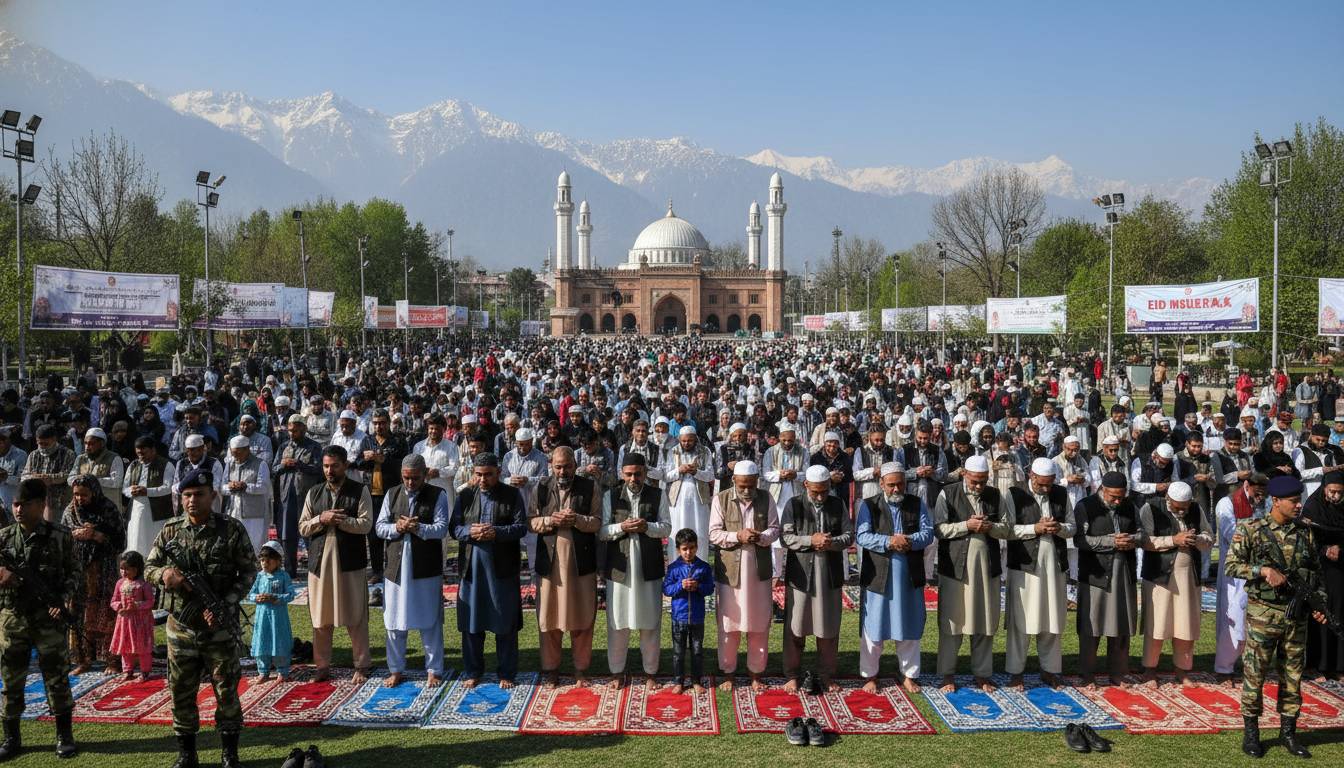
Eid prayers were held peacefully across Jammu and Kashmir on March 31, 2025, with large gatherings reported at major prayer grounds and shrines under heavy security deployment, according to PTI and local media reports. The calm observance came alongside renewed political criticism after Chief Minister Omar Abdullah questioned the closure of Srinagar’s historic Jamia Masjid and Eidgah for congregational prayers.
Eid in Jammu and Kashmir this year carried two parallel storylines. One was public and visible: thousands of worshippers gathering for Eid-ul-Fitr prayers in Srinagar, Jammu and other districts, with authorities maintaining extensive security arrangements. The other was political and symbolic: the continued restriction on prayers at Srinagar’s Jamia Masjid and Eidgah, two of the Valley’s most prominent religious sites. Together, those developments turned a routine festival report into a wider debate over security policy, religious access and state control in one of India’s most sensitive regions.
ℹ️
The central development was a split between peaceful Eid observance and restricted access at key Srinagar sites.
PTI reported peaceful celebrations in Jammu on March 31, 2025, while multiple reports said Jamia Masjid and Eidgah in Srinagar remained closed for Eid prayers the same day.
Key Reported Developments on Eid in J&K
| Item | Reported status | Source | Date |
|---|---|---|---|
| Eid prayers in Jammu region | Held peacefully amid tight security | PTI via The Week | March 31, 2025 |
| Hazratbal Shrine prayers | Congregational prayers held | Hindustan Times | March 31, 2025 |
| Jamia Masjid, Srinagar | Reported closed for Eid prayers | Hindustan Times, Kashmir Post, TOI | March 31, 2025 |
| Eidgah, Srinagar | Reported closed for Eid prayers | Kashmir Observer, Hindustan Times | March 30-31, 2025 |
Source: PTI, Hindustan Times, Kashmir Observer, Times of India | Published March 30-31, 2025
March 31, 2025 prayers proceed under visible security
In the Jammu region, Eid-ul-Fitr was celebrated with what PTI described as religious fervour and traditional gaiety, with worshippers assembling at eidgahs and mosques to offer prayers for peace. The report, published by The Week on March 31, 2025, said security arrangements were tightened across the region as large crowds gathered. Lieutenant Governor Manoj Sinha and Chief Minister Omar Abdullah also issued Eid greetings ahead of the festival.
In Srinagar, congregational prayers were reported at Hazratbal Shrine, one of Kashmir’s most important religious sites. Hindustan Times reported that Eid celebrations passed peacefully there on March 31, 2025. That detail matters because it shows the administration permitted major public observance at selected venues even as restrictions remained in place at other historically significant locations.
The contrast between open access at Hazratbal and closure at Jamia Masjid and Eidgah shaped much of the reaction. For residents, the issue was not whether Eid could be celebrated at all, but why some of the most symbolically important congregational spaces in Srinagar were unavailable on one of the most important days in the Islamic calendar.
Timeline of the Eid and Jamia Masjid dispute
March 30, 2025: Kashmir Observer reports no Eid prayers at Eidgah Srinagar and uncertainty over Jamia Masjid arrangements.
March 31, 2025: PTI reports peaceful Eid celebrations in Jammu region under tight security.
March 31, 2025: Hindustan Times and other outlets report Jamia Masjid and Eidgah remained closed for Eid prayers in Srinagar.
June 7, 2025: Times of India reports Jamia Masjid was locked on Eid-ul-Adha, drawing criticism from Omar Abdullah and others.
March 6, 2026: Deccan Herald reports Jamia Masjid remained closed for Friday prayers during Ramadan amid restrictions in Srinagar.
Why Jamia Masjid’s closure triggered political criticism
Chief Minister Omar Abdullah publicly questioned the closure of Jamia Masjid, adding his voice to criticism that has surfaced repeatedly when restrictions are imposed on the mosque. The issue is politically sensitive because Jamia Masjid is not just a place of worship; it is also one of Srinagar’s most visible religious and civic landmarks.
Reports from March 31, 2025 said the mosque remained shut and security personnel were deployed in strength in the Nowhatta area. Kashmir Post reported that worshippers were prevented from entering the 14th-century mosque, while Hindustan Times separately carried criticism from Mirwaiz Umar Farooq, who said he had been detained at home and condemned the denial of Eid prayers at Jamia Masjid and Eidgah.
Omar Abdullah’s criticism fits a broader pattern. In earlier and later episodes, he also objected to restrictions at the mosque. Hindustan Times reported on a separate February 2025 closure during Shab-e-Baraat, when Abdullah said the decision reflected a lack of confidence. Times of India later reported similar criticism from him after Jamia Masjid was locked on Eid-ul-Adha on June 7, 2025. That sequence suggests the Eid-ul-Fitr dispute was not an isolated incident but part of a recurring conflict over access to the site.
📊
The dispute is less about whether Eid was celebrated and more about where it was allowed.
Hazratbal hosted prayers, while Jamia Masjid and Eidgah were reported closed on March 31, 2025, according to Hindustan Times, Kashmir Observer and Kashmir Post.
2-site contrast in Srinagar shows the administration’s security approach
The available reporting points to a selective security model rather than a blanket ban on Eid observance. Hazratbal was open. Jammu’s eidgahs and mosques were active. But Jamia Masjid and Eidgah in Srinagar were restricted. That distinction is important for understanding the administration’s likely rationale.
Nowhatta, where Jamia Masjid is located, has long been treated as a high-sensitivity zone by security agencies. Past reporting has linked restrictions there to fears of protests, sloganeering or broader law-and-order concerns. Older reporting from ThePrint, citing police sources in a previous Eid-related closure, said authorities were concerned about attempts to incite unrest inside or around the mosque. While that report predates the 2025 Eid-ul-Fitr closure by several years, it provides historical context for why the site is often handled differently from other prayer venues.
That said, no detailed public justification appears in the reports cited for the March 31, 2025 closure itself. The absence of a formal, detailed explanation has helped fuel criticism from political leaders and religious bodies, who argue that repeated restrictions on major Islamic occasions deepen mistrust rather than reduce tension.
Srinagar Religious Sites: Access Contrast on Eid
| Site | Status on March 31, 2025 | Significance |
|---|---|---|
| Hazratbal Shrine | Prayers held | Major Valley shrine with large congregational importance |
| Jamia Masjid, Nowhatta | Reported closed | Historic central mosque in old Srinagar |
| Eidgah, Srinagar | Reported closed | Traditional large Eid congregation ground |
Source: Hindustan Times, Kashmir Observer, Kashmir Post | March 31, 2025
2025 to 2026 restrictions show the issue did not end with Eid
The March 2025 Eid episode sits within a longer chain of restrictions around Jamia Masjid. Hindustan Times reported the mosque was sealed on Shab-e-Baraat in February 2025. Times of India reported it was locked again on Eid-ul-Adha in June 2025. Deccan Herald then reported on March 6, 2026 that Jamia Masjid remained closed for Friday congregation during Ramadan amid a tense security situation in Srinagar.
That chronology matters because it shows continuity. The dispute is not limited to one festival or one administration decision. It has become a recurring flashpoint where security management, political messaging and religious rights intersect. For readers outside the region, that pattern is the key to understanding why a peaceful Eid celebration can still produce sharp political fallout.
At the same time, the peaceful conduct of prayers across much of Jammu and Kashmir indicates that authorities succeeded in preventing violence on the day. The unresolved question is whether repeated closures at high-profile sites are viewed as necessary preventive policing or as disproportionate restrictions on worship. Public reporting confirms the disagreement. It does not resolve it.
Frequently Asked Questions
Was Eid celebrated peacefully across Jammu and Kashmir?
Yes. PTI reported on March 31, 2025 that Eid-ul-Fitr was celebrated peacefully across the Jammu region under tight security, and Hindustan Times reported peaceful congregational prayers at Hazratbal Shrine in Srinagar the same day.
Why did Omar Abdullah question the Jamia Masjid closure?
Omar Abdullah objected to the reported closure of Srinagar’s Jamia Masjid for Eid prayers, arguing that restricting access to a major religious site on an important Islamic festival was unjustified. His criticism aligned with earlier and later objections he made over similar closures in 2025.
Was Jamia Masjid the only site affected in Srinagar?
No. Reports from March 30-31, 2025 also said Eidgah in Srinagar remained closed for Eid prayers. At the same time, Hazratbal Shrine hosted congregational prayers, showing that restrictions were applied selectively rather than across all religious venues.
Did authorities explain the closure in detail?
Public reports cited security concerns and law-and-order sensitivity around downtown Srinagar, especially Nowhatta. But the reports reviewed here do not show a detailed official public explanation specifically tied to the March 31, 2025 Eid-ul-Fitr closure.
Has Jamia Masjid faced similar restrictions before or after this Eid?
Yes. Reporting shows repeated restrictions at the mosque, including on Shab-e-Baraat in February 2025, Eid-ul-Adha in June 2025, and a Friday congregation during Ramadan in March 2026. That pattern has made the mosque a recurring political and religious flashpoint.
Conclusion
Eid-ul-Fitr in Jammu and Kashmir on March 31, 2025 was marked by peaceful prayers, visible security and a renewed dispute over access to Srinagar’s most prominent religious spaces. The day’s events showed that large-scale observance was possible without major unrest, but they also underscored how restrictions at Jamia Masjid and Eidgah continue to carry political weight far beyond a single festival. For policymakers, religious leaders and residents, the core issue remains unchanged: how to balance security management with public confidence and religious freedom in a region where symbolism matters as much as crowd control.
Disclaimer: This article is for informational purposes only. Information may have changed since publication. Always verify information independently and consult qualified professionals for specific advice.