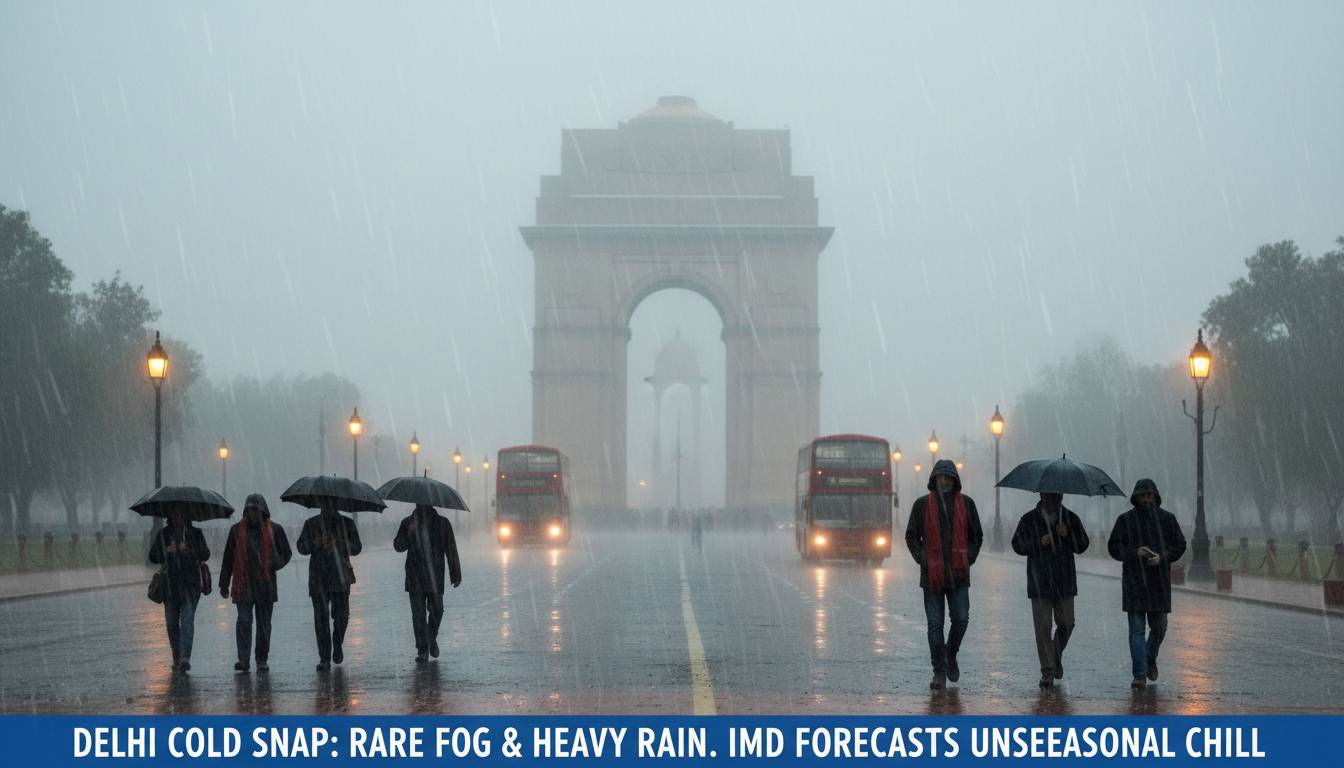
Delhi recorded its coldest March day in six years after a spell of rain, with fog and near-saturated air following the weather shift. The India Meteorological Department, or IMD, said Safdarjung logged a sharp temperature drop after rainfall linked to a western disturbance, while humidity touched 100% in parts of the capital and visibility fell under foggy conditions. For residents and commuters, the key questions are what changed, how unusual the reading is, and what the IMD forecast signals next.
ℹ️
The weather swing is notable because Delhi had also seen unusually warm March conditions earlier in 2026.
Times of India reported Safdarjung touched 36.8 degrees Celsius on March 12, 2026, while NDTV said the city had already logged the hottest first week of March in 50 years before the rain-led reversal.
March 2026 Rain Shift Pulls Delhi Back From Early Heat
The cold snap stands out because it follows a very different start to the month. Safdarjung, Delhi’s base observatory, had already posted unusually high daytime temperatures in early March 2026, including 36.8 degrees Celsius on March 12, according to The Times of India. NDTV separately reported that Delhi reached 35.7 degrees Celsius in the first week of March, the highest maximum for that period in 50 years. That makes the later drop more than a routine fluctuation; it marks a sharp reversal inside the same month.
The trigger is consistent with Delhi’s established late-winter and early-spring weather pattern: a western disturbance bringing cloud cover, rain, and cooler northwesterly conditions after passage. Historical reporting shows similar setups have produced abrupt March cool-downs before. The Indian Express reported that Delhi recorded a minimum of 13 degrees Celsius during a rainy March spell in 2019, then described as the coldest March day in four years. Older Times of India reporting also documented unusually cold March conditions in 2017 and extreme March rainfall events in 2015.
Delhi Weather Context: Recent March Extremes
| Period/Event | Reading | Context |
|---|---|---|
| March 12, 2026 | 36.8°C max | Warmest day of year at that point |
| First week of March 2026 | 35.7°C max | Highest first-week March maximum in 50 years |
| March 2019 rainy spell | 13°C minimum | Coldest March day in 4 years |
| March 2015 | 56.8 mm rain in 24 hours | Wettest March day in 100 years, per TOI |
| March 2019 month-to-date | 101.9 mm rain | Highest March rainfall so far, per HT report at the time |
Source: Times of India, NDTV, Indian Express, Hindustan Times | Published reports accessed March 21, 2026
Why 100% Humidity and Fog Followed the Rain
Rain alone does not explain the full impact. After precipitation, the air near the surface can become saturated, especially when winds weaken overnight and temperatures fall toward the dew point. That is why reports of 100% humidity and fog often appear together after a wet spell in Delhi. In practical terms, the atmosphere has little room left to hold additional moisture, so water condenses into suspended droplets, reducing visibility.
Delhi has seen this pattern in other cool-season episodes. Hindustan Times reported on February 3, 2026, that Safdarjung visibility fell to 50 metres during a dense fog event. An IMD press release for that period also recorded visibility of 50 metres at Safdarjung between 0330 IST and 0630 IST. In late January 2026, IMD data showed moderate fog at Safdarjung and low visibility episodes across the region. Those examples matter because they show how quickly visibility can deteriorate when moisture remains trapped near the surface.
For transport and daily life, the combination of rain-soaked ground, high humidity, and fog is often more disruptive than the temperature reading itself. Road traffic slows first. Flight and rail operations can also face delays when visibility drops sharply, even if rainfall has already ended.
Weather Timeline Behind the Delhi Cool-Down
Early March 2026: Delhi posts unusually high maximum temperatures, including 35.7°C in the first week, the highest for that period in 50 years, according to NDTV.
March 12, 2026: Safdarjung reaches 36.8°C, the warmest day of the year at that point, according to The Times of India.
Mid-March 2026: Rain-bearing weather system moves across north India, lowering temperatures and raising humidity.
After rainfall: Fog forms in moisture-rich conditions, with humidity reported at 100% in parts of Delhi and visibility affected.
6-Year Comparison Shows How Rare the Reading Is
The phrase “coldest March day in six years” matters because it places the event against a recent baseline rather than against all-time records. Delhi’s March weather can swing widely, but readings low enough to become the coldest for the month in six years are still uncommon. Historical coverage suggests the city has alternated between hot March spells and rain-cooled interruptions, yet not every rainy episode resets a multi-year low.
That context is important for readers outside India as well. Delhi’s climate in March usually trends toward warmer afternoons as winter retreats. A coldest-in-six-years marker therefore signals a meaningful departure from the expected seasonal climb. It also comes after a run of warmer anomalies. In 2024, Times of India reported Delhi’s mean March minimum temperature was 14.3 degrees Celsius, the coolest March nights in five years. In 2023, the same paper said March was cooler than the prior hot February, helped by repeated rain activity. The 2026 event appears to extend that pattern of volatility, but with a sharper single-day headline reading.
📊
Delhi’s March weather has become a story of extremes, not a straight seasonal warm-up.
Published reports show the city moved from a 50-year early-March heat mark in 2026 to a rain-driven coldest-March-day-in-six-years reading within the same month.
IMD Forecast After the Rain: What Delhi Can Expect Next
The IMD forecast is the most important near-term guide because post-rain cooling in Delhi often fades once skies clear and sunshine returns. While the exact forecast window in the headline report is not reproduced here from an official bulletin, IMD’s standard pattern after western-disturbance rain is for minimum temperatures to stay lower for a short period, with daytime temperatures recovering as cloud cover decreases. Fog risk is usually highest in the immediate aftermath when moisture remains elevated overnight.
That means residents should watch three variables in the next 24 to 72 hours: overnight minimum temperature, morning visibility, and any fresh rain or drizzle warnings. If winds strengthen and skies open up, fog can ease quickly. If moisture lingers under calm conditions, patchy to moderate fog can persist into the morning commute. IMD bulletins and Delhi airport weather updates are the most reliable sources for those short-term changes.
For a broader climate reading, the event underlines how western disturbances still shape north India’s transition from winter to summer. They can interrupt heat build-up, produce localized heavy rain, and create high-humidity fog episodes that feel more like January than late March. That is the core reason this weather turn has drawn attention.
Frequently Asked Questions
Why is Delhi’s coldest March day in six years considered unusual?
It is unusual because March in Delhi generally trends warmer as winter ends. The event is more striking because the city had already seen very high temperatures earlier in March 2026, including 36.8°C at Safdarjung on March 12, according to The Times of India.
What caused the sudden drop in temperature?
The main cause is rain and cloud cover associated with a western disturbance. Such systems lower daytime heating, cool the air mass, and can leave enough moisture behind for fog formation. Historical Delhi weather reports from IMD-linked coverage show this pattern has driven earlier March cool spells too.
How does 100% humidity relate to fog?
When humidity reaches 100%, the air is saturated and water vapor condenses into tiny droplets. Near the ground, that condensation appears as fog if temperatures and wind conditions allow it. After rainfall, this becomes more likely because the surface and lower atmosphere hold extra moisture.
Has Delhi seen similar March rain events before?
Yes. Times of India reported a 56.8 mm March rainfall event in 2015 that was described as the wettest March day in 100 years. Hindustan Times also reported that Safdarjung had recorded 101.9 mm of rainfall in March 2019 up to that point, the highest ever for the month so far.
What should residents watch in the IMD forecast now?
The most relevant indicators are minimum temperature, morning fog or visibility warnings, and any fresh rain forecast over Delhi-NCR. These determine whether the cool spell lasts briefly or extends into another day, and whether transport disruptions remain possible during early hours.
Disclaimer: This article is for informational purposes only. Weather conditions and forecasts can change quickly after publication. Readers should verify the latest IMD bulletins and local transport advisories for real-time updates.