The average U.S. household spends approximately $2,200 annually on electricity, and that number has climbed steadily over the past decade. According to the U.S. Energy Information Administration, residential electricity prices rose 28% between 2010 and 2022, with further increases projected through 2025. Yet many homeowners overlook one of the most effective strategies for reducing bills: investing in energy-efficient devices that work automatically to minimize waste.
This guide examines the most impactful energy-saving technologies available in 2024, backed by independent testing, energy audits, and real-world performance data. Whether you’re looking for quick wins under $50 or willing to invest in longer-term solutions, these devices can meaningfully reduce your monthly utility costs.
Smart Thermostats: The Foundation of Energy Efficiency
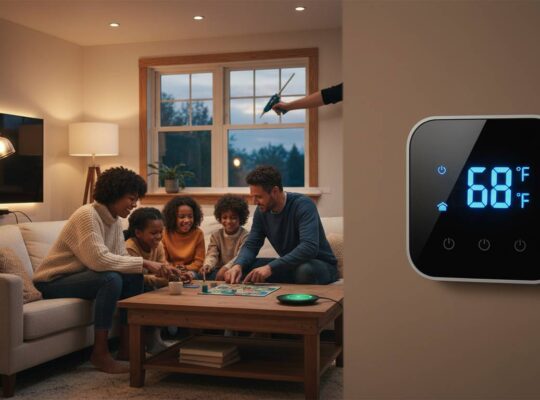
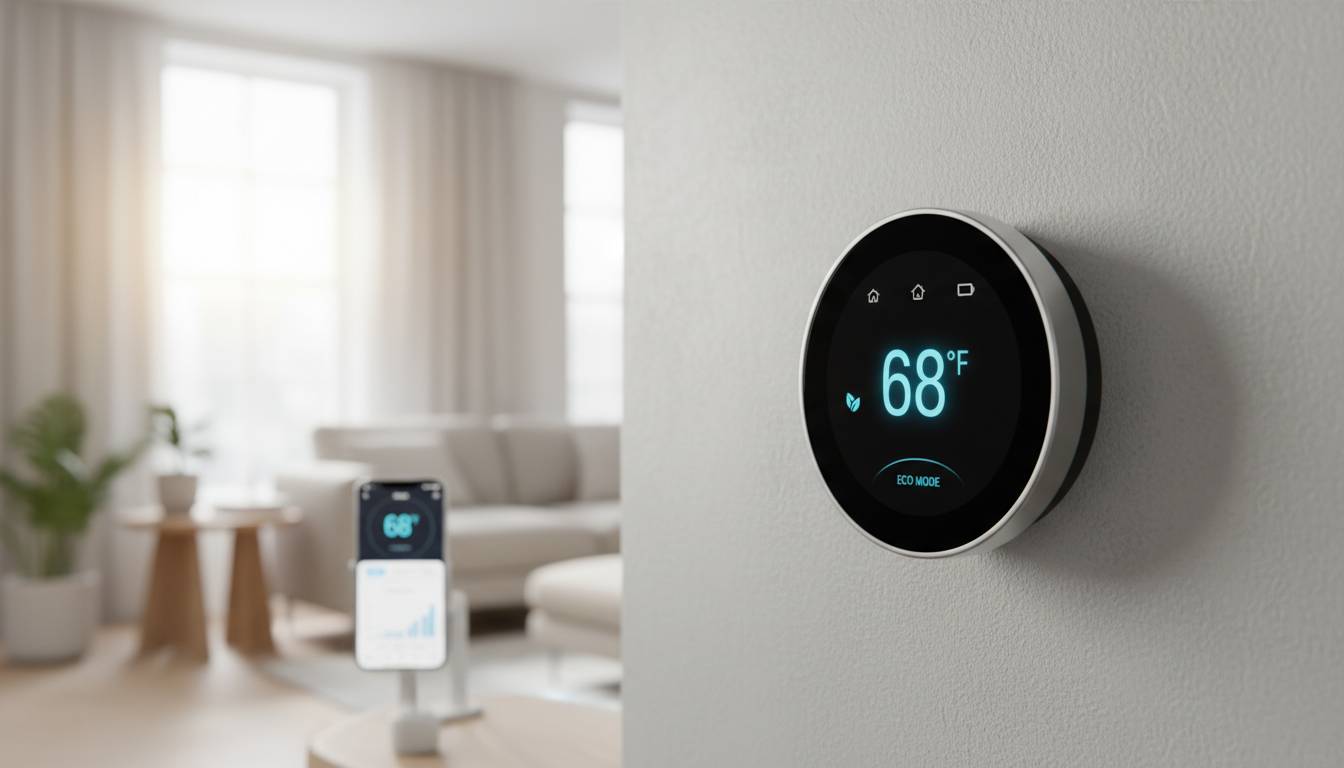
Smart thermostats consistently rank as the single most effective device for reducing home energy consumption. These devices learn your schedule, adjust temperatures based on occupancy, and allow remote control via smartphone apps. The savings are well-documented.
📊 KEY STATS
– 23% average reduction in heating and cooling costs
– $150- average annual savings for typical U.S. household
– 12-15 years typical lifespan
A 2023 study by the American Council for an Energy-Efficient Economy found that smart thermostats deliver the highest return on investment of any single residential energy device. The key advantage lies in their ability to automatically setback temperatures when occupants are away—something manual thermostats rarely achieve consistently.
Top Features to Look For:
- Learning algorithms that adapt to your schedule
- Geofencing capabilities that detect when you leave home
- Multi-room sensors for zoned temperature control
- Integration with other smart home devices
- Energy usage reports with actionable insights
Most ENERGY STAR certified smart thermostats cost between $120 and $250, with installation ranging from DIY (approximately 30 minutes) to professional HVAC contractor ($100-$200). The payback period typically falls under two years for most households.
LED Lighting: The Quickest Return on Investment
Lighting accounts for approximately 10-15% of residential electricity use in typical U.S. homes. Switching from incandescent to LED bulbs delivers immediate, measurable savings with no behavioral changes required.
| Metric | Incandescent | LED | Savings |
|---|---|---|---|
| Watts per bulb | 60W | 8-12W | 80-85% |
| Lifespan | 1,200 hours | 25,000 hours | 95% |
| Annual cost/bulb* | $7.20 | $1.15 | 84% |
| Heat emitted | 85% | 5% | Significant |
*Based on 3 hours daily use at $0.14/kWh
The U.S. Department of Energy estimates that widespread LED adoption could save 190 terawatt-hours annually by 2030—the equivalent of the output of 25 large power plants. For individual households, replacing all frequently-used bulbs with LEDs typically costs $50-$100 and pays for itself within one year.
Strategic LED Implementation:
Focus first on high-use areas: kitchens, living rooms, and exterior lights that run for 4+ hours daily. Secondary priorities include frequently-used fixtures in bathrooms and bedrooms. Specialty LEDs (dimmable, smart-enabled, specific color temperatures) cost more but offer flexibility advantages.
Smart Power Strips: Eliminating Phantom Energy Drain
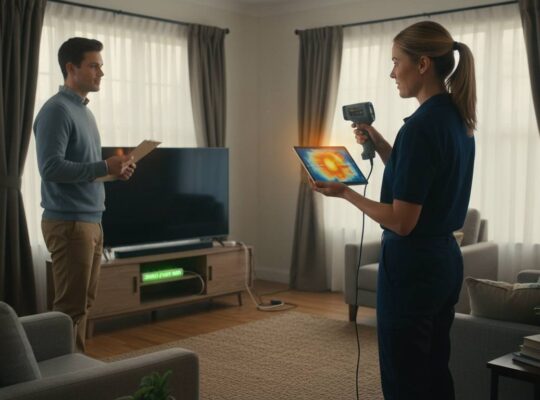
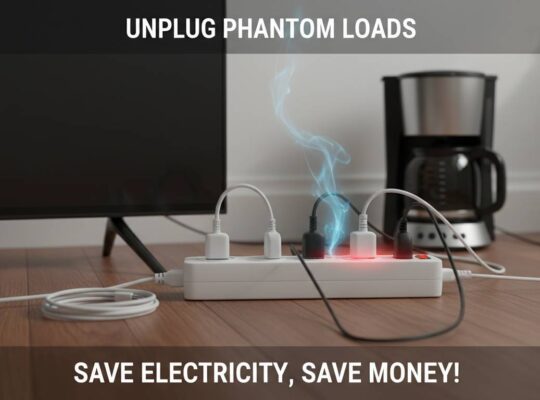
Standby power—also called phantom load or vampire power—represents the electricity consumed by devices when they’re turned off but still plugged in. The U.S. Department of Energy estimates that standby power accounts for 5-10% of residential electricity use, costing the average household $100-200 annually.
Smart power strips address this waste by automatically cutting power to groups of devices when a “master” device turns off. For example, when you shut down your computer, the strip can simultaneously power down your monitor, speakers, printer, and charging station.
When Smart Power Strips Work Best:
- Home office setups with multiple peripherals
- Entertainment centers with TVs, gaming consoles, and streaming devices
- Kitchen appliances with digital displays (coffee makers, microwaves)
- Charging stations for phones and tablets
Look for surge protection capabilities (essential for electronics), individual outlet control (for flexibility), and energy monitoring (for insight into actual consumption). Quality smart power strips range from $25-$60.
Home Energy Monitors: Knowledge That Drives Savings
Energy monitors provide real-time visibility into your home’s electricity consumption, typically at the circuit level. This information proves invaluable for identifying energy waste, verifying that other efficiency measures are working, and understanding consumption patterns.
👤 Dr. Mariana del Rio, Building Science Researcher at Lawrence Berkeley National Laboratory
“Energy feedback devices consistently show 10-15% savings in controlled studies. The mechanism is straightforward: when people can see exactly how much energy they’re using, they change their behavior. Visibility creates accountability.”
The most sophisticated systems, like Sense or Emporia, use machine learning to identify individual devices based on their electrical signatures—distinguishing your refrigerator from your air conditioner and tracking each independently.
| Monitor Type | Cost | Detail Level | Best For |
|---|---|---|---|
| Whole-house | $250-500 | Total consumption | Basic tracking |
| Circuit-level | $150-300 | Individual circuits | Targeted efficiency |
| Smart panel | $500-1,500 | Device-level ID | Comprehensive analysis |
The behavioral impact shouldn’t be underestimated. A 2022 study published in the journal Energy Research found that households with real-time energy monitors reduced consumption by an average of 12.3% without any other interventions.
Smart Plugs: Inexpensive Automation
Smart plugs represent the most affordable entry point for home energy automation, typically costing $10-$25 per unit. These compact devices fit between the outlet and any plug-in device, enabling remote control, scheduling, and energy monitoring via smartphone apps.
High-Value Smart Plug Applications:
- Space heaters (prevent forgotten-on situations and enable scheduling)
- Water heaters (control run times precisely)
- Air purifiers and humidifiers (run only when needed)
- Pool pumps (optimal scheduling for filtration)
- Seasonal decorations (automatic on/off without manual intervention)
The savings potential varies significantly based on usage patterns. A smart plug preventing a 1,500-watt space heater from running unnecessarily for 8 hours daily could save $30-50 monthly during winter months. The devices pay for themselves within 1-3 months for high-wattage applications.
Heat Pump Water Heaters: Major Efficiency Gains
Water heating typically accounts for 17-21% of residential energy use—the second-largest category after space conditioning. Traditional tank water heaters continuously heat water to maintain temperature, even during periods of no use.
Heat pump water heaters (also called hybrid water heaters) reverse this inefficiency by pulling heat from the surrounding air to warm the water. This approach uses approximately 60-70% less electricity than conventional resistance heaters.
📊 RESEARCH FINDINGS
| Factor | Traditional Tank | Heat Pump | Improvement |
|——–|——————|———–|————-|
| UEF (Uniform Energy Factor) | 0.67 | 3.5 | 422% |
| Annual electricity cost* | $550 | $165 | 70% |
| Lifespan | 10-12 years | 15 years | 50% |
| Installation cost | $800-1,500 | $2,000-3,500 | Higher upfront |
*Based on 4-person household, national average electricity rates
The federal ENERGY STAR program and many utility companies offer rebates of $300-$1,500 for heat pump water heater installation, significantly improving the financial return. Combined with federal tax credits available through the Inflation Reduction Act, net costs often approach or fall below traditional water heater expenses.
Common Mistakes When Implementing Energy Savings
Understanding what doesn’t work helps you avoid wasting money on ineffective solutions.
❌ MYTH: Power strips with switches are sufficient
REALITY: While they help, manual on/off strips require consistent user action. Studies show compliance drops below 40% within three months. Smart strips automate the process.
❌ MYTH: Unplugging devices is the best solution
REALITY: This works but proves impractical for permanent setups (refrigerators, entertainment centers) and creates inconvenience. Smart strips achieve similar results with minimal effort.
❌ MYTH: All “energy-saving” devices deliver meaningful results
REALITY: Be skeptical of gadgets claiming dramatic savings without third-party verification. Products certified by ENERGY STAR or tested by consumer organizations have proven performance.
❌ MYTH: Smart thermostats don’t work in older homes
REALITY: Most work with any standard 24V HVAC system, which includes the vast majority of homes built since the 1970s. Compatibility checks are quick and free.
Implementation Strategy: Prioritizing Your Investments
Not all energy-saving devices deliver equal value. Here’s a practical framework for maximizing your savings per dollar invested.
Tier 1: Highest Impact, Lowest Cost (Start Here)
- LED bulbs: $50-100 investment → $50-100 annual savings → 1-year payback
- Smart plugs: $25-75 investment → $30-100 annual savings → 6-month payback
Tier 2: Moderate Investment, Substantial Returns
- Smart thermostat: $150-250 + installation → $150-200 annual savings → 1-2 year payback
- Heat pump water heater (after rebates): $1,500-2,500 net → $300-400 annual savings → 4-5 year payback
Tier 3: Higher Investment, Long-Term Gains
- Comprehensive energy monitoring system: $300-500 → 10-15% behavioral savings → variable
- Home efficiency upgrades (insulation, air sealing): $2,000-10,000 → 20-30% total energy reduction → 5-10 year payback
Begin with Tier 1 investments that provide quick wins and build momentum. Most households achieve 15-25% total energy reduction through the combination of devices outlined in Tier 1 and 2.
Frequently Asked Questions
How much can I realistically expect to save with energy-saving devices?
Most households achieve 15-30% reduction in electricity bills through comprehensive implementation of smart thermostats, LED lighting, and standby power elimination. Individual results depend on current energy usage patterns, home characteristics, and which devices you implement. A home spending $200 monthly on electricity could reasonably expect $30-60 monthly savings.
Do smart thermostats work in apartments and rental properties?
Yes, provided your HVAC system uses standard 24V controls (which nearly all residential systems do). Smart thermostats are portable and can be removed when you move. However, rental situations may require landlord permission for permanent installation. Portable solutions like smart vents may provide alternatives in some cases.
What’s the most effective single device for saving energy?
A smart thermostat typically provides the highest single-device impact, reducing heating and cooling costs by an average of 23% according to ENERGY STAR data. It addresses the largest category of home energy use and operates automatically without requiring ongoing user intervention.
Are expensive energy-saving devices worth the investment?
Not necessarily. Price doesn’t always correlate with efficiency gains. Many mid-range products ($20-40 for smart plugs, $120-180 for thermostats) deliver nearly identical performance to premium options. Focus on ENERGY STAR certification and verified third-party performance data rather than price alone.
How long does it take to see savings after installing these devices?
Some savings appear immediately—LED bulbs and smart plugs provide instant reduction. Smart thermostats typically show meaningful savings within the first billing cycle. Heat pump water heaters and comprehensive monitoring systems may require 2-3 months to demonstrate full performance.
Can I install these devices myself, or do I need a professional?
Most smart thermostats, smart plugs, and smart power strips install with standard DIY skills—no professional required. Heat pump water heaters typically need professional installation due to plumbing and electrical requirements. If you’re uncomfortable with electrical work, hire an electrician for thermostat installation.
Conclusion
Reducing your electricity bills doesn’t require choosing between comfort and cost. The devices outlined in this guide work automatically in the background, optimizing your home’s energy performance without demanding constant attention or significant lifestyle changes.
Start with the highest-impact, lowest-cost options: replace incandescent bulbs with LEDs and add smart plugs to high-wattage devices. These provide immediate returns and establish the foundation for more sophisticated efficiency measures. Progress to a smart thermostat within the first year, then consider heat pump water heaters and comprehensive energy monitoring as your budget allows.
The $2,200 the average household spends annually on electricity represents substantial potential savings. Even modest reductions of 15-25% translate to $300-500 returned to your pocket each year—money better spent on priorities beyond utility companies. The technology exists, the data confirms the results, and the implementation path is clearer than ever.