
Energy costs continue to climb, and for millions of American households, monthly utility bills represent one of the largest regular expenses. The U.S. Energy Information Administration reports that the average residential electricity bill now exceeds $150 per month, with heating and cooling costs accounting for nearly half of total energy consumption in most homes. But here’s what many people don’t realize: you don’t need to live in discomfort or make major lifestyle changes to see meaningful savings. Simple adjustments to how you use energy—many taking less than five minutes to implement—can reduce your monthly bills by 10% to 30% without sacrificing comfort or convenience.
This guide covers practical, immediately actionable energy saving strategies that work for any home, apartment, or budget. We’ve organized these tips by the areas where they deliver the biggest impact, from thermostat adjustments to everyday habits that add up over time.
Understanding Your Energy consumption
Before diving into specific tips, it helps to understand where your energy actually goes. The U.S. Department of Energy breaks down average residential energy use into several categories:
| End Use | Percentage of Home Energy |
|---|---|
| Heating and cooling | 48% |
| Water heating | 14% |
| Appliances and electronics | 13% |
| Lighting | 9% |
| Other (miscellaneous) | 16% |
This distribution reveals why heating and cooling deserve your immediate attention—they represent nearly half of your total energy bill. However, the good news is that multiple strategies across all categories can work together to maximize your savings.
Thermostat Optimization: The Single Biggest Saver
Adjusting your thermostat is the single most impactful change you can make. The U.S. Department of Energy estimates that properly setting your thermostat can save you up to 10% annually on heating and cooling costs. That’s potentially $150 or more per year for average households.
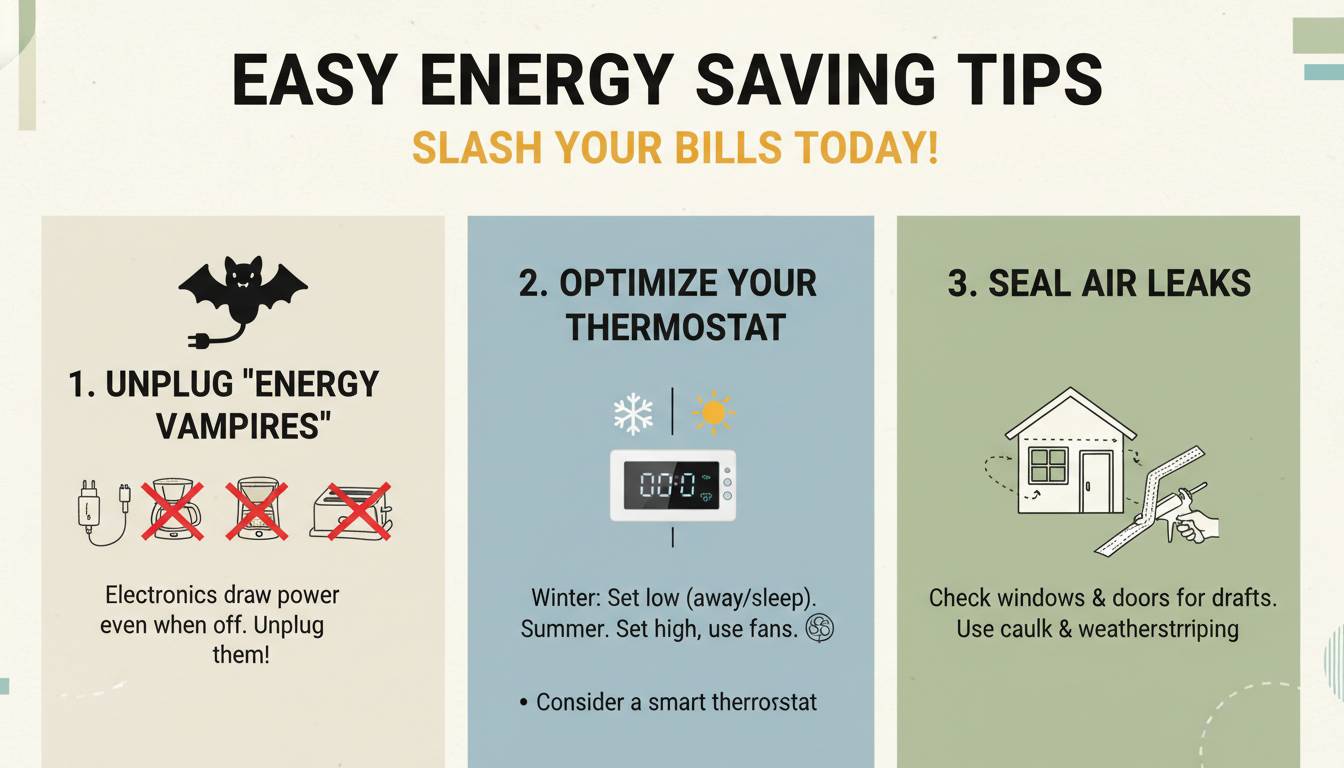
For winter heating: Set your thermostat to 68°F (20°C) while you’re awake and at home. Lower it by 7-10 degrees when you’re asleep or away for extended periods. A programmable thermostat automates this process, and smart thermostats learn your schedule and optimize automatically.
For summer cooling: Set your thermostat to 78°F (26°C) when you’re home. Every degree lower increases cooling costs by about 3%. Use ceiling fans to feel cooler at higher thermostat settings—ceiling fans cool people, not rooms, so turn them off when leaving.
The smart thermostat advantage: Models like the Google Nest, ecobee, and Honeywell T6 Pro learn your preferences and create schedules that balance comfort with efficiency. Most households see ROI within one to two years through optimized temperature management alone.
Sealing Air Leaks: Stop Money from Escaping
Air leaks around windows, doors, electrical outlets, and plumbing fixtures can account for 10% to 20% of heating and cooling waste. The good news? Most air sealing costs less than $50 and takes an afternoon.
Check these common leak locations:
- Weatherstripping around door and window frames
- Caulk gaps between window frames and walls
- Electrical outlet and switch plate covers on exterior walls
- Gaps where pipes, vents, or cables enter walls
- Attic hatchways and basement stairwells
- Ductwork connections in attics and crawl spaces
DIY sealing supplies: Foam caulk for gaps up to 1 inch, weatherstripping tape for doors and windows, and foam gasket plugs for electrical outlets cost between $10 and $30 at any hardware store. For larger gaps or hidden leaks in walls, consider hiring a professional for a home energy audit.
The Environmental Protection Agency’s ENERGY STAR program estimates that sealing air leaks and adding insulation can save the average homeowner $200 or more per year on heating and cooling costs.
Lighting Upgrades: Small Change, Big Impact
Lighting accounts for about 9% of home energy use, but switching to efficient bulbs delivers instant savings with minimal effort.
LED bulbs vs. incandescent: LED bulbs use up to 75% less energy and last 25 times longer than traditional incandescent bulbs. While LEDs cost more upfront—typically $3 to $10 per bulb versus under $1 for incandescents—they pay for themselves within months and save $75 to $150 over their lifespan.
Practical lighting strategies:
- Replace the five most-used bulbs first (likely in living areas and kitchens)
- Use natural daylight whenever possible—open curtains during daylight hours
- Install motion sensors or timers in low-traffic areas like closets and garages
- Consider task lighting (desk lamps, under-cabinet lights) instead of overhead lighting for specific activities
A household that replaces 15 frequently-used bulbs with LEDs can save approximately $100 to $200 annually, according to ENERGY STAR calculations.
Appliance Efficiency: Smart Usage Habits
Major appliances consume significant energy, but strategic usage patterns can reduce their impact without replacing them.
Refrigerator best practices:
- Set temperature to 37-40°F (3-4°C) for fresh food and 0°F (-18°C) for freezers
- Keep coils clean—vacuum them twice yearly
- Ensure door seals are airtight (test by closing a dollar bill in the door; it should hold snugly)
- Don’t leave the door open longer than necessary
- Allow hot food to cool before refrigerating
Washer and dryer tips:
- Wash full loads only—it’s more efficient than multiple small loads
- Use cold water for most laundry (90% of energy goes to heating water)
- Air-dry clothes when possible, even just the last cycle
- Clean the lint filter after every load
- Vent dryers properly outside (blocked vents force dryers to work harder)
Dishwasher efficiency:
- Run only full loads
- Skip the pre-rinse—modern dishwashers handle food debris well
- Use the air-dry or energy-saver setting instead of heat drying
These habits collectively can save $50 to $150 per year on utility costs while extending appliance lifespans.
Water Heating: Reducing a Hidden Energy Drain
Water heating ranks as the second-largest energy expense in most homes, accounting for about 14% of utility bills. Several strategies can cut these costs significantly.
Temperature adjustment: Lower your water heater thermostat to 120°F (49°C). This is hot enough for most household needs but reduces standby heat loss. The Department of Energy reports this single change can save 4% to 22% annually on water heating costs—anywhere from $30 to $100 per year.
Insulation improvements:
- Add an insulating blanket to older water heaters (those without built-in insulation)
- Insulate the first six feet of hot water pipes exiting the water heater
- These supplies cost under $30 and reduce heat loss during storage and distribution
Usage habits:
- Take shorter showers—each minute of shower time uses about 2.5 gallons of hot water
- Fix leaky faucets promptly; a dripping faucet can waste over 3,000 gallons annually
- Consider low-flow showerheads ($10-$30) which use 2 gallons per minute versus standard 5-gallon models
Electronics and Phantom Loads
Standby power—also called phantom load or vampire power—occurs when devices consume energy even when turned off. The Natural Resources Defense Council estimates that standby power accounts for 5% to 10% of residential electricity use, costing the average household $100 to $200 per year.
Combat phantom loads with these methods:
- Use power strips with switches to turn off multiple devices at once
- Uncharge chargers when not in use—they draw power even without a device connected
- Enable sleep mode on computers rather than leaving screensavers running
- Smart power strips automatically cut power to devices that go into standby mode
Entertainment and office equipment: Game consoles, televisions, computers, and printers often use significant standby power. A gaming console in standby mode can use 10 watts or more continuously—adding over $10 to monthly bills annually.
Heating and Cooling Equipment Maintenance
Well-maintained HVAC systems operate more efficiently and last longer, delivering both immediate savings and long-term benefits.
Filter maintenance: Replace or clean HVAC filters every 1-3 months, depending on usage and filter type. Clogged filters restrict airflow, forcing systems to work harder and consume more energy. A clean filter can reduce energy consumption by 5% to 15%.
Professional maintenance: Annual professional servicing for heating and cooling systems ensures optimal performance. Technicians check refrigerant levels, clean coils, verify proper airflow, and identify potential problems before they become expensive repairs.
Ductwork inspection: Leaky ducts can waste 20% to 30% of heated or cooled air before it reaches living spaces. Professional duct sealing typically costs $200-$500 but pays for itself within 2-3 years through energy savings.
Behavioral Changes That Add Up
Beyond equipment and settings, simple daily habits compound into significant savings over time.
Kitchen habits:
- Use the microwave or toaster oven instead of the full oven when possible (they use less energy)
- Match pot sizes to burner sizes
- Use the oven’s residual heat—turn it off a few minutes before food finishes cooking
- Air-dry dishes instead of using the heat dry setting on dishwashers
Laundry and general habits:
- Air-dry clothes on a drying rack or clothesline when weather permits
- Turn off lights when leaving rooms
- Unplug rarely-used appliances
- Use cold water for washing clothes unless dealing with heavy stains
These habits individually save small amounts, but collectively can reduce energy bills by 5% to 15% annually.
Getting Professional Help: Energy Audits
For homeowners seeking deeper savings, a professional home energy audit identifies the most impactful improvements for your specific home. The Department of Energy estimates that comprehensive energy audits typically cost $200-$500 but can identify $200-$600 in annual savings.
What to expect: Professional auditors use specialized equipment like blower doors and infrared cameras to detect air leaks and insulation problems invisible to the naked eye. They provide a detailed report prioritizing improvements by cost-effectiveness.
Rebates and incentives: Many utilities and government programs offer rebates for energy-efficient upgrades, smart thermostaps, insulation improvements, and professional audits. The Database of State Incentives for Renewables and Efficiency (DSIRE) lists available programs by state.
Frequently Asked Questions
How much can I realistically save by implementing these energy saving tips?
Most households can save 10% to 30% on their energy bills through the tips outlined in this guide. According to the U.S. Department of Energy, a combination of thermostat adjustments, air sealing, and lighting upgrades typically saves $200 to $500 annually. The exact amount depends on your current energy usage, climate, home efficiency, and which strategies you implement. Starting with the highest-impact changes—thermostat settings, air sealing, and LED lighting—produces the quickest and largest returns.
What is the easiest energy saving tip to implement today?
Changing your thermostat settings takes less than a minute and delivers immediate results. Simply lowering your thermostat by 2-3 degrees in winter or raising it in summer can save 5% to 10% on heating and cooling costs. For those renting or unable to adjust thermostats, unplugging unused chargers and electronics addresses phantom loads instantly—these small devices quietly add $10-$20 to monthly bills.
Do smart thermostats really save money?
Yes, smart thermostats consistently deliver savings for most households. A 2023 study by ENERGY STAR found that smart thermostats save an average of 8% on heating and cooling costs, translating to roughly $50-$150 annually depending on local energy rates. They optimize temperature based on your schedule, weather conditions, and learning algorithms. Most models pay for themselves within 1-2 years through energy savings alone.
How long does it take to see savings from energy saving changes?
Some changes produce immediate savings—thermostat adjustments, unplugging phantom loads, and turning off lights appear on your next bill. Others take longer to materialize, like replacing appliances or adding insulation, where ROI may take 1-5 years. Most households notice a 5% to 15% reduction in their first month after implementing the quick-win strategies like thermostat optimization, lighting changes, and sealing air leaks.
Are there any free energy saving resources available?
Yes, many utilities offer free or low-cost energy audits, rebates for efficient appliances, and free smart thermostats to customers. The U.S. Department of Energy’s Home Energy Score program provides standardized efficiency assessments. Additionally, many libraries and community centers host free weatherization workshops. Online tools like the ENERGY STAR Home Improvement Toolbox help homeowners prioritize upgrades based on potential savings.
What are the most cost-effective energy improvements?
Air sealing and thermostat optimization rank among the most cost-effective improvements—they require minimal investment (often under $50 for materials) and deliver immediate, substantial savings. LED lighting replacements cost more upfront but provide exceptional returns over their lifespan. Adding insulation to under-insulated attics typically costs $1,000-$2,000 but can save $200-$600 annually, making it one of the best long-term investments for homeowners in colder climates.
Conclusion
Saving energy and reducing your bills doesn’t require expensive upgrades or dramatic lifestyle changes. By focusing on the highest-impact areas—heating and cooling, air sealing, lighting, and everyday habits—you can achieve meaningful savings starting immediately. The most effective approach combines multiple strategies: adjust your thermostat, seal obvious air leaks, switch to LED bulbs, and develop conscious habits around electronics and appliance use. These changes work together synergistically, compounding your savings over time.
Begin with the free or low-cost changes today: adjust your thermostat, replace your most-used light bulbs, and seal obvious air leaks with weatherstripping and caulk. Within weeks, you’ll see lower utility bills while maintaining—or improving—your home comfort. Energy efficiency is one of the few areas where doing the right thing for your wallet and the environment align perfectly.