
QUICK ANSWER: Home renewable energy systems—primarily solar panels, wind turbines, and geothermal heat pumps—can reduce electricity bills by 50-100% while increasing property values by 4.1% on average. The average residential solar system costs $16,000-$25,000 after federal tax credits, with payback periods of 6-12 years depending on location and electricity rates. Combined with battery storage, homeowners can achieve energy independence while contributing to grid stability.
AT-A-GLANCE:
| Factor | Solar Panels | Wind Turbine | Geothermal Heat Pump |
|---|---|---|---|
| Avg. System Cost | $16,000-$25,000 | $10,000-$40,000 | $10,000-$25,000 |
| Energy Savings | 40-100% | 50-100% | 30-70% |
| Payback Period | 6-12 years | 8-15 years | 7-14 years |
| Lifespan | 25-30 years | 20-25 years | 25+ years |
| Best For | Most U.S. homes | Rural, windy areas | Any climate |
KEY TAKEAWAYS:
– ✅ The federal Investment Tax Credit (ITC) covers 30% of system costs through 2032, dropping to 26% in 2033
– ✅ Average U.S. electricity rates increased 15% from 2022-2024, making renewables increasingly economical (EIA, November 2024)
– ✅ Home battery systems like Tesla Powerwall 3 cost $13,500-$16,500 installed, enabling backup power and time-of-use savings
– ❌ Common mistake: Installing renewable systems without first improving energy efficiency—sealing air leaks and upgrading insulation typically saves more per dollar spent
– 💡 Expert insight: “The ROI calculation should include not just utility savings but also protection against future rate increases and increased home resale value” — Energy.gov Residential Energy Team
KEY ENTITIES:
– Products/Tools: Tesla Powerwall, LG Chem RESU, Enphase IQ Battery, Vestas small wind turbines, SunPower panels
– Incentives: Federal ITC, state net metering programs, utility rebates, PACE financing
– Standards: NEC Article 690 (solar), ENERGY STAR certification
– Organizations: NREL, SEIA, Energy.gov, NABCEP
LAST UPDATED: January 2025
Introduction
The mathematics of home energy is shifting decisively. After decades of incremental improvements, residential renewable energy has reached a tipping point where financial returns now rival or exceed traditional investments while delivering unprecedented energy independence. Between rising utility rates, generous federal incentives, and dramatically lower equipment costs, the economic case for solar, wind, and geothermal has never been stronger.
This guide examines each major residential renewable technology through the lens of real-world economics and practical implementation. We’ll explore what’s actually worth investing in, what pitfalls to avoid, and how to calculate whether your specific home and location make the numbers work. Whether you own a suburban ranch or a rural acreage, there’s likely a renewable path that fits your situation—we’ll help you find it.
Understanding Your Energy Profile Before Going Renewable
How to Calculate Your Home’s Energy Baseline
Before investing in any renewable system, you need精确 understanding of your actual energy consumption. Your annual electricity usage—measured in kilowatt-hours (kWh)—forms the foundation of every sizing calculation and ROI projection.
Start by pulling 12 consecutive months of utility bills. Look for the total kWh consumed each month, not just the dollar amount, as rates vary seasonally. The average U.S. household consumes approximately 10,800 kWh annually, but this ranges widely: efficient new homes may use 6,000-8,000 kWh while larger older homes can exceed 20,000 kWh.
CRITICAL STEP: Your energy profile determines system sizing, which directly affects costs and savings. Oversizing wastes money; undersizing leaves savings on the table.
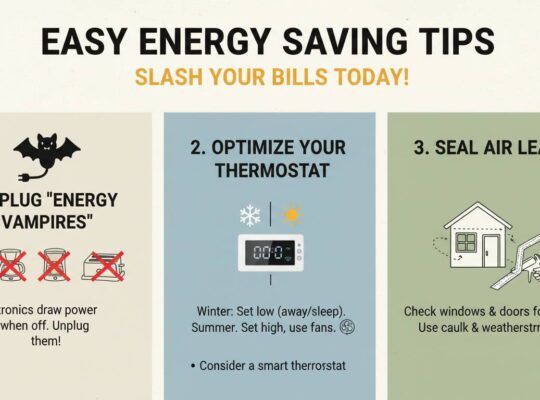
The Efficiency First Principle
Here’s what most homeowners get backwards: they spend $20,000 on solar panels while their home leaks air through gaps that cost perhaps $500 to seal. This approach leaves thousands of dollars in savings unclaimed.
The Department of Energy estimates that air sealing and insulation improvements typically provide a 100-200% return on investment—far better than solar’s 15-25% annual returns. Before any renewable installation:
- Conduct an energy audit (many utilities offer free or subsidized audits costing $100-$300)
- Seal air leaks around windows, doors, and penetrations
- Upgrade attic insulation to R-38 or higher
- Replace incandescent lighting with LED
- Upgrade to ENERGY STAR appliances where needed
Only after these improvements should you size your renewable system. You’ll need fewer panels, spend less money, and capture more savings.
Residential Solar Power: The Established Choice
System Components and Costs
A grid-tied residential solar system consists of four main components: solar panels (modules), inverter(s), mounting hardware, and monitoring equipment. Battery backup systems add another major component and significant cost.
| Component | Function | Typical Cost Range |
|---|---|---|
| Solar Panels | Convert sunlight to DC electricity | $8,000-$15,000 |
| Inverter | Convert DC to AC for home/grid | $2,000-$4,000 |
| Mounting/Racking | Secure panels to roof/ground | $1,500-$3,000 |
| Battery (optional) | Store excess for backup/time-of-use | $8,000-$15,000 |
| Installation Labor | Professional permitting and install | $4,000-$8,000 |
| Total System | 6-10 kW typical | $16,000-$35,000 |
Prices shown reflect 2024 market rates after the 30% federal tax credit deduction.
Net Metering: Understanding the Compensation Structure
Net metering policies vary significantly by state and utility, and recent changes have made understanding your specific situation essential. In essence, net metering credits you at retail electricity rates for excess power your system sends to the grid.
However, several states have transitioned from true net metering to “grid export” rates that pay significantly less—sometimes 30-50% below retail rates. California, New York, and Hawaii have already implemented these changes, while other states are considering similar shifts.
Before installing, confirm your utility’s current policy and any announced changes. This directly impacts your expected payback period by 2-4 years in many cases.
Roof Considerations: Orientation, Shading, and Condition
South-facing roofs in the Northern Hemisphere capture the most energy, but east and west orientations still work well—typically achieving 80-90% of optimal output. Northern exposures generally don’t produce enough energy to justify the panel cost.
Shading is the enemy of solar production. Even partial shading from trees, chimneys, or neighboring buildings can reduce output by 30-50%. Modern microinverter and power optimizer systems mitigate some shading impacts, but removing or trimming trees is often necessary.
Your roof should have at least 15-20 years of remaining life. Installing panels on a roof needing replacement soon means removing and reinstalling panels—an expensive proposition.
Small-Scale Wind: Practical for the Right Location
When Wind Makes Sense
Residential wind turbines require specific conditions to be economical. Unlike solar, which works almost anywhere with adequate roof space, wind energy demands consistent wind resources—typically 12+ mph average annual wind speed.
The Wind Energy Resource Atlas of the United States identifies the Great Plains, coastal regions, and mountain passes as having the best residential wind potential. Suburban and urban areas generally lack adequate wind due to buildings and trees creating turbulence.
Turbine Types and Sizing
Small residential wind turbines fall into two categories: horizontal-axis (propeller-style, most common) and vertical-axis (eggbeater/Darrieus designs). Horizontal-axis turbines are more efficient and widely available.
| Turbine Size | Rated Output | Typical Annual Production | Best Application |
|---|---|---|---|
| 1-2 kW | 1-2 kW | 1,500-3,500 kWh | Small cabin, minimal needs |
| 5-10 kW | 5-10 kW | 8,000-20,000 kWh | Single-family home (windy site) |
| 10-15 kW | 10-15 kW | 20,000-40,000 kWh | Large home, excellent wind |
For most residential applications, a 5-10 kW system provides the best balance of cost and output. Larger systems face diminishing returns due to infrastructure requirements.
Installation Requirements and Costs
Wind turbines require tower heights of 80-120 feet to capture adequate wind resources. This creates installation challenges and costs not present with solar:
- Tower cost: $5,000-$15,000 depending on height and type
- Concrete foundation: $1,000-$3,000
- Permitting and zoning: Variable, can be significant in some jurisdictions
- Total installed cost: $10,000-$40,000 for typical residential systems
The tall towers required for wind access create noise concerns, aesthetic objections from neighbors, and potential zoning conflicts. These non-technical factors frequently determine whether wind is viable for a given property.
Geothermal Heat Pumps: Efficient Heating and Cooling
How Geothermal Works
Geothermal heat pumps (GHP), also called ground-source heat pumps, use the stable temperature of the earth (typically 45-75°F depending on depth and location) to provide highly efficient heating and cooling. Rather than generating heat like a furnace, GHPs simply move heat between your home and the ground—a process that uses 70-80% less electricity than conventional HVAC systems.
This efficiency translates directly to operating savings. According to the Department of Energy, geothermal systems use 25-50% less electricity than traditional HVAC while providing equivalent heating and cooling.
System Costs and Installation
| System Type | Description | Installed Cost |
|---|---|---|
| Horizontal Loop | Pipes buried 4-6 feet deep | $10,000-$20,000 |
| Vertical Loop | Pipes drilled 100-400 feet | $15,000-$30,000 |
| Pond/Lake Loop | Coils in water body | $10,000-$17,000 |
Costs vary significantly based on:
- Climate: Colder regions require deeper loops
- Available space: Horizontal loops need adequate yard area
- Soil conditions: Rocky soil increases drilling costs
- System size: Larger homes need larger systems
The federal Residential Clean Energy Credit covers 30% of geothermal installation costs, making the effective after-credit investment $7,000-$21,000 for most homeowners.
Lifespan and Maintenance
Geothermal systems are renowned for longevity. The underground loops typically last 25-50 years, while the heat pump unit itself lasts 20-25 years with proper maintenance. This extended lifespan often makes geothermal the lowest cost option over a 30-year horizon, despite higher upfront costs than conventional HVAC.
Battery Storage: Adding Resilience and Time-Shifting
Why Add Battery Storage?
Residential batteries serve three primary functions:
- Backup power during outages: Keep essential circuits running when the grid fails
- Time-of-use optimization: Store cheap midday solar power for expensive evening use
- Grid services participation: Some utilities pay homeowners to provide grid stability
For most homeowners, backup power is the primary motivation, especially in areas prone to outages from storms, wildfires, or grid instability.
Battery Options and Costs
| Battery Model | Capacity | Usable Energy | Warranty | Installed Cost |
|---|---|---|---|---|
| Tesla Powerwall 3 | 13.5 kWh | 13.5 kWh | 10 years | $13,500-$16,500 |
| Enphase IQ Battery | 3.5 kWh/unit | 3.24 kWh | 10 years | $7,000-$14,000 (scalable) |
| LG Chem RESU10H | 9.8 kWh | 9.3 kWh | 10 years | $8,000-$11,000 |
| Franklin WH Smart | 13.6 kWh | 13.6 kWh | 12 years | $14,000-$17,000 |
Costs shown include installation but vary by installer and location. Multiple units can be combined for greater capacity.
Is Battery Storage Economical?
Pure economics favor battery storage only in limited scenarios:
- High time-of-use rates: If your utility charges significantly more (50%+) for evening versus midday electricity, batteries can save money through arbitrage
- Frequent outages: Each outage day without power saves an amount equivalent to your daily electricity cost—batteries make sense if outage costs exceed battery costs over the system’s lifespan
- Value stacking: Combining backup power, time-of-use optimization, and potential grid service payments improves the economic case
For many homeowners, batteries provide peace of value that doesn’t show up in simple ROI calculations—which is perfectly valid. Just don’t expect batteries to pay for themselves in most scenarios.
Federal Incentives and Financing Options
The Residential Clean Energy Credit (ITC)
The Inflation Reduction Act extended and enhanced the Investment Tax Credit for residential renewable energy:
| Installation Year | Tax Credit |
|---|---|
| 2022-2032 | 30% |
| 2033 | 26% |
| 2034 | 22% |
| 2035+ | 0% (unless extended) |
The credit applies to solar, wind, geothermal, and battery storage systems. It covers equipment and installation costs, with no upper limit. The credit is non-reflatable but carries forward—meaning if you don’t owe enough taxes to use the full credit in one year, you can carry the remainder forward.
Critical requirement: You must own your system (not lease) to claim the full credit. Property-assessed clean energy (PACE) financing and loans where you own the system also qualify.
Additional State and Local Incentives
Beyond federal credits, most states offer additional incentives:
- State tax credits: Many states offer 10-35% additional credits, some stackable with federal
- Net metering: Credits for exported electricity (value varies by state/utility)
- Utility rebates: One-time payments or per-kWh incentives, often $200-$1,000
- Property tax exemptions: Some states exclude renewable system value from property taxes
- Rebates for battery storage: Growing number of utilities offer $200-$500 per kWh
The Database of State Incentives for Renewables and Efficiency (DSIRE) provides comprehensive, state-specific information at dsireusa.org.
Calculating Your Payback Period
The Simple Formula
Your simple payback period equals:
Total Net Cost ÷ Annual Electricity Savings = Years to Break Even
Where:
- Total Net Cost = Gross system cost minus all incentives and rebates
- Annual Electricity Savings = Your annual kWh consumption × your electricity rate
Example Calculation: Solar for the Average Home
- Annual consumption: 10,800 kWh
- Electricity rate: $0.15/kWh (national average)
- Annual bill: $1,620
- System size: 8 kW (produces ~11,000 kWh/year in average location)
- System cost: $22,000 (gross)
- Federal tax credit (30%): $6,600
- Net cost: $15,400
- Annual savings: $1,620 (100% offset assumption)
- Simple payback: $15,400 ÷ $1,620 = 9.5 years
This example ignores electricity rate increases, which shorten payback in real terms. It also ignores increased property value, which often exceeds the net system cost.
Variables That Affect Your Numbers
- Your electricity rate: Higher rates = faster payback (and rates are rising)
- Your state’s net metering policy: Retail vs. wholesale rates significantly impact savings
- Your solar resource: More sun = more production = faster payback
- System degradation: Panels lose ~0.5-1% efficiency annually
- Inverter replacement: Plan for $2,000-$4,000 around year 12-15
Frequently Asked Questions
Q: How long do residential solar panels last?
Direct Answer: Most solar panels carry 25-30 year warranties and will continue producing electricity at 80-85% of original output at year 25. The inverter typically needs replacement at years 12-15, costing $2,000-$4,000.
Detailed Explanation: Panel degradation is slow—approximately 0.5% per year for quality panels. After 25 years, a well-maintained system still produces 75-85% of its original output. This extended lifespan, combined with 25-year equipment warranties from major manufacturers, makes solar a long-term investment rather than a short-term fix. The key is choosing reputable equipment with proven track records and qualified installers who follow manufacturer specifications.
Q: Will solar panels work during power outages?
Direct Answer: No—standard grid-tied solar systems automatically shut down during outages for safety reasons, as they could send electricity back to grid lines and endanger utility workers making repairs.
Detailed Explanation: This safety requirement exists in all grid-tied systems per National Electrical Code Article 690. To have power during outages, you need battery storage (like Tesla Powerwall or Enphase IQ Battery) that can island from the grid and power your home independently. Some battery systems can also be paired with generators for extended backup. If outage resilience matters to you, budget for batteries—they’re the only way to achieve it with solar.
Q: What is the best renewable energy system for a home in a cloudy climate?
Direct Answer: Geothermal heat pumps often make the most sense in cloudy climates because they provide both heating and cooling savings regardless of sunlight, and their efficiency advantage (400-600% vs. 25-50% for conventional HVAC) applies everywhere.
Detailed Explanation: While solar production decreases in cloudy areas, it doesn’t disappear entirely—panels still produce 30-50% of their rated output even on overcast days. However, geothermal’s dual heating and cooling savings often provide better financial returns in moderate climates where air conditioning and heating loads are both significant. If you have suitable land for ground loops, geothermal typically offers the fastest payback in cloudy regions, plus the predictability of production that solar cannot match.
Q: How much does a home energy audit cost, and is it worth it?
Direct Answer: Home energy audits typically cost $100-$300 through utility programs or certified auditors, with some utilities offering free audits. Yes—they’re absolutely worth it because they identify the highest-value efficiency improvements for your specific home.
Detailed Explanation: A professional audit uses blower-door testing, infrared cameras, and other diagnostic tools to identify exactly where your home wastes energy. The auditor provides a prioritized list of improvements with estimated costs and savings. This targeted approach typically finds $500-$2,000 in quick-fix items that offer 100%+ ROI, plus higher-investment items that still outperform solar returns. The small audit investment almost always pays back many times over in subsequent savings.
Q: Can I install renewable energy myself to save money?
Direct Answer: While DIY solar installation is technically possible in some jurisdictions, it’s generally not recommended—professional installation costs are typically worth paying for safety, code compliance, warranty protection, and insurance coverage.
Detailed Explanation: DIY solar faces several challenges: proper permitting requires electrical knowledge; roof mounting must withstand wind loads and maintain waterproofing; electrical connections must meet code for safety and insurance; and DIY systems may void panel warranties or cause issues when selling your home. The labor cost (typically 15-25% of system cost) provides substantial value in terms of safety, code compliance, and peace of mind. For most homeowners, the small savings from DIY don’t justify the risks.
Conclusion: Making Your Renewable Energy Decision
The economic case for residential renewable energy has never been stronger. With federal tax credits at 30% through 2032, electricity rates consistently rising, and equipment costs at historic lows, the financial fundamentals align for most homeowners—particularly those in sunny states or those looking to reduce their largest utility expense.
IMMEDIATE ACTION STEPS:
| Timeframe | Action | Expected Outcome |
|---|---|---|
| This Week | Request free quotes from 3+ local solar installers | Compare pricing, verify equipment brands |
| This Month | Order a professional energy audit ($100-$300) | Identify efficiency improvements with best ROI |
| Before Installation | Check your state’s net metering policy and incentive programs | Maximize total incentive value |
| Before Signing | Verify installer certifications (NABCEP preferred) and read warranty terms carefully | Protect your long-term investment |
FINAL RECOMMENDATION: For most U.S. homeowners with suitable roof space and sun exposure, grid-tied solar without batteries provides the best balance of cost, savings, and simplicity. Add battery storage if you experience frequent outages, have time-of-use electricity rates, or simply want the peace of mind that comes with backup power. Geothermal makes excellent sense for homeowners in any climate who need to replace their HVAC system anyway—combining a necessary expense with renewable investment. Wind remains viable only for properties with excellent wind resources and adequate space.
Regardless of which technology fits your situation, start with an energy audit. The efficiency improvements you discover will make any renewable investment work harder and pay back faster.