
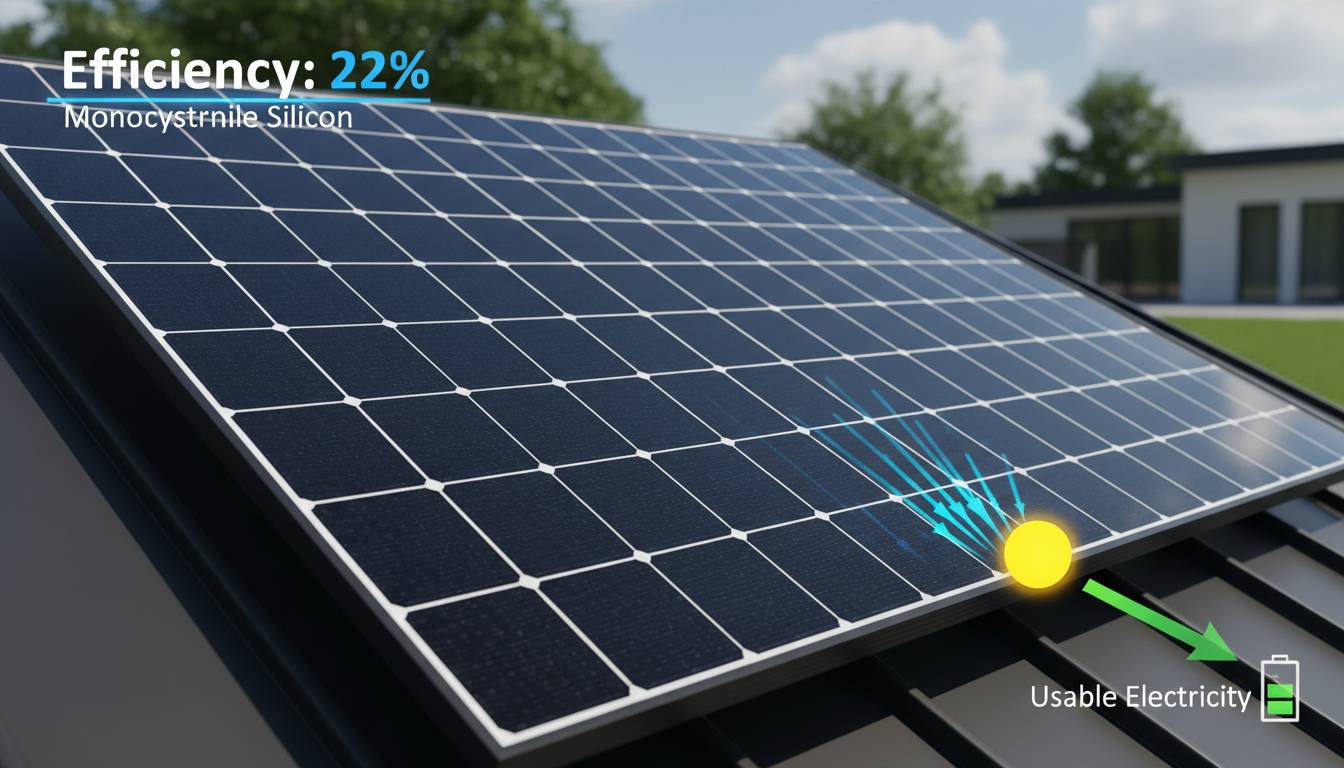
Solar panel efficiency determines how much sunlight your panels convert into usable electricity—and directly impacts your savings over the system’s lifetime. Most homeowners don’t realize that choosing a panel just 5% more efficient can mean thousands of dollars in additional savings over 25 years. This guide breaks down everything you need to know about solar panel efficiency, from the science behind it to practical steps you can take to maximize your return on investment.
Key Insights
- Standard residential solar panels convert 15-22% of sunlight into electricity, with premium panels reaching 23%
- A 1% increase in panel efficiency can generate an additional $500-$1,000 in savings over a 25-year system lifespan
- Temperature, shading, and installation angle each reduce panel output by 5-25% when not optimized
- Most panels degrade at 0.5% annually, meaning a 20% efficient panel performs at 17.5% after 25 years
What Is Solar Panel Efficiency?
Solar panel efficiency refers to the percentage of sunlight energy that a panel converts into electrical energy. A panel rated at 20% efficiency converts one-fifth of the solar energy it absorbs into usable electricity. This metric is one of the most important specifications when comparing solar panels, but it requires context to be meaningful for your purchasing decisions.
The theoretical maximum efficiency for a single-junction silicon solar cell is approximately 33%, known as the Shockley-Queisser limit. This ceiling exists because sunlight contains photons with various energy levels, and some energy is inevitably lost as heat during the conversion process. Current commercial panels operate at roughly half this theoretical maximum, though ongoing research continues to push boundaries.
Panel efficiency differs from system efficiency. Your solar panel’s efficiency rating measures the panel itself under laboratory conditions (Standard Test Conditions or STC). Real-world system efficiency accounts for additional factors including inverter losses (typically 2-4%), wiring losses (1-3%), soiling and shading (5-20%), and temperature degradation. A system with 20% efficient panels might deliver only 14-16% of available sunlight as usable electricity at your home.
The distinction matters because manufacturers often highlight maximum laboratory efficiency numbers that don’t reflect actual performance. Understanding this gap helps set realistic expectations for your energy production and savings projections.
Factors That Affect Solar Panel Efficiency
Temperature Performance
Solar panels actually become less efficient as they heat up—a counterintuitive but critical factor. Most panels have a temperature coefficient between -0.3% and -0.5% per degree Celsius above 25°C (77°F). This means on a hot summer day when your roof reaches 45°C, a panel with a -0.4% coefficient loses approximately 8% of its rated output.
This temperature effect explains why panels sometimes produce less power on scorching summer afternoons compared to milder spring days with less sunlight. Proper ventilation behind panels (achieved through adequate mounting height) helps dissipate heat and maintain better efficiency.
Orientation and Tilt Angle
The direction your panels face dramatically affects energy production. In the United States, true south-facing orientation (for northern hemisphere placement) produces maximum annual output. East or west-facing arrays can reduce energy production by 15-25% compared to south-facing installations.
Optimal tilt angle varies by location latitude. A general rule suggests tilting panels at your latitude angle for year-round production, or steeper (latitude plus 15°) for winter-heavy energy use and shallower (latitude minus 15°) for summer dominance. Most residential installations use fixed angles between 20-35 degrees, which provides reasonable year-round performance.
Shading and Obstructions
Even partial shading on a single panel can disproportionately reduce entire string output. Modern panels use bypass diodes to minimize this effect, but shading remains one of the largest efficiency killers in residential systems. Tree growth, nearby buildings, chimneys, and seasonal changes (like autumn leaf coverage) all impact performance.
Professional installers conduct shade analysis using tools like solar path calculators or drone surveys to identify problem areas. Sometimes as little as 10% shading can reduce output by 50% or more, depending on how the shaded cells are connected within the panel.
Soiling and Maintenance
Dust, pollen, bird droppings, and debris accumulate on panels over time, reducing efficiency by 5-25% depending on your environment. Areas with low rainfall or high dust exposure see greater losses. Studies from the National Renewable Energy Laboratory indicate that regular cleaning can recover 5-15% of lost production in typical residential settings.
Types of Solar Panel Efficiency Ratings
Standard Test Conditions (STC)
STC efficiency represents panel performance under ideal laboratory conditions: 1,000 watts per square meter of irradiance, 25°C cell temperature, and air mass 1.5 spectrum. These numbers appear on panel spec sheets and enable comparison between products under consistent conditions.
STC ratings provide useful benchmarks but overestimate real-world performance. A 400-watt panel at STC rarely produces 400 watts on your roof.
Real-World Performance (NOCT)
The Normal Operating Cell Temperature (NOCT) rating better reflects actual conditions: 800 watts per square meter irradiance, 20°C ambient temperature, and typical mounting configurations. NOCT values typically run 20-30% lower than STC ratings, providing more realistic production expectations.
For example, a panel rated 400 watts STC might produce 280-320 watts under typical NOCT conditions—a number that should factor into your system sizing calculations.
Temperature Coefficient Specifications
Beyond general efficiency ratings, temperature coefficient specifications tell you exactly how much performance degrades per degree above 25°C. Lower coefficients (closer to -0.3%) indicate panels that handle heat better—particularly valuable in hot climates.
Premium manufacturers often achieve better temperature coefficients through better cell architecture and quality materials, providing another differentiator beyond raw efficiency percentages.
Comparing Panel Technologies
| Technology | Efficiency Range | Cost | Best Applications |
|---|---|---|---|
| Monocrystalline | 19-23% | $$$ | Residential, limited roof space |
| Polycrystalline | 15-18% | $$ | Large installations, budget-conscious |
| Thin-Film (CdTe) | 18-22% | $$ | Commercial flat roofs, building-integrated |
| PERC | 20-23% | $$$ | High-performance residential |
| Bifacial | 19-24% | $$$$ | Ground mounts, commercial |
Monocrystalline panels, made from single-crystal silicon, offer the highest efficiency for residential applications and dominate the U.S. market. Polycrystalline panels cost less but efficiency suffers. Thin-film technologies provide flexibility for commercial applications but haven’t achieved mainstream residential adoption.
Passivated Emitter Rear Cell (PERC) technology adds a reflective layer to capture more light, improving efficiency by 1-2% over standard monocrystalline at similar costs. Bifacial panels capture light from both sides, generating additional power from reflected sunlight—ideal for light-colored surfaces or ground mounts.
How to Maximize Your System Efficiency
Choose High-Efficiency Panels for Limited Roof Space
If your roof has limited usable area, higher-efficiency panels produce more power per square foot. The premium for efficiency panels (20% vs. 17%) typically costs 10-20% more but can generate 15-20% more electricity over the same footprint. For tight roof spaces, this math often favors premium panels despite higher upfront costs.
Calculate your specific situation: divide your available roof area by the panel efficiency to estimate total system capacity, then compare panel options within your space constraints.
Optimize Installation Parameters
Professional installers determine optimal panel positioning, but you can ensure best practices:
- South-facing orientation provides maximum annual production in the U.S.
- Proper tilt angle balances seasonal production
- Adequate spacing between panel rows prevents inter-row shading
- Quality mounting with proper ventilation reduces temperature losses
- Microinverters or power optimizers minimize shading impact on individual panels
Implement Monitoring and Maintenance
Modern systems include monitoring that tracks production versus expectations. Sudden drops indicate problems—panel failures, inverter issues, or newly-developed shading. Establishing a cleaning schedule based on your environment (annual in rainy areas, semi-annual in dry/dusty regions) maintains peak efficiency.
The Solar Energy Industries Association recommends checking system performance monthly and cleaning panels when soiling exceeds 5% coverage visible from ground inspection.
Calculating Your Efficiency Savings Impact
Understanding efficiency’s financial impact helps justify panel selection decisions.
Consider two 6 kW systems: one using 17% efficient panels ($18,000 installed) versus 20% efficient panels ($21,000 installed). The higher-efficiency system produces approximately 17.6% more kWh annually due to better conversion plus typically better temperature performance and degradation rates.
Over 25 years, assuming 0.5% annual degradation and $0.15/kWh electricity rates:
- 17% efficient system: approximately 195,000 kWh lifetime production ($29,250 value)
- 20% efficient system: approximately 228,000 kWh lifetime production ($34,200 value)
The $3,000 premium for higher efficiency generates approximately $4,950 additional value—a return exceeding the extra investment. This calculation varies based on your local electricity rates, available roof space, and specific panel characteristics.
Common Solar Efficiency Mistakes
Mistake 1: Prioritizing Lowest Cost Over Efficiency
Budget panels often use lower-efficiency cells that underperform over decades. While cheaper upfront, these panels generate less lifetime value despite similar installation costs.
Mistake 2: Ignoring Temperature Coefficients in Hot Climates
Homeowners in desert Southwest or hot Southern regions lose significant production to heat. Selecting panels with low temperature coefficients (better than -0.4%/°C) substantially improves hot-weather performance.
Mistake 3: Failing to Account for Future Shading
Trees mature, neighbors build additions, and HVAC units get installed. What looks like a clear roof today may develop shadows. Professional shade analysis and planning for future conditions prevents efficiency surprises.
Mistake 4: Neglecting Inverter Efficiency
Panel efficiency means nothing if your inverter wastes converted power. Inverter efficiencies range from 95-99%—choosing premium inverters (SolarEdge, Enphase, Fronius) recovers 2-4% more usable electricity.
The Future of Solar Panel Efficiency
The solar industry continues advancing efficiency through research and manufacturing improvements. Perovskite tandem cells demonstrate potential to exceed 30% efficiency in laboratory settings, and several manufacturers plan commercial releases within 3-5 years.
Bifacial technology adoption is accelerating, with installation growth exceeding 40% annually according to Wood Mackenzie. These panels generate 10-20% more energy by capturing reflected light, though require appropriate mounting surfaces.
For current buyers, efficiency gains from existing technologies provide meaningful savings without waiting for future developments. Panel efficiency improvements of 0.5-1% annually translate to better returns on every new installation.
Frequently Asked Questions
What is a good efficiency rating for residential solar panels?
A good efficiency rating for residential panels falls between 18-22% for most homes. Panels at 20% or higher are considered premium, while 15-17% panels offer budget-friendly options. The right choice depends on your roof space, budget, and long-term energy goals.
Does higher efficiency solar panels mean better return on investment?
Higher efficiency panels typically offer better ROI when roof space is limited, as they generate more power per square foot. However, if you have ample roof space and electricity rates are lower, premium panels may not justify the added cost. Calculate your specific situation using your roof dimensions and local electricity rates.
How often do solar panels lose efficiency?
Solar panels degrade at approximately 0.5% per year on average, meaning a panel at 20% efficiency will perform at about 17.5% after 25 years. Premium panels often degrade slower (0.3-0.4% annually), maintaining better output throughout their lifespan.
Can I improve my solar panel efficiency after installation?
Yes, you can improve system efficiency after installation through regular cleaning, trimming trees that cause shading, upgrading to more efficient inverters, or adding power optimizers to mitigate partial shading effects. Monitoring systems help identify when these improvements provide meaningful benefits.
What’s the difference between panel efficiency and system efficiency?
Panel efficiency measures the panel itself under laboratory conditions (STC), while system efficiency accounts for real-world factors including inverter losses, wiring, temperature effects, shading, and soiling. A system typically delivers 75-85% of its panels’ rated efficiency in actual use.
How do I know if my solar panels are performing efficiently?
Compare your system’s actual production against expected output (available from your installer or monitoring app). Significant shortfalls (more than 10-15% below expectations) may indicate problems. Annual production should decline roughly 0.5% from the previous year—faster degradation suggests issues requiring inspection.
Conclusion
Solar panel efficiency directly determines how much electricity your system generates and how much money you save over its 25-30 year lifespan. While laboratory efficiency ratings provide useful comparison points, understanding real-world factors—temperature, shading, orientation, and maintenance—matters more for actual performance.
For most U.S. homeowners, selecting panels in the 19-22% efficiency range provides the best balance of cost and performance. Prioritize professional installation with proper orientation, invest in quality inverters, and establish a maintenance routine to protect your efficiency over time. These decisions compound: small improvements in efficiency translate to thousands of dollars in additional savings as electricity rates rise and your system ages.
The most efficient panel isn’t always the best choice—but understanding efficiency helps you make informed decisions that maximize your solar investment.