
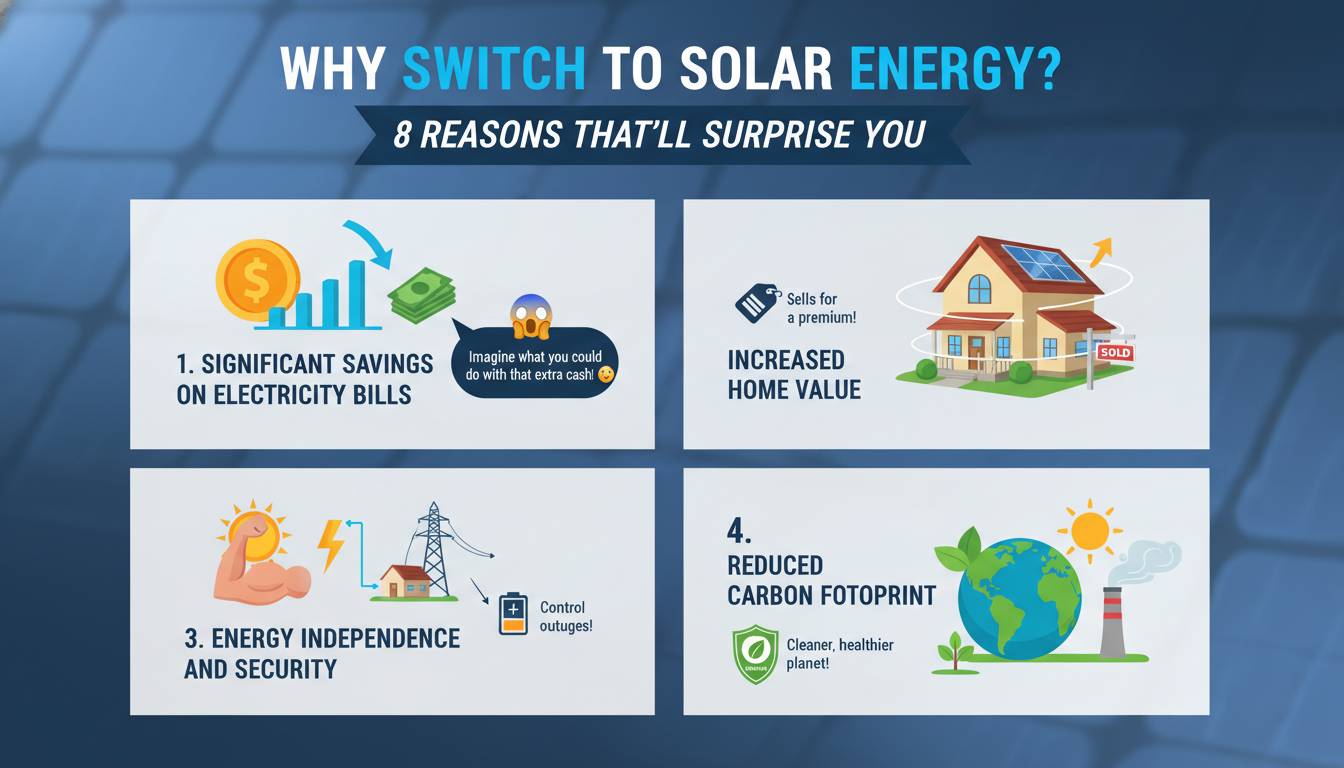
The average American household spends approximately $1,700 annually on electricity bills, a figure that has climbed steadily over the past decade as utility rates continue to rise. Meanwhile, the sun provides enough energy in one hour to power the entire planet for a year. This disconnect between abundant clean energy and expensive fossil fuel dependence represents one of the most significant economic opportunities available to homeowners today. Switching to solar energy isn’t merely an environmental choice—it’s a financial decision that transformed over 3 million American households in 2023 alone, with projections indicating another 4 million installations by 2025.
The Financial Case: How Solar Saves You Money
The most compelling reason to switch to solar energy centers on economics. Residential solar panel systems have dropped in price by more than 70% since 2010, making them accessible to a broader range of homeowners than ever before. According to the Solar Energy Industries Association, the average residential solar installation costs between $15,000 and $25,000 after federal tax credits, with systems typically paying for themselves within 6 to 12 years depending on local electricity rates and available sunlight.
Consider the long-term mathematics: a $20,000 solar installation lasting 25 years generates approximately $50,000 to $70,000 in electricity savings at current rates—conservative estimates that don’t account for future utility rate increases, which historically average 3-5% annually. Many homeowners who switched in the early 2010s now generate electricity at costs significantly below their neighbors’ utility rates, essentially eliminating their largest monthly utility expense for decades.
Net metering policies amplify these savings further. When your solar panels produce more electricity than you consume, utility companies in most states credit you at the retail rate—essentially turning your meter backward. Some utilities even pay cash for excess generation, though net metering availability varies by state and utility provider.
| Cost Factor | Traditional Grid | Solar Energy |
|---|---|---|
| Average Monthly Bill | $147 | $0-30 (loan/lease) |
| 25-Year Total Cost | $44,100 | $20,000-35,000 |
| Rate Increase Vulnerability | High | None |
| System Lifespan | Indefinite | 25-30 years |
Environmental Impact: Reduce Your Carbon Footprint Significantly
The environmental argument for solar extends far beyond personal economics. The average residential solar system prevents 3 to 4 tons of carbon emissions annually—the equivalent of planting over 100 trees every year. For context, transportation accounts for approximately 29% of U.S. greenhouse gas emissions, while electricity generation contributes 25%. Switching to solar directly addresses the electricity portion while reducing demand on fossil fuel plants that otherwise power your home.
A single coal-fired power plant emits approximately 3.7 million tons of carbon dioxide annually. Multiply the 3 million American solar households by 3.5 tons each, and residential solar prevents over 10 million tons of CO2 emissions yearly—the output equivalent of removing over 2 million cars from the road. The National Renewable Energy Laboratory reports that widespread solar adoption could reduce U.S. electricity sector emissions by up to 78% by 2050.
Dr. John B. “We cannot solve the climate crisis without addressing how we generate electricity,” explains Dr. Leahy, Director of Energy Policy at Columbia University’s Center on Sustainable Development. “Residential solar represents the most immediate, scalable action individual households can take. The technology works, the economics make sense, and the environmental benefits compound exponentially as adoption increases.”
The water consumption aspect often gets overlooked. Traditional power plants consume billions of gallons annually for cooling and processing. Solar photovoltaic systems require virtually no water for operation, making them particularly valuable in drought-prone regions of the American West and Southwest.
Energy Independence: Break Free from Utility Dependency
Utility grid vulnerability became painfully apparent during winter storms Uri and Elliott, which caused widespread power outages across Texas and the central United States in 2021 and 2022. These events highlighted a fundamental truth: when the grid fails, your lights go out. Solar systems with battery storage provide a resilient alternative that insulates your household from grid failures, extreme weather events, and infrastructure degradation.
Energy independence through solar + storage means your home becomes its own power plant. During daylight hours, your panels generate electricity. Any excess charges your battery bank. When the sun sets or storms knock out power lines, your home draws from stored energy—silently, automatically, without interruption. For households in areas prone to outages or those seeking backup power, this represents transformative security.
| Grid Dependency Comparison | Grid-Only | Solar + Battery |
|---|---|---|
| Outage Protection | None | 12-48 hours |
| Rate Arbitrage | Limited | Maximum |
| Peak Hour Control | None | Full |
| Future Rate Risk | Exposed | Hedged |
Beyond personal resilience, distributed solar generation strengthens the broader grid. When millions of homes generate their own power, transmission losses decrease, grid congestion eases, and the entire electrical infrastructure becomes more resilient against both physical and cyber threats. This distributed model fundamentally changes the relationship between consumers and utility companies—from passive ratepayers to active energy participants.
Property Value Increase: Solar Panels as Home Improvements
Real estate data consistently demonstrates that solar panels increase property values. Lawrence Berkeley National Laboratory’s comprehensive study of over 22,000 home sales found that solar panels increase home values by approximately $4 per watt—meaning a typical 6-kilowatt residential system adds roughly $24,000 to a home’s value. This premium exceeds the cost of installation in most markets, effectively making solar a home improvement that pays for itself twice: once through utility bill savings, again at resale.
The premium persists across diverse housing markets. California, where solar penetration is highest, shows average value premiums of $14,000-$18,000 depending on system size. Texas, Florida, and other rapidly growing solar markets show similar patterns as buyer awareness increases. Notably, homes with solar sell 20% faster than comparable non-solar homes in many markets, reflecting strong buyer preference for energy-independent properties.
Appraisers now routinely include solar in their valuations, with the Appraisal Institute issuing guidance specifically addressing how to assess solar systems. The key factors include system age, remaining warranty period, installed cost, and local comparable sales—standard considerations that make solar property value impacts transparent and quantifiable.
Minimal Maintenance: Set It and Forget It
One of solar energy’s best-kept secrets involves minimal maintenance requirements. Unlike heating and cooling systems that require annual servicing, appliances that break unexpectedly, or landscaping that demands constant attention, solar photovoltaic systems operate largely without intervention. Most manufacturers warrant their panels for 25 to 30 years, with degradation rates of only 0.5% to 0.8% annually—meaning your system still produces 80-90% of its original output at the end of the warranty period.
The maintenance checklist is straightforward: occasional panel cleaning (often accomplished by rainfall), annual inspection of mounting hardware and electrical connections, and monitoring system performance through built-in software. Most modern systems include smartphone apps that alert you to any performance issues, essentially providing automatic health monitoring without homeowner effort.
| Maintenance Aspect | Requirement | Frequency |
|---|---|---|
| Panel Cleaning | Hose or rain | As needed |
| Inverter Replacement | Once | 10-15 years |
| System Inspection | Professional | Every 2-3 years |
| Monitoring | App-based | Continuous |
| Cost | Minimal | ~$100-300/year |
Tree trimming may be necessary if shade encroaches on your panels, and inverter replacement (costing $1,000-$2,500) typically occurs once during the system’s lifespan. Beyond these items, solar systems essentially operate independently, freeing homeowners from the constant attention that other home systems demand.
Federal and State Incentives: Free Money for Switching
The Inflation Reduction Act of 2022 represents the most significant clean energy investment in American history, and residential solar benefits substantially. The federal Investment Tax Credit (ITC) allows homeowners to deduct 30% of solar installation costs from their federal taxes—a direct dollar-for-dollar reduction. This credit applies to equipment, installation labor, permitting fees, and even necessary electrical upgrades.
Key federal provisions include:
- 30% tax credit through 2032, stepping down to 26% in 2033 and 22% in 2034
- No cap on residential system size
- Transferability provisions allowing credits to be sold in certain circumstances
- Bonus credits for domestic manufacturing and projects in energy communities
State incentives vary dramatically but often include additional rebates, tax exemptions, and performance-based incentives. California offers the Self-Generation Incentive Program providing thousands in rebates. New York provides state tax credits stacking with federal benefits. Massachusetts, New Jersey, and other states offer Solar Renewable Energy Credits (SRECs) that generate ongoing payments for every megawatt-hour your system produces.
The combination of federal tax credits, state incentives, utility rebates, and accelerated depreciation means many homeowners install solar for less than half the gross cost. These programs exist specifically to accelerate adoption, representing billions in taxpayer and ratepayer funds directed toward clean energy deployment.
Technology Advances: Modern Solar Bears No Resemblance to the Past
The solar panels of 2024 would be unrecognizable to someone who last reviewed the technology a decade ago. Modern photovoltaic cells achieve 22-25% efficiency compared to 12-15% for earlier generations—a 50% improvement in power output per square foot. This efficiency gain means smaller roof spaces can generate equivalent or greater power, expanding solar viability to more home types.
Bifacial panels capture sunlight from both sides, increasing energy production by 5-15%. Monocrystalline PERC cells (Passivated Emitter Rear Cell) dominate the residential market for their superior performance in partial shade and lower light conditions. Microinverters and power optimizers allow each panel to operate independently, meaning shade on one panel doesn’t cripple your entire system—a dramatic improvement over older string inverter designs.
Battery storage technology has similarly transformed. Tesla’s Powerwall 3, Enphase IQ Battery, and FranklinWH systems offer 13+ kWh of usable capacity with 10-year warranties, seamless backup switching, and intelligent energy management. These systems integrate with solar to provide round-the-clock clean energy independence, functionality that simply didn’t exist at residential scale five years ago.
“Every 18 months, we see meaningful improvements in both efficiency and cost,” notes Michael Carr, former Director of the Solar Energy Technologies Office at the U.S. Department of Energy. “The trajectory suggests continued price drops and performance gains for at least the next decade. Waiting for ‘better’ technology is a moving target—the best time to install was five years ago; the second-best time is now.”
Future-Proof Your Home Against Rising Costs and Regulations
Utility rates don’t decrease—they only increase. The U.S. Energy Information Administration projects electricity prices will rise 2-3% annually for the foreseeable future, with some regions experiencing higher increases due to grid modernization costs, renewable integration requirements, and infrastructure investments. Solar essentially locks in your electricity costs at today’s rates for the next quarter-century.
Beyond cost protection, building codes increasingly require solar or solar-ready infrastructure in new construction. California, Washington, and other states have mandated solar on new homes. As climate policies tighten, more jurisdictions will follow. Installing solar now ensures compliance with evolving regulations while avoiding future retrofit costs.
Electric vehicle adoption compounds the economic argument further. Home charging typically adds $30-60 to monthly electricity bills—energy that solar panels can offset. The combination of EV ownership and residential solar creates a complete transportation energy solution powered entirely by the sun, eliminating both gasoline expenses and utility bills simultaneously.
| Future Consideration | Without Solar | With Solar |
|---|---|---|
| 10-Year Cost Projection | $25,000+ in utility costs | Locked at ~$0 |
| EV Charging Costs | $3,600-$7,200 | Included in solar |
| Grid Vulnerability | Fully exposed | Protected with battery |
| Property Market Position | Standard | Premium |
Making the Switch: What You Need to Know
The installation process typically takes 1-3 days for residential systems, with most homeowners going from contract to activation within 2-6 weeks. Financing options include cash purchase (best long-term economics), solar loans (zero-money-down options available), solar leases, and power purchase agreements (PPAs)—each with distinct financial implications worth comparing carefully.
Selecting an installer requires due diligence. The North American Board of Certified Energy Practitioners (NABCEP) credentials indicate qualified professionals. Reviewing recent installations, checking customer reviews, and comparing multiple bids from different companies ensures competitive pricing and quality workmanship. The lowest bid often isn’t the best value when equipment quality, warranty terms, and service reputation matter for a 25-year commitment.
Frequently Asked Questions
How long do solar panels last?
Most residential solar panels come with 25-30 year warranties and will continue producing electricity for 30-40 years, though at slightly reduced efficiency. The industry standard degradation rate is 0.5% annually, meaning after 25 years, your system still produces approximately 87-88% of its original output.
Will solar work in cloudy climates or northern states?
Yes. Germany, one of the world’s leading solar markets, has climate similar to the Pacific Northwest and parts of the Midwest. Solar panels generate electricity from visible light, not heat, so they still produce meaningful power on cloudy days—typically 10-25% of their sunny-day output. Northern states with longer summer days often achieve comparable annual generation to sunnier southern states due to extended daylight hours.
What happens to solar panels during a power outage?
Standard grid-tied solar systems automatically shut down during outages for safety—this prevents solar power from flowing back onto lines while utility workers repair the grid. However, solar + battery systems provide continuous power during outages, automatically switching to battery supply within milliseconds of grid failure.
Is my roof suitable for solar?
South-facing roofs with minimal shading provide optimal conditions, but east and west-facing roofs work well. Modern systems can mount on most roof types including asphalt shingle, metal, tile, and flat roofs. A qualified solar installer performs a detailed assessment evaluating roof angle, orientation, structural condition, and shading to determine optimal system design.
How much does solar cost in 2024?
After the 30% federal tax credit, most homeowners pay $15,000-$25,000 for a typical 6-8 kW residential system. This translates to roughly $2.50-$3.50 per watt after incentives. Larger systems or premium equipment increase costs, while smaller systems in low-electricity-rate areas cost less. Many installers offer zero-down financing, making monthly payments often lower than current electricity bills.
Can I install solar myself to save money?
DIY solar is possible but generally not recommended for most homeowners. Professional installation ensures proper permitting, electrical safety, roof mounting, code compliance, and warranty preservation. Mistakes in installation can create fire hazards, void equipment warranties, or cause performance problems that cost more to repair than professional installation would have saved.
Conclusion
The question isn’t whether switching to solar energy makes sense—it’s why anyone would continue paying escalating utility rates when a proven, cost-effective alternative exists. With 30% federal tax credits available, technology that outperforms earlier generations by every measure, and economics that favor early adopters, the window of maximum opportunity remains open but won’t stay that way indefinitely.
Every day you wait represents money spent on utility bills that could instead build equity in your own energy production. The eight reasons outlined here—financial savings, environmental impact, energy independence, property value appreciation, minimal maintenance, available incentives, technological maturity, and future protection—combine to create an overwhelming case for residential solar adoption.
The transition to solar energy represents more than an individual choice. It connects household economics to environmental responsibility, personal resilience to community grid stability, and immediate savings to long-term energy independence. For American homeowners seeking control over their energy future while reducing their environmental footprint, solar provides the most complete answer available today.