
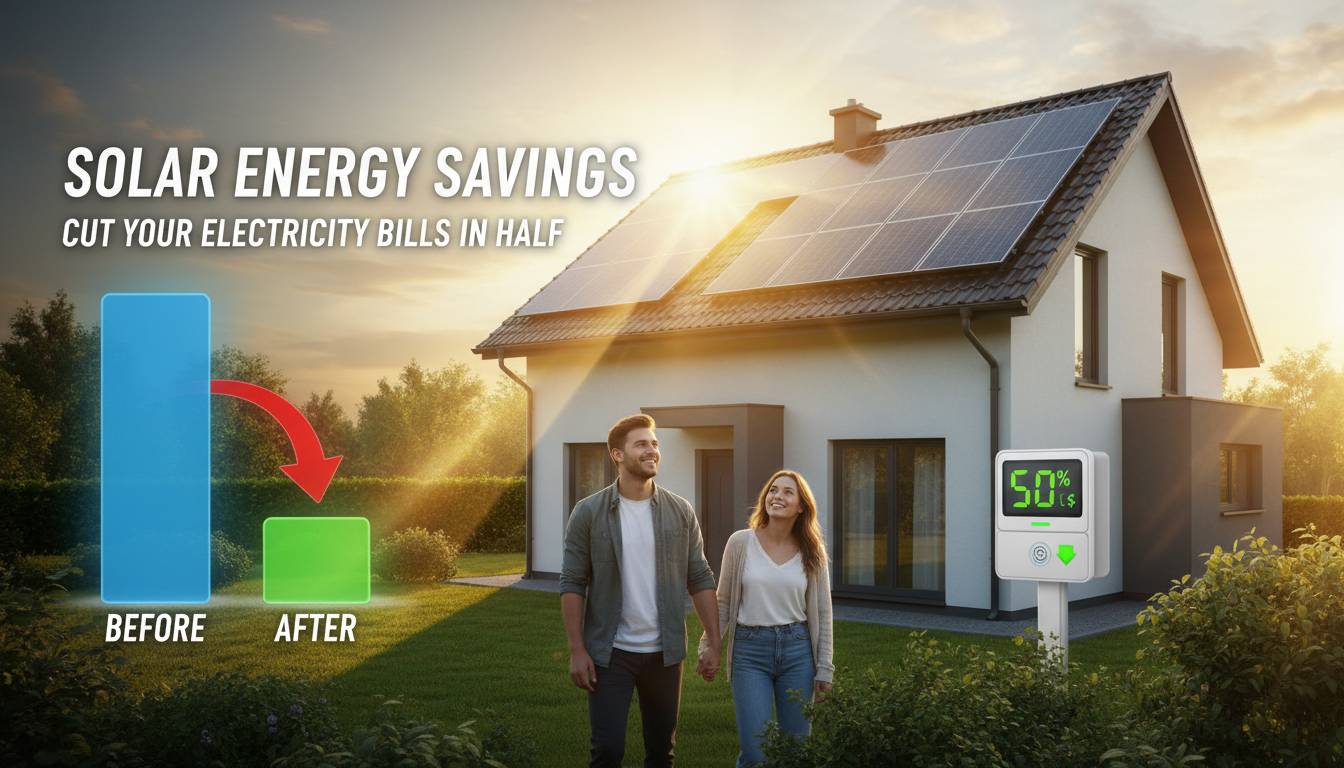
Switching to solar energy represents one of the most significant financial decisions homeowners can make in the modern era. With electricity rates climbing an average of 4-5% annually across the United States, solar panels offer a pathway to dramatically reduce—or potentially eliminate—your monthly utility bills while protecting yourself from future rate increases. The combination of falling solar panel costs, generous federal tax incentives, and net metering programs has created an unprecedented opportunity for American homeowners to take control of their energy costs.
How Solar Energy Reduces Your Electricity Bills
Solar energy savings work through a straightforward mechanism: photovoltaic panels convert sunlight into electricity that powers your home’s appliances, lighting, and climate control systems. When your solar system produces more electricity than your home consumes, the excess flows back into the grid, earning you credits through net metering programs offered by most utility companies.
Key Insights
– The average American household spends approximately $175 per month on electricity, totaling $2,100 annually
– A properly sized solar system can offset 70-100% of typical household electricity consumption
– Solar panels continue generating electricity for 25-30 years with minimal performance degradation
– The federal investment tax credit allows you to deduct 30% of solar installation costs from your federal taxes
The financial mathematics becomes compelling when you project these savings over the lifetime of your solar system. After accounting for the initial investment, most homeowners experience full return on their solar investment within 6-10 years, followed by a decade or more of essentially free electricity. This translates to $15,000-$30,000 in cumulative savings over a typical 25-year panel warranty period.
Calculating Your Solar Savings Potential
Before investing in a solar energy system, you need accurate estimates tailored to your specific situation. Several online calculators provide preliminary savings projections, but understanding the underlying factors ensures more accurate predictions.
| Factor | Impact on Savings |
|---|---|
| Monthly electricity bill ($) | Higher bills = greater savings potential |
| Roof orientation (south-facing ideal) | Optimal placement increases output 15-25% |
| Local electricity rates | Higher rates = faster payback |
| System size (kW) | Larger systems offset more consumption |
| Shading/roof space | Obstructions reduce efficiency |
The average residential solar system in the United States is sized between 5 and 10 kilowatts, with most homeowners choosing 6-8 kW systems. For reference, a 7 kW system produces approximately 28-35 kWh per day in optimal conditions, which closely matches the daily consumption of a typical American household.
To calculate your potential savings, multiply your current annual electricity costs by the expected system lifespan (typically 25 years), then subtract the total investment including installation, equipment, and maintenance. Dividing your net savings by the payback period reveals your actual return on investment, which often exceeds 10-15% annually—significantly better than most traditional investment vehicles.
Factors That Affect Your Solar Savings
While solar energy offers substantial savings potential, numerous variables influence your actual results. Understanding these factors helps set realistic expectations and optimize your system’s performance.
Roof Characteristics and Orientation
South-facing roofs in the Northern Hemisphere receive the maximum solar irradiance, producing 15-25% more electricity than east or west-facing installations. Roof pitch also affects performance—steeper angles work better in northern latitudes with lower sun angles, while flatter roofs suit southern regions. The age and condition of your roof matter too; installing solar panels on older roofs may require premature removal and reinstallation during replacement.
Local Climate and Sunlight Hours
States like Arizona, California, Nevada, and New Mexico enjoy abundant sunshine, generating more kilowatt-hours per installed watt. However, solar panels produce electricity even on cloudy days—typically 10-25% of their rated output—making solar viable across most of the continental United States. Northeastern states with lower sunlight hours still achieve meaningful savings, though slightly larger systems may be necessary.
Electricity Rate Structure
Your utility company’s rate structure significantly impacts solar savings. Time-of-use pricing, where electricity costs more during peak afternoon hours, actually benefits solar owners since panels produce the most power during those expensive periods. Understanding whether your utility offers true net metering, modified net metering, or buy-all-sell-all compensation determines how much you receive for excess production.
System Efficiency and Degradation
Modern solar panels degrade at approximately 0.5-0.8% annually, meaning after 25 years, your system will still produce roughly 80-88% of its original output. Choosing quality equipment from established manufacturers ensures your system maintains performance throughout its lifespan. Inverter replacement, typically required after 10-15 years, represents the primary maintenance expense beyond occasional panel cleaning.
Solar Panel Costs vs. Long-Term Savings
The financial case for solar has strengthened dramatically over the past decade. According to the Solar Energy Industries Association, the average cost of a residential solar system has dropped from over $40,000 in 2010 to approximately $20,000-$25,000 after federal tax credits in 2024. This 50% price reduction, combined with rising electricity rates, has transformed solar from an environmental luxury into a sound financial investment.
Typical Cost Breakdown (7 kW System)
– Solar panels and mounting equipment: $12,000-$15,000
– Inverter (string or microinverters): $2,000-$4,000
– Installation labor and permits: $4,000-$7,000
– Optional battery storage: $8,000-$15,000
– Total before incentives: $20,000-$30,000
– Federal tax credit (30%): $6,000-$9,000
– Net cost after credit: $14,000-$21,000
Against this $14,000-$21,000 investment, homeowners typically save $1,500-$2,500 annually on electricity bills, depending on their location and consumption patterns. This produces a payback period of 7-10 years, with 15-20 years of essentially free electricity thereafter. Over a 25-year analysis period, cumulative savings typically range from $20,000 to $40,000.
The economics become even more attractive when you consider that electricity rates have increased an average of 4-5% annually over the past two decades with no indication of slowing. While your solar payment remains fixed (if financed) or zero (if purchased outright), utility rates continue climbing, effectively increasing your savings each year.
Maximizing Your Solar Investment
Strategic decisions during and after installation significantly impact your total savings. Consider these optimization approaches to extract maximum value from your solar energy system.
Panel Placement and Quality
Invest in high-efficiency panels from Tier 1 manufacturers, which offer better performance guarantees and longer warranties. While premium panels cost more upfront, their superior degradation rates and efficiency ratings produce greater lifetime savings. Positioning panels to avoid partial shading—even from nearby trees or chimneys—prevents hot spots that reduce output.
Energy Efficiency Improvements
Combining solar with energy efficiency upgrades amplifies your savings. Before installing solar, conduct an energy audit to identify major consumption sources. Upgrading to LED lighting, high-efficiency HVAC systems, and Energy Star appliances reduces your required system size while lowering overall energy consumption.
Battery Storage Integration
Adding solar batteries like the Tesla Powerwall or LG Chem RESU allows you to store excess daytime production for evening use. While batteries increase upfront costs by $8,000-$15,000, they provide backup power during outages and maximize self-consumption, reducing reliance on grid electricity even further. Several states offer battery incentive programs that offset a portion of storage costs.
Monitoring and Maintenance
Most modern solar systems include smartphone monitoring that tracks daily production and consumption. Regularly cleaning panels—particularly in dusty climates or after pollen seasons—maintains optimal efficiency. Annual professional inspections identify potential issues before they impact performance.
Federal and State Solar Incentives
The federal government and many state utilities offer substantial incentives that accelerate your solar payback timeline.
Federal Investment Tax Credit (ITC)
The ITC allows homeowners to deduct 30% of their solar installation costs from federal taxes through 2032, stepping down to 26% in 2033 and 22% in 2034. This credit applies to the total system cost including panels, inverters, mounting equipment, installation labor, and permitted batteries. You can claim the credit whether you own your system outright or finance it through a solar loan.
State and Local Incentives
Beyond federal benefits, many states offer additional incentives:
| State | Notable Incentives |
|---|---|
| California | Net metering, state tax credits, local utility rebates |
| Massachusetts | SMART incentive program, state tax credit |
| New Jersey | SREC program, rebates from utilities |
| New York | NY-Sun incentive, state tax credit |
| Arizona | Net metering, utility rebates |
Many municipalities also offer property tax exemptions for solar installations, preventing increased property assessments from offsetting your energy savings. The Database of State Incentives for Renewables and Efficiency (DSIRE) provides comprehensive listings for all available programs in your area.
Real-World Solar Savings Examples
Actual homeowner experiences illustrate the tangible benefits of solar energy adoption.
California Family of Four
The Martinez family in Sacramento installed a 7.2 kW system in 2021 at a net cost of $18,500 after federal tax credits. Their previous annual electricity bills averaged $2,400. After going solar, their average monthly utility cost dropped to $25 (connection fee only), saving approximately $2,375 annually. Their 25-year projected savings exceed $55,000, with their system fully paid off within 7.5 years.
New Jersey Suburban Homeowners
The Thompson household in Monmouth County installed a 9.8 kW system in 2020 with a net cost of $22,000. Their previous annual electricity costs were $3,100. Through net metering credits and minimal grid dependence, they now pay roughly $50 per month total, saving approximately $2,700 annually. Their payback period is approximately 8 years, with lifetime savings projected at $65,000.
Texas Ranch Home
The Johnson family in Austin opted for a 10 kW system with battery backup in 2022, spending $28,000 after incentives. Their former annual electricity costs of $2,800 have been reduced to approximately $400 per year (minimal grid connection plus battery maintenance), saving $2,400 annually. Texas’s high electricity rates and generous net metering policies accelerate their return on investment.
Frequently Asked Questions
How much do solar panels cost for an average home?
The average residential solar system costs between $15,000 and $25,000 after applying the 30% federal tax credit. A typical 6-8 kW system, suitable for most American homes, runs $20,000-$30,000 before incentives. Prices vary based on system size, panel quality, installation complexity, and local market conditions.
How long does it take for solar panels to pay for themselves?
Most homeowners achieve full payback within 6-10 years, depending on electricity rates, system cost, available incentives, and energy consumption patterns. After the payback period, solar produces electricity at no additional cost for the remaining 15-20 years of the system warranty.
Do solar panels work on cloudy days?
Yes, solar panels generate electricity even under cloud cover, typically producing 10-25% of their rated output. While direct sunlight produces maximum power, diffuse light still allows meaningful energy generation. Homes in traditionally cloudy regions like the Pacific Northwest can still benefit from solar, though slightly larger systems may be necessary.
What happens to my electricity bill with solar?
With net metering, your solar system offsets your electricity consumption, and any excess production earns credits. Most solar homeowners pay only a small monthly connection fee ($10-$25) to remain connected to the grid for backup power. Some households achieve $0 monthly bills or even receive small credits from their utilities.
Will solar increase my property value?
Multiple studies indicate that homes with solar panels sell for approximately 4-5% more than homes without solar. The National Renewable Energy Laboratory found that every dollar saved on electricity adds approximately $20 to property value, making solar a sound investment for homeowners planning to sell.
What is the federal tax credit for solar in 2024?
The federal solar investment tax credit allows homeowners to deduct 30% of their solar installation costs from federal taxes in 2024. This applies to systems installed through 2032, with the credit stepping down to 26% in 2033 and 22% in 2034. The credit can be claimed whether you purchase your system outright or finance it through a solar loan.
Conclusion
Solar energy has matured into a financially sound investment offering predictable, long-term savings for American homeowners. With the 30% federal tax credit available through 2032, electricity rates continuously climbing, and solar technology costs at historic lows, the economic case for residential solar has never been stronger. Most homeowners can expect to cut their electricity bills in half—or eliminate them entirely—while protecting against future utility rate increases.
The key to maximizing your solar investment lies in careful planning: accurately assessing your energy consumption, obtaining multiple competitive bids from reputable installers, understanding available local incentives, and optimizing your system’s design for your specific roof and climate conditions. Whether you choose to purchase your system outright, finance through a solar loan, or opt for a power purchase agreement, the fundamental math remains compelling.
Making the switch to solar energy represents more than a financial decision—it positions you as part of America’s clean energy transition while securing predictable, escalating savings for decades to come. The technology works, the economics make sense, and the time to act is now while federal incentives remain at their most generous levels.