Hydropower generates electricity by using the natural force of flowing or falling water to spin turbines connected to generators. This technology converts the kinetic energy of water into mechanical energy, then transforms it into electrical energy through electromagnetic induction. As one of the oldest and most reliable renewable energy sources, hydropower provides approximately 6% of total U.S. electricity generation and serves as a cornerstone of the nation’s clean energy portfolio. Understanding how hydropower works reveals why it remains vital to America’s energy independence and climate goals.
The Fundamentals of Hydropower
The principle behind hydropower is elegantly simple: water in motion possesses kinetic energy that can be captured and converted into electricity. This process harnesses the hydrologic cycle, where the sun evaporates water from oceans, lakes, and rivers, forming clouds that precipitate water back to Earth, creating continuous flow in waterways. Hydropower facilities capture a portion of this natural energy flow, converting it into usable power without consuming the water itself.
The fundamental equation for hydropower power generation depends on two primary factors: flow rate (the volume of water passing through the turbine per second) and head (the vertical distance the water falls). The power output increases with both higher flow rates and greater vertical drops. This relationship is expressed mathematically as Power = ηρgQH, where η represents efficiency, ρ is water density, g represents gravitational acceleration, Q is flow rate, and H is the head height. Engineers use this formula to design facilities that maximize energy capture from available water resources.
Water density plays a crucial role in hydropower’s efficiency compared to other energy sources. At 1,000 kilograms per cubic meter, water is approximately 800 times denser than air, meaning even modest water flows generate substantial power. A single gallon of water falling one foot produces enough energy to light a 1-watt LED bulb for about 10 seconds. When scaled to industrial levels, the energy potential becomes enormous, which is why hydropower has been economically competitive for over a century.
How a Hydroelectric Plant Generates Electricity
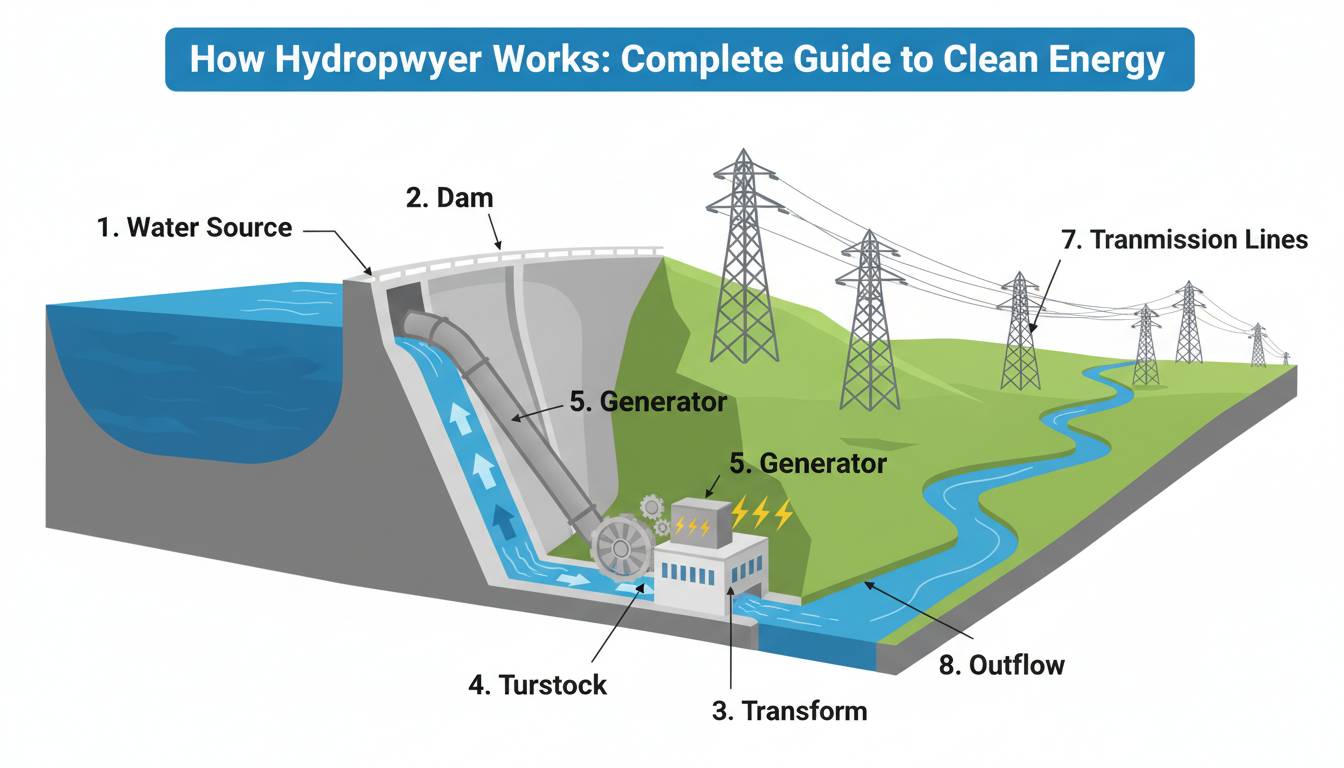
The electricity generation process at a hydroelectric plant follows a carefully orchestrated sequence of energy conversions. Water from a reservoir or river intake passes through intake structures designed to screen out debris and fish. This water then travels through penstocks—large pipes that direct the flow downward toward the turbines. The combination of gravity and the design of these intake systems creates the pressure and flow needed to spin the turbine blades efficiently.
Turbines represent the heart of any hydroelectric facility. The three primary turbine designs each optimize different water conditions. Francis turbines, the most common type, work effectively with moderate heads and flows, featuring blades that capture water flowing through them. Kaplan turbines suit locations with lower heads but high flow rates, using adjustable blades for optimal performance. Pelton turbines excel in high-head applications where water arrives at high pressure from significant vertical drops, utilizing nozzle-directed jets that strike cup-shaped buckets.
Once the turbine spins, it connects directly to a generator through a rotating shaft. The generator contains copper wire coils within powerful magnetic fields. As the coils rotate, electrons move through the wire, creating an electrical current through electromagnetic induction—the same principle discovered by Michael Faraday in 1831. This generated electricity typically produces three-phase alternating current at frequencies matching the power grid requirements (60 Hz in the United States).
Transformers then increase the voltage for efficient transmission over long distances. Transmission lines carry this electricity across the grid to substations, where voltage decreases for distribution to homes and businesses. The entire process from water flow to usable electricity occurs almost instantaneously, with facilities capable of ramping power output up or down within minutes—far faster than thermal power plants that require hours to adjust.
Types of Hydroelectric Power Systems
Hydroelectric facilities vary significantly based on their location, water source, and operational characteristics. Understanding these distinctions helps explain why hydropower can be adapted to diverse geographic and economic contexts.
Reservoir (Run-of-River) Hydroelectricity stores water behind dams, creating large reservoirs that serve as natural batteries. These facilities control water release to match electricity demand, providing dispatchable power that grid operators value highly. The reservoir also enables pumped storage, where water can be recycled between upper and lower reservoirs during off-peak hours to store excess electricity for later use. This makes reservoir hydropower essential for grid stability and renewable integration.
Run-of-River Facilities generate electricity without large reservoirs, instead diverting a portion of a river’s flow through turbines and returning water downstream. These projects typically have smaller environmental footprints than dam-based facilities but provide less storage capacity. Many run-of-river installations serve remote communities or industrial operations where connection to the main grid proves impractical.
Pumped Storage Hydroelectricity operates like a giant rechargeable battery, moving water between reservoirs at different elevations to store and generate electricity on demand. During periods of low electricity demand (typically overnight), pumps move water from the lower reservoir to the upper reservoir. When electricity demand peaks, water flows back down through turbines, generating power within seconds. The United States operates approximately 40 pumped storage facilities, providing about 95% of the nation’s grid energy storage capacity.
Tidal and In-Stream Hydroelectric Systems represent emerging technologies that capture energy from ocean currents and tidal movements. While still nascent compared to traditional hydropower, these technologies offer predictable, renewable power generation in coastal regions. Several pilot projects operate in U.S. waters, exploring whether marine hydrokinetic energy can contribute meaningfully to the renewable energy mix.
The Environmental and Economic Benefits
Hydropower offers compelling advantages that explain its enduring role in U.S. energy policy. As a renewable resource, it produces electricity without burning fossil fuels, generating zero direct carbon emissions during operation. The U.S. Energy Information Administration reports that hydropower prevents approximately 200 million metric tons of carbon dioxide emissions annually—equivalent to removing 40 million cars from the road. This climate benefit positions hydropower as essential for achieving national decarbonization targets.
The economic advantages extend beyond emissions reduction. Once constructed, hydroelectric facilities operate with remarkably low fuel costs since water flows freely from natural hydrology. Operational and maintenance expenses are predictable, and facilities routinely operate for 50-100 years with proper maintenance—far exceeding the 20-30-year lifespans typical of thermal power plants. This longevity provides stable, long-term electricity pricing that benefits consumers and utilities alike.
Hydropower facilities also provide valuable ecosystem services beyond electricity generation. Reservoirs create recreational opportunities for boating, fishing, and wildlife habitat. Many dams include fish ladders and other passage systems that support migratory fish populations. Additionally, controlled water releases can manage downstream flooding, regulate river temperatures for aquatic species, and maintain minimum flow levels that protect ecosystem health.
| Hydropower Benefits | Impact |
|---|---|
| U.S. electricity generation | ~6% of total (40-45% of renewable) |
| Annual emissions avoided | ~200 million metric tons CO2 |
| Facility lifespan | 50-100 years |
| Grid storage capacity provided | ~95% of U.S. energy storage |
Major Hydropower Plants in the United States
The United States hosts the world’s second-largest hydropower capacity, with over 2,500 hydroelectric facilities operating across the nation. Understanding these installations illustrates the scale and diversity of American hydropower.
Grand Coulee Dam on the Columbia River in Washington state represents the nation’s largest hydroelectric facility and one of the largest concrete structures ever built. Completed in 1942 and expanded in subsequent decades, Grand Coulee produces approximately 21 billion kilowatt-hours annually—enough to power nearly 2 million homes. The dam’s six generators have a combined capacity of 6,809 megawatts, making it the fifth-largest power plant of any type in the world.
The Hoover Dam, constructed between 1931 and 1936, stands as an engineering marvel and continues generating clean electricity 90 years after its completion. Located on the border between Nevada and Arizona, Hoover Dam’s 17 turbines produce about 4 billion kilowatt-hours yearly from the Colorado River’s flow. The dam also created Lake Mead, the largest reservoir in the United States by volume.
Bath County Pumped Storage Station in Virginia holds the distinction of being the largest pumped storage facility in the world. With a generation capacity of 3,003 megawatts, Bath County can respond to grid fluctuations within seconds, providing critical reliability services that support wind and solar integration across the eastern United States.
Challenges and Limitations
Despite its benefits, hydropower faces significant challenges that constrain future growth. Environmental concerns rank foremost among these limitations. Dams alter natural river ecosystems, blocking migratory fish passages, changing water temperatures, and modifying downstream flow patterns. Some species, including several salmon populations in the Pacific Northwest, have declined dramatically due to habitat fragmentation from hydroelectric dams.
Climate change introduces additional uncertainty for hydropower operations. Shifting precipitation patterns affect water availability in many river basins, while earlier spring snowmelt and changing runoff timing complicate reservoir management. The western United States has experienced prolonged droughts that reduced hydroelectric generation significantly, demonstrating the resource’s vulnerability to changing hydrological conditions.
Regulatory complexity creates substantial development barriers. New hydroelectric projects require extensive environmental reviews, permits from multiple federal and state agencies, and consultation with Indigenous communities whose ancestral lands and fishing rights may be affected. These requirements, while essential for environmental protection, extend project timelines and increase development costs substantially.
The Future of Hydropower
The hydropower industry pursues multiple pathways to expand generation while addressing environmental concerns. Modernization of existing facilities offers the most immediate opportunity, as many dams built in the mid-20th century are candidates for efficiency upgrades. Installing newer turbine designs, adding generating capacity, and modernizing control systems can increase output by 10-15% at existing facilities without new environmental impacts.
Low-Impact Hydropower certifications encourage environmental stewardship among facility operators. The Low Impact Hydropower Institute provides certification for facilities meeting stringent criteria for fish passage, water quality, recreation, and heritage protection. Certified facilities gain marketing advantages that reward responsible operations.
Marine Hydrokinetic Technology development advances steadily, with wave energy converters, tidal turbines, and in-stream generators reaching commercial viability. While current contributions remain modest, the vast potential of ocean energy could eventually supplement traditional hydropower significantly.
Frequently Asked Questions
How efficient is hydropower compared to other energy sources?
Hydroelectric plants achieve typical efficiency rates of 85-95%, meaning they convert a higher percentage of available energy into electricity than any other major power generation technology. Fossil fuel power plants average 33-45% efficiency, while even combined-cycle natural gas turbines reach only 60%.
Does hydropower require a dam to work?
No, hydropower does not necessarily require a dam. Run-of-river facilities generate electricity by diverting a portion of a river’s flow through turbines without creating large reservoirs. However, dams enable water storage that provides reliable, dispatchable power and grid stabilization capabilities.
How much electricity can a single hydroelectric turbine produce?
Turbine capacity varies enormously based on head height and flow rate. Small turbines might generate 100 kilowatts, enough for a few dozen homes. The largest turbines at facilities like Grand Coulee produce over 600 megawatts each—sufficient to power half a million homes.
Is hydropower truly renewable?
Yes, hydropower is considered renewable because it relies on the continuous hydrologic cycle powered by solar energy. Water evaporates, forms clouds, precipitates, and returns to rivers and reservoirs in an endless loop. The water itself is not consumed; only its energy is captured.
Can hydropower help stabilize the electrical grid?
Absolutely. Hydroelectric facilities can ramp power output up or down within minutes, providing crucial load-following and frequency regulation services. Pumped storage facilities offer even faster response times, making them invaluable for integrating variable wind and solar generation.
What happens to fish at hydroelectric dams?
Modern facilities incorporate various fish protection measures. Fish ladders help migratory species bypass dams, while screens and bypass systems guide fish away from turbine intakes. Some facilities even transport fish around dams via trucks or barges. However, fish mortality rates remain a concern, and ongoing research continues improving passage technologies.
Conclusion
Hydropower transforms the perpetual motion of Earth’s water cycle into reliable, renewable electricity through a remarkably elegant combination of gravity, turbine mechanics, and electromagnetic principles. From massive facilities like Grand Coulee to modest run-of-river installations, hydroelectric power provides stable, low-carbon electricity that anchors the American renewable energy portfolio. While environmental challenges and climate uncertainties require ongoing attention, continued modernization and emerging technologies position hydropower to remain essential to U.S. clean energy goals for decades to come. Understanding how hydropower works empowers consumers and policymakers to appreciate this mature technology’s continued relevance in a rapidly evolving energy landscape.