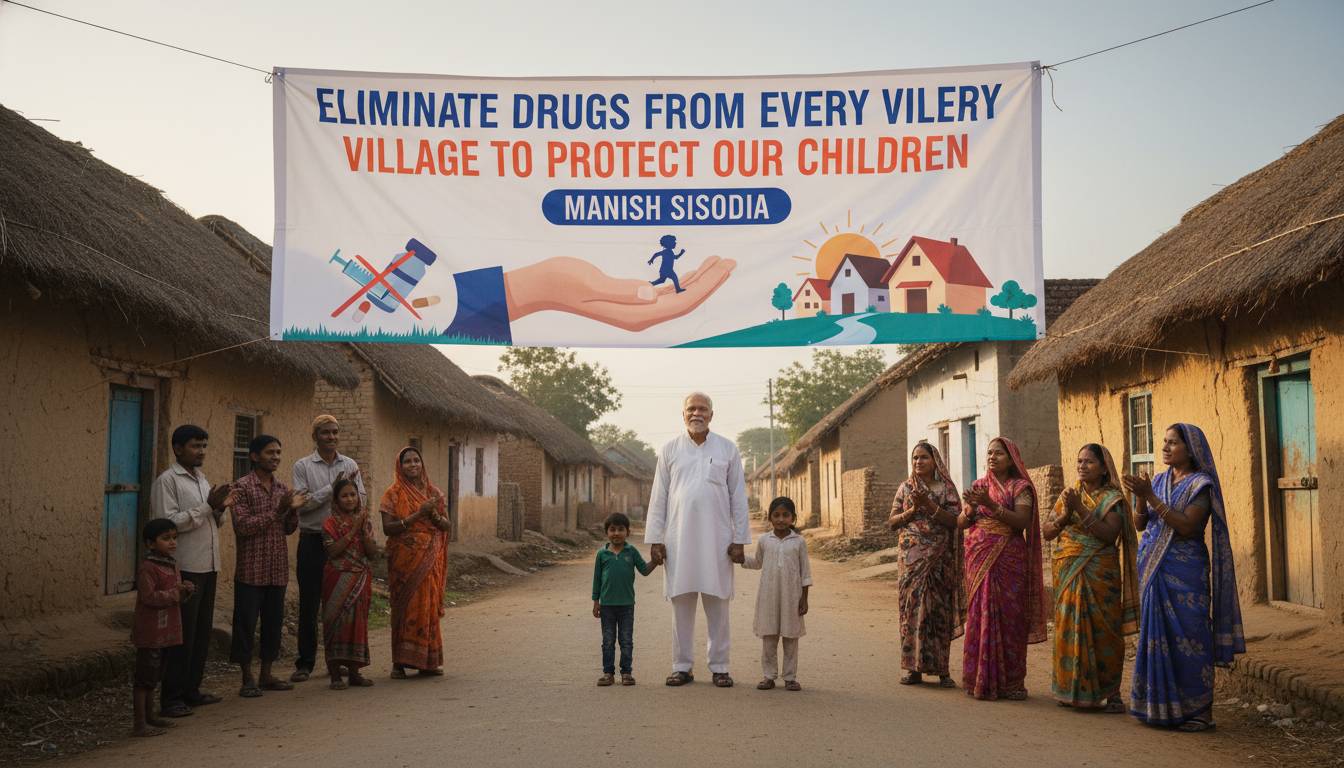
Aam Aadmi Party leader Manish Sisodia said Punjab’s anti-drug drive is “not a one-day fight” but a sustained “Yudh Nashean Virudh,” calling for drugs to be eliminated from every village to protect children’s future. His remarks come amid the Punjab government’s broader campaign against narcotics, which party leaders say has expanded from enforcement to village-level mobilization and school outreach, according to Indian Express, Hindustan Times, The Week, and other published reports in 2025 and 2026.
ℹ️
Core message:
Sisodia’s statement frames Punjab’s anti-drug effort as a long-duration social campaign, not a single-day event, with village participation and child protection at the center of the political message. Source: Indian Express coverage of the campaign and related public remarks in 2025; The Week report published February 16, 2026.
How Sisodia framed the anti-drug campaign in Punjab
Manish Sisodia’s statement fits into the language used by the Aam Aadmi Party and the Punjab government around the “Yudh Nashean Virudh” campaign, translated as a war against drugs. Published reports show party leaders repeatedly presenting the campaign as a statewide effort that requires village-level participation, public vigilance, and long-term pressure on traffickers rather than a symbolic event.
Indian Express reported in 2025 that Sisodia said the Punjab government and the AAP organization would jointly run a campaign against drugs in “mission mode” to make the state drug-free. The same report said block presidents were tasked with visiting villages and spreading the message that drug peddlers would not be allowed to operate there. That language closely matches the theme in the statement highlighted here: the fight is continuous, local, and tied to the safety of future generations.
Key Published References to the Campaign
| Source | Published | Key Detail |
|---|---|---|
| Indian Express | 2025 | Reported Sisodia said the anti-drug campaign would run in mission mode across Punjab, including villages. |
| Hindustan Times | 2025 | Reported anti-drug curriculum rollout for more than 8 lakh students in Classes 9 to 12 under the campaign. |
| The Week | February 16, 2026 | Reported AAP leaders promoted the campaign at a state-level event and said it began on March 1, 2025. |
| The Tribune | 2025 | Reported village and ward defense committees were formed to monitor drug-related activity. |
Source: Indian Express, Hindustan Times, The Week, The Tribune | accessed March 21, 2026
The emphasis on children is also consistent with other campaign messaging. Hindustan Times reported that Punjab launched an anti-drug curriculum in schools under the same campaign, aimed at sensitizing more than 8 lakh students in Classes 9 to 12 about the dangers of addiction. That school-focused component gives policy context to Sisodia’s argument that eliminating drugs from villages is necessary to secure children’s future.
March 1, 2025 to February 16, 2026: the timeline behind “Yudh Nashean Virudh”
The anti-drug campaign has developed in phases rather than through a single announcement. The Week reported on February 16, 2026 that Arvind Kejriwal said the “Yudh Nashian Virudh” campaign began on March 1, 2025. Over the following months, media reports described public meetings, village outreach, school programs, and declarations by local communities that they were moving toward or had achieved drug-free status.
Campaign Timeline
March 1, 2025: The anti-drug campaign “Yudh Nashian Virudh” begins, according to remarks reported by The Week on February 16, 2026.
April 2025: Reports describe the campaign as a mass movement in villages, with local resolutions and public participation highlighted in regional coverage.
Mid-2025: Indian Express reports Sisodia and other AAP leaders expand anti-drug messaging into urban Punjab while maintaining village outreach.
Mid-2025: Hindustan Times reports Punjab launches an anti-drug curriculum targeting more than 8 lakh students in Classes 9 to 12.
February 16, 2026: The Week reports a state-level event promoting the campaign, attended by Kejriwal, Bhagwant Mann, and Manish Sisodia.
This timeline matters because it shows the statement is part of an ongoing political and administrative narrative. Sisodia’s wording does not stand alone. It sits within a broader campaign that combines policing, public messaging, school-based prevention, and local committees.
Separately, The Tribune reported that village defense committees and ward defense committees were formed to monitor drug-related activities. That detail supports the village-centered framing in Sisodia’s statement. If the campaign’s operational model depends on local committees, then the call to eliminate drugs from every village is not just rhetorical. It reflects the structure the government and party have publicly promoted.
What village-level enforcement and school outreach signal
The campaign’s public architecture has two visible pillars: local vigilance and youth prevention. The village side includes defense committees, sarpanch-led resolutions, and public pledges. The education side includes curriculum-based awareness in schools and repeated messaging that addiction threatens families and the next generation.
📊
Education scale:
Hindustan Times reported that Punjab’s anti-drug curriculum under “Yudh Nashian Virudh” targeted more than 8 lakh students in Classes 9 to 12, showing the campaign extends beyond policing into prevention.
Hindustan Times said the school initiative aimed to sensitize students to the perils of drug addiction. The report also noted a related push to build gyms and playgrounds in villages, presented as a way to keep youth away from drug temptation. That is significant because it broadens the campaign from law enforcement to social intervention.
By comparison, The Tribune’s reporting on village and ward defense committees points to a decentralized monitoring model. Local bodies are expected to watch for drug-related activity and help prevent traffickers from regaining a foothold. In political terms, Sisodia’s statement draws these strands together: villages are the frontline, and children are the reason the campaign must continue.
Why the statement matters beyond a single speech
The phrase “this isn’t a one-day fight” is politically important because it sets expectations. It suggests the campaign should be judged over time, not by one rally or one police action. It also places responsibility on both the state and local communities. Indian Express reported that AAP leaders described the campaign as one that the government and party organization would run together. That dual structure means the message is designed to travel through administration and party networks at the same time.
There is also a broader communications pattern. Multiple reports from 2025 and 2026 use similar language about saving Punjab’s youth, protecting families, and making every village drug-free. Sisodia’s statement therefore reinforces a recurring campaign line rather than introducing a new policy. The verifiable takeaway is not a fresh law or a newly disclosed statistic. It is the continued positioning of anti-drug action as a statewide, village-driven, child-focused effort.
Campaign Components Mentioned in Published Reports
| Component | Description | Reported By |
|---|---|---|
| Village outreach | Party workers and leaders visit villages to spread anti-drug messaging. | Indian Express |
| Defense committees | Village and ward committees monitor drug-related activities. | The Tribune |
| School curriculum | Anti-drug lessons target more than 8 lakh students in Classes 9-12. | Hindustan Times |
| State-level events | Senior AAP leaders publicly promote the campaign. | The Week |
Source: Named media reports | accessed March 21, 2026
For readers outside India, the key context is that Punjab has long faced political and social debate over narcotics, youth addiction, and trafficking. In this setting, statements like Sisodia’s are aimed at showing continuity, local accountability, and a family-centered rationale for anti-drug policy.
Frequently Asked Questions
What did Manish Sisodia say about drugs in villages?
Sisodia said the anti-drug effort is not a one-day fight but a continuing “Yudh Nashean Virudh,” and that drugs must be eliminated from every village to secure children’s future. The wording aligns with campaign themes reported by Indian Express and other outlets in 2025 and 2026.
What is “Yudh Nashean Virudh”?
It is the name used for Punjab’s anti-drug campaign. The Week reported on February 16, 2026 that Arvind Kejriwal said the campaign began on March 1, 2025. Media coverage describes it as combining public outreach, enforcement messaging, and youth-focused prevention.
Is the campaign focused only on policing?
No. Published reports show it also includes prevention and community participation. Hindustan Times reported an anti-drug curriculum for more than 8 lakh students, while The Tribune reported village and ward defense committees to monitor local drug-related activity.
Why does the statement emphasize children’s future?
The campaign consistently links drug abuse to harm to youth, families, and long-term social stability. That framing appears in multiple reports and is reinforced by school-based awareness efforts and village-level messaging intended to keep children away from addiction.
Did Sisodia announce a new law or policy in this statement?
Based on the publicly available reports reviewed here, the statement appears to reinforce the existing anti-drug campaign narrative rather than announce a new law. The emphasis is on sustained implementation, village participation, and child protection.
Disclaimer: This article is for informational purposes only. Information may have changed since publication. Always verify information independently and consult qualified professionals for specific advice.