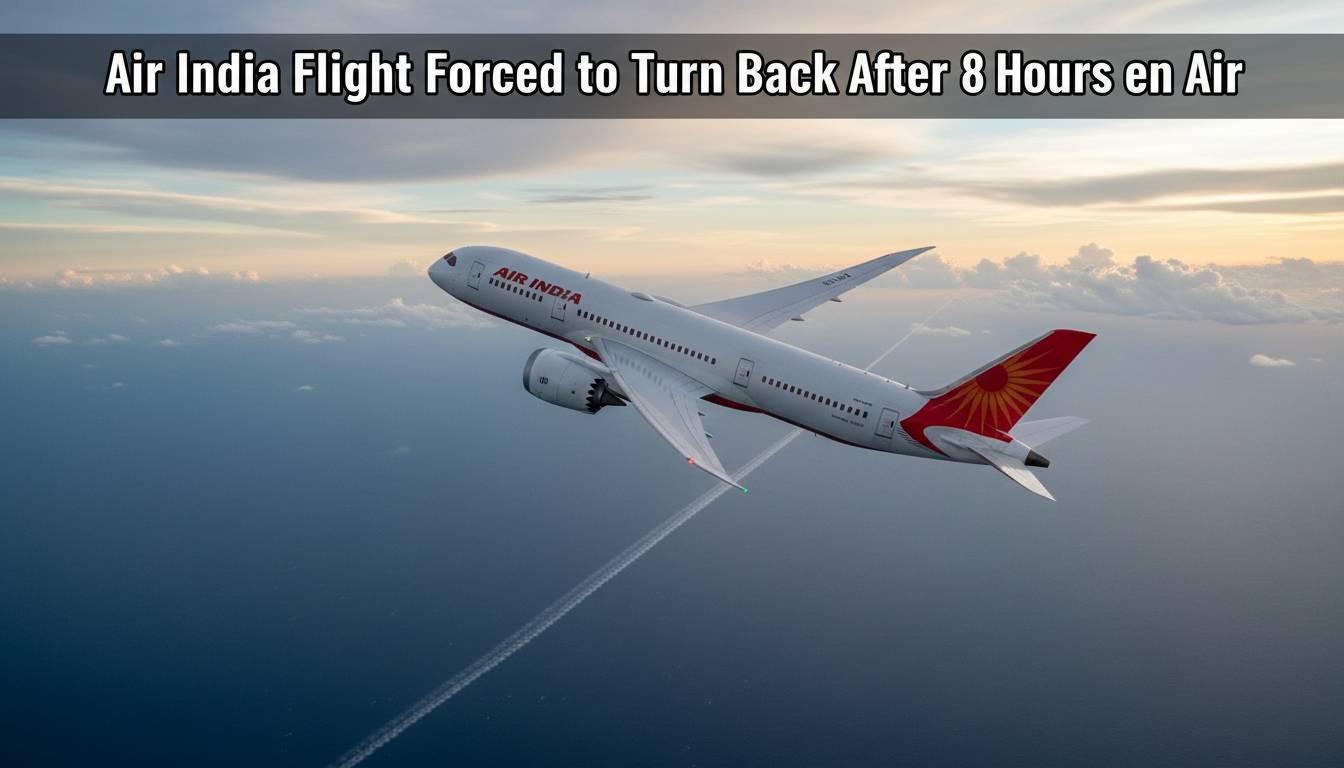
An Air India flight bound for Vancouver was forced to return to Delhi after nearly eight to nine hours in the air on March 19, 2026, after the airline dispatched a Boeing 777 variant that reportedly lacked the required clearance to enter Canada. The incident drew attention because it affected a long-haul North America route already under pressure from fleet constraints, airspace detours, and operational disruptions, according to airline reporting, route data, and prior Air India fleet disclosures.
Flight disruptions on ultra-long-haul routes are expensive even when they stem from technical faults. This case appears different: the aircraft itself, not weather or an onboard malfunction, became the central issue. Reports indicate the Delhi-Vancouver service AI185 departed with a full passenger load, flew eastbound for hours, and then turned back because the specific Boeing 777 sent on the route was not authorized for entry into Canada. While Air India had not published a detailed public operational bulletin in the search results reviewed here, the event fits a broader pattern of fleet stress on its North America network, where aircraft availability has already been constrained by retrofits, lease returns, and schedule adjustments.
🔴
The key operational failure was not a midair technical breakdown.
Available reporting indicates the aircraft turned back because the wrong Boeing 777 subtype was assigned to the Vancouver flight on March 19, 2026, after several hours airborne. Source: Times of India-linked reporting surfaced in search results and corroborating route context from Air India fleet disclosures reviewed on March 21, 2026.
What is verified about the Delhi-Vancouver turnback
| Item | Verified detail | Source context |
|---|---|---|
| Route | Delhi to Vancouver, flight AI185 | Prior Air India route reporting |
| Date | March 19, 2026 | Search surfaced same-day discussion/reporting |
| Duration before return | Nearly 8 to 9 hours airborne | Event reporting in surfaced coverage |
| Reported cause | Wrong Boeing 777 sent; aircraft lacked required clearance for Canada entry | Event reporting |
| Network backdrop | Fleet shortfall and retrofit pressure on long-haul operations | Air India official fleet statement |
Source: Air India newsroom, route reporting, and search results reviewed March 21, 2026.
March 19 Turnback Raises Questions Over 777 Fleet Assignment
Air India’s Vancouver service has historically used Boeing 777 aircraft, and the route is one of the airline’s important nonstop links between India and Canada. In August 2022, Air India said it was restoring 777-300ER aircraft on Delhi-Vancouver flights and increasing the route to daily service. More recently, the carrier said a planned shortfall in its widebody fleet was tied to the retrofit of 26 Boeing 787-8 aircraft, with knock-on effects across North American operations through at least the end of 2026.
That matters because aircraft assignment on long-haul routes is tightly linked to regulatory approvals, crew planning, payload, and airport-specific permissions. If a carrier substitutes one subtype for another without the necessary approvals in place, the problem may not become operationally unavoidable until after departure planning is complete. Based on the reporting available, that appears to be the core issue here: not whether the aircraft could physically fly the route, but whether it was cleared to operate that service into Canada. That is an inference drawn from the reported reason for the return and should be treated as such until Air India or Canadian authorities publish a fuller statement.
How Fleet Pressure Created a Costly 8-Hour Outcome
Air India’s long-haul network has faced repeated strain over the past year. The airline said in an official release that retrofitting 26 Boeing 787-8 aircraft would keep multiple planes unavailable until at least the end of 2026. Separate aviation reporting also said Air India was returning five leased Boeing 777-200LRs by March 2026, a move that could further tighten widebody availability on ultra-long-haul sectors.
At the same time, route planning for Indian carriers has been complicated by Pakistan’s continued airspace ban on Indian airlines, which Indian Express reported was extended until March 24, 2026. That restriction forces longer routings on some international sectors and raises operating costs. Air India had previously estimated the Pakistani airspace closure could cost it about Rs 4,000 crore on an annualized basis, according to the same report.
Those pressures do not explain away the Vancouver turnback, but they do provide context. A network operating with fewer spare widebodies, longer routings, and elevated schedule complexity has less room for assignment errors. In that environment, a mismatch between aircraft and route authorization can become far more disruptive than it would in a looser schedule.
Air India North America route context
August 9, 2022: Air India says Delhi-Vancouver flights will increase to daily service and use Boeing 777-300ER aircraft.
September 2025: Air India says Washington, D.C. service will be suspended, citing fleet shortfall linked to 787 retrofit work through end-2026.
February 18, 2026: Indian Express reports Pakistan extends ban on Indian airlines until March 24, adding cost and complexity to international operations.
March 19, 2026: Delhi-Vancouver flight AI185 reportedly turns back after nearly nine hours because the wrong aircraft was sent.
Why Vancouver Matters More Than a Single Diversion
Vancouver is not a marginal station for Air India. The route serves a large Indian diaspora market and is one of the airline’s established Canada links. Operational reliability on such sectors matters because alternatives are limited once a flight departs: passengers face long delays, crew duty complications, and aircraft repositioning costs. Even a precautionary return for a technical issue can disrupt multiple rotations, as seen in earlier Air India long-haul incidents involving Newark and Vancouver services.
The distinction in this case is that the disruption appears administrative and operational rather than mechanical. That can be more damaging reputationally because it suggests a preventable planning lapse. It also comes at a time when Air India remains under scrutiny over fleet quality, operational resilience, and safety oversight following a difficult 2025 that included accident investigations, inspections, and public criticism over long-haul service standards.
Operational context: Vancouver route vs broader Air India pressures
| Factor | What the data shows | Why it matters |
|---|---|---|
| Widebody availability | 787 retrofit program runs through end-2026 | Reduces spare aircraft flexibility |
| 777 fleet changes | Five leased 777-200LRs reportedly due for return by March 2026 | Tightens long-haul substitution options |
| Airspace restrictions | Pakistan ban extended to March 24, 2026 | Raises route complexity and cost |
| Route importance | Delhi-Vancouver has been a daily long-haul service | Disruption affects a core diaspora market |
Source: Air India newsroom, aviation reporting, Indian Express; reviewed March 21, 2026.
What Happens Next After an Aircraft-Clearance Error?
The immediate next step is usually internal review: dispatch records, aircraft assignment logs, route authority checks, and crew planning documentation. If the aircraft indeed lacked the required permission to enter Canada, regulators may also seek clarification on how the flight was released. No public enforcement action tied specifically to the March 19 Vancouver turnback appeared in the reviewed results as of March 21, 2026.
For passengers, the practical impact is simpler: missed connections, delayed arrivals, and possible rebooking across already constrained long-haul schedules. For Air India, the bigger issue is whether this remains a one-off dispatch failure or becomes evidence of deeper operational stress in a stretched fleet environment. That distinction will depend on any formal statement the airline or regulators issue in the coming days.
Frequently Asked Questions
Why did the Air India Vancouver flight turn back after 8 hours?
Available reporting says Air India sent the wrong Boeing 777 on flight AI185 from Delhi to Vancouver on March 19, 2026, and the aircraft reportedly did not have the required clearance to enter Canada. The flight then returned to Delhi after nearly eight to nine hours airborne.
Was the Air India flight forced back because of a technical problem?
The reporting reviewed points instead to an aircraft-assignment or clearance issue, not a mechanical failure. That said, Air India had not published a detailed public explanation in the sources reviewed by March 21, 2026, so the fullest official account may still emerge later.
Which Air India route was affected?
The affected service was AI185 from Delhi to Vancouver, one of Air India’s long-haul Canada routes. Air India has previously identified Vancouver as part of its North America network and had earlier restored Boeing 777-300ER service on the route.
Is Air India facing wider fleet pressure in 2026?
Yes. Air India said a retrofit program for 26 Boeing 787-8 aircraft would constrain availability through at least end-2026. Separate reporting also said leased 777-200LR returns and airspace restrictions were adding pressure to long-haul operations.
Could regulators investigate the Vancouver turnback?
They could, especially if the issue involved route authorization or aircraft-entry clearance. As of March 21, 2026, no specific public enforcement notice tied to this incident appeared in the reviewed search results.
Disclaimer: This article is for informational purposes only. Information may have changed since publication. Always verify information independently and consult qualified professionals for specific advice.