
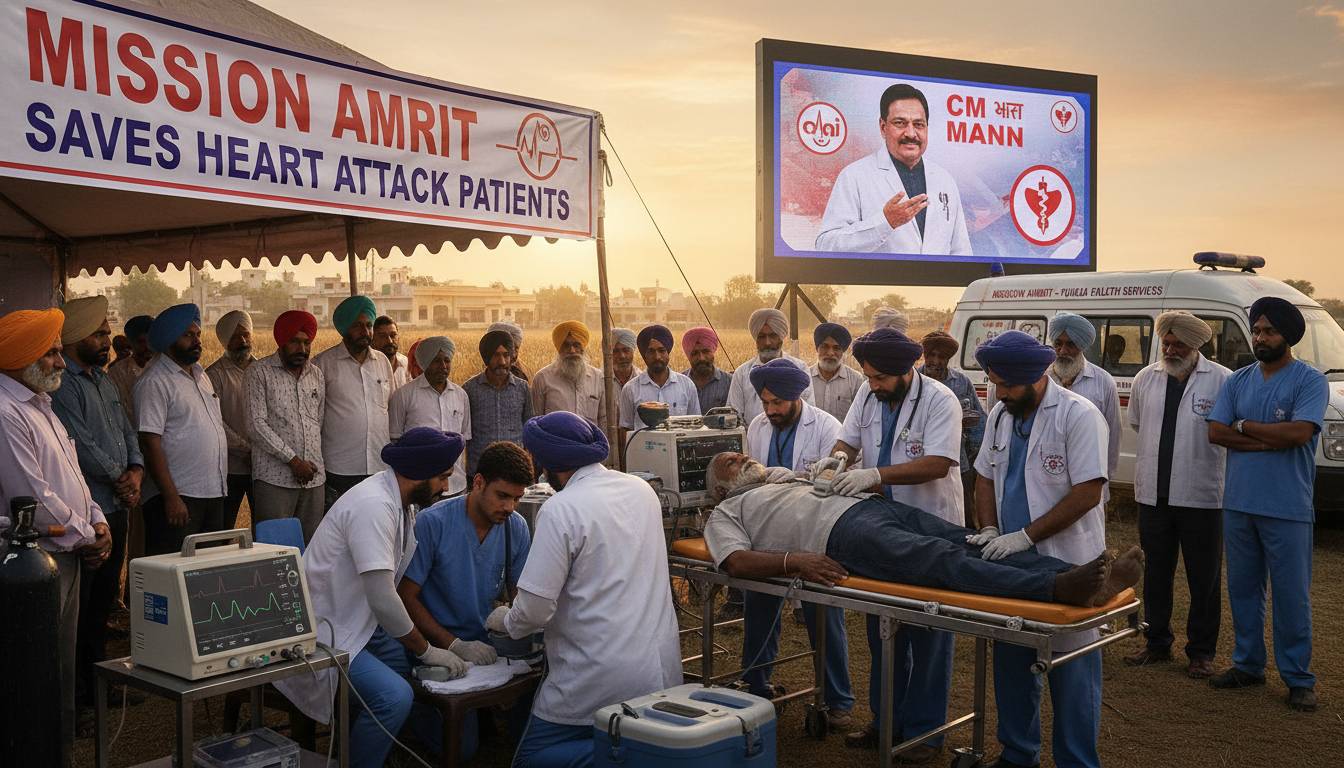
Punjab’s “Mission Amrit” has been positioned by Chief Minister Bhagwant Singh Mann as a statewide emergency cardiac-care network designed to cut treatment delays for severe heart attack patients across all 23 districts. The program, built on the STEMI care model, links district and sub-divisional hospitals with specialist hubs for rapid diagnosis, clot-busting treatment, and telecardiology support. Publicly available reports show the initiative’s statewide expansion began on July 1, 2025, with trained staff, hub-and-spoke hospitals, and a focus on the “golden hour” in heart attack care.
💡
Mission Amrit is a STEMI response program covering Punjab’s 23 districts.
Public reports describe it as “Acute Myocardial Reperfusion In Time,” aimed at early diagnosis and thrombolysis for ST-segment elevation myocardial infarction patients through a statewide hub-and-spoke network launched on July 1, 2025. Sources: VOH Network and Hindustan Times, published July 2025.
July 1, 2025 Launch Put 23 Districts Into One STEMI Network
Mission Amrit is not a general wellness campaign. It is a targeted emergency-care program for STEMI, the most dangerous form of heart attack, where blocked coronary arteries require immediate restoration of blood flow. Reports on the launch say Punjab expanded the project statewide on National Doctors’ Day, July 1, 2025, bringing all 23 districts into the system.
The operating model is practical. District and sub-divisional hospitals function as “spokes” that identify suspected STEMI cases, perform ECG-based assessment, and begin thrombolysis when indicated. Larger institutions act as “hubs,” offering specialist interpretation and teleconsultation support. Named hub hospitals in public coverage include Dayanand Medical College and Hospital in Ludhiana, Government Medical College and Hospital Sector 32 in Chandigarh, government medical colleges in Patiala, Faridkot and Amritsar, and AIIMS Bathinda.
Mission Amrit: Publicly Reported Operating Structure
| Metric | Reported Detail |
|---|---|
| State coverage | 23 districts in Punjab |
| Program focus | STEMI / severe heart attack response |
| Launch date | July 1, 2025 |
| Spoke facilities | District and sub-divisional hospitals |
| Hub support | Specialist hospitals with teleconsultation |
| Drug pathway | Thrombolysis using Tenecteplase |
Source: VOH Network and Hindustan Times reports on the statewide launch, July 2025.
700 Trained Staff Explain How the Program Works on the Ground
One of the clearest operational details in public reporting is workforce preparation. Hindustan Times reported that more than 700 staff members, including medical specialists, emergency medical officers, and nurses from all 23 districts, underwent capacity-building training at DMCH Ludhiana before or during the statewide rollout. That matters because STEMI treatment depends on speed, protocol discipline, and confidence at the first point of care.
The treatment pathway described in launch coverage centers on early ECG diagnosis and thrombolysis with Tenecteplase at spoke hospitals, followed by specialist guidance and referral where needed. In cardiac emergencies, this model is designed to reduce the time lost when patients must travel long distances before receiving any reperfusion therapy. The “golden hour” framing in public health messaging reflects that urgency.
Mission Amrit Timeline
Before July 2025: Punjab had already piloted STEMI-linked emergency cardiac care in selected settings, according to year-end government-linked reporting.
July 1, 2025: Statewide expansion of Mission Amrit launched across all 23 districts on National Doctors’ Day.
July 2025 rollout phase: More than 700 healthcare personnel were reported trained to support diagnosis and thrombolysis.
March 21, 2026: Bhagwant Mann remains Chief Minister of Punjab, according to the Punjab government’s official “Who’s Who” page.
What Is Driving Claims That Thousands of Patients Were Helped?
The user’s topic references a claim that Mission Amrit is “helping save thousands of heart attack patients” across 23 districts. Publicly available search results confirm the statewide launch, district coverage, training scale, and treatment design. They do not, in the material located here, provide an official audited statewide patient tally that independently verifies the exact “thousands saved” figure. Because of that, the safest factual framing is that the Punjab government and associated public statements present Mission Amrit as a life-saving statewide intervention intended to improve outcomes for heart attack patients.
That distinction matters for accuracy. A program can be clearly designed to save lives and may well have treated large numbers of patients, but a precise count of lives saved requires outcome data, methodology, and a dated official release or dataset. In the sources reviewed, those details were not available in full. For a news article, the verified core is the statewide STEMI network, the 23-district footprint, the use of thrombolysis, and the training of more than 700 personnel.
ℹ️
The strongest verified fact is the statewide rollout, not a precise saved-lives count.
Available public reports support Mission Amrit’s launch, structure, and staffing. They do not, in the sources reviewed, provide a fully documented official statewide figure for exactly how many patients were saved.
23-District Coverage Matters Because Distance Often Delays Cardiac Care
Punjab’s statewide design is central to the story. In many regions, severe heart attack patients lose critical time traveling from smaller towns to tertiary hospitals. Mission Amrit’s hub-and-spoke setup attempts to shift the first lifesaving step closer to the patient by enabling district and sub-divisional hospitals to diagnose STEMI quickly and administer clot-busting therapy before transfer. That is the practical significance of 23-district coverage.
The model also fits the broader healthcare expansion narrative promoted by the Mann government, which has emphasized decentralized access through public facilities. While that wider policy context appears in government-linked and media reporting, Mission Amrit stands out because it addresses a time-sensitive emergency where minutes can change survival and disability outcomes.
Why Mission Amrit’s Design Is Significant
| Component | Why It Matters |
|---|---|
| ECG at spoke hospitals | Supports earlier STEMI identification |
| Tenecteplase thrombolysis | Allows immediate clot-busting treatment where cath labs are not nearby |
| Teleconsultation hubs | Connects smaller hospitals with specialist cardiac guidance |
| 23-district rollout | Expands access beyond major urban centers |
| 700+ trained staff | Improves readiness for emergency response |
Source: VOH Network and Hindustan Times launch reports, July 2025.
Frequently Asked Questions
Frequently Asked Questions
What is Mission Amrit in Punjab?
Mission Amrit is Punjab’s statewide STEMI emergency-care initiative for severe heart attack patients. Public reports describe the acronym as “Acute Myocardial Reperfusion In Time” and say it was expanded across all 23 districts on July 1, 2025.
When did the statewide rollout begin?
The statewide expansion was publicly reported on July 1, 2025, which was National Doctors’ Day in India. Coverage from that date says the Punjab government launched the 23-district rollout then.
How does Mission Amrit treat heart attack patients?
The model uses district and sub-divisional hospitals as first-response centers for ECG diagnosis and thrombolysis, while larger hub hospitals provide teleconsultation and specialist support. Public reports specifically mention the clot-buster drug Tenecteplase.
How many healthcare workers were trained for the program?
Hindustan Times reported that more than 700 staff members, including specialists, emergency medical officers, and nurses from all 23 districts, underwent training linked to the rollout at DMCH Ludhiana in July 2025.
Has an official figure confirmed that thousands of patients were saved?
The sources reviewed for this article confirm the program’s statewide launch and operating model, but they do not provide a fully documented official statewide tally verifying the exact phrase “thousands saved.” That claim should be attributed to public statements unless backed by a dated official dataset or release.
Disclaimer: This article is for informational purposes only. Information may have changed since publication. Always verify information independently and consult qualified professionals for specific advice.