
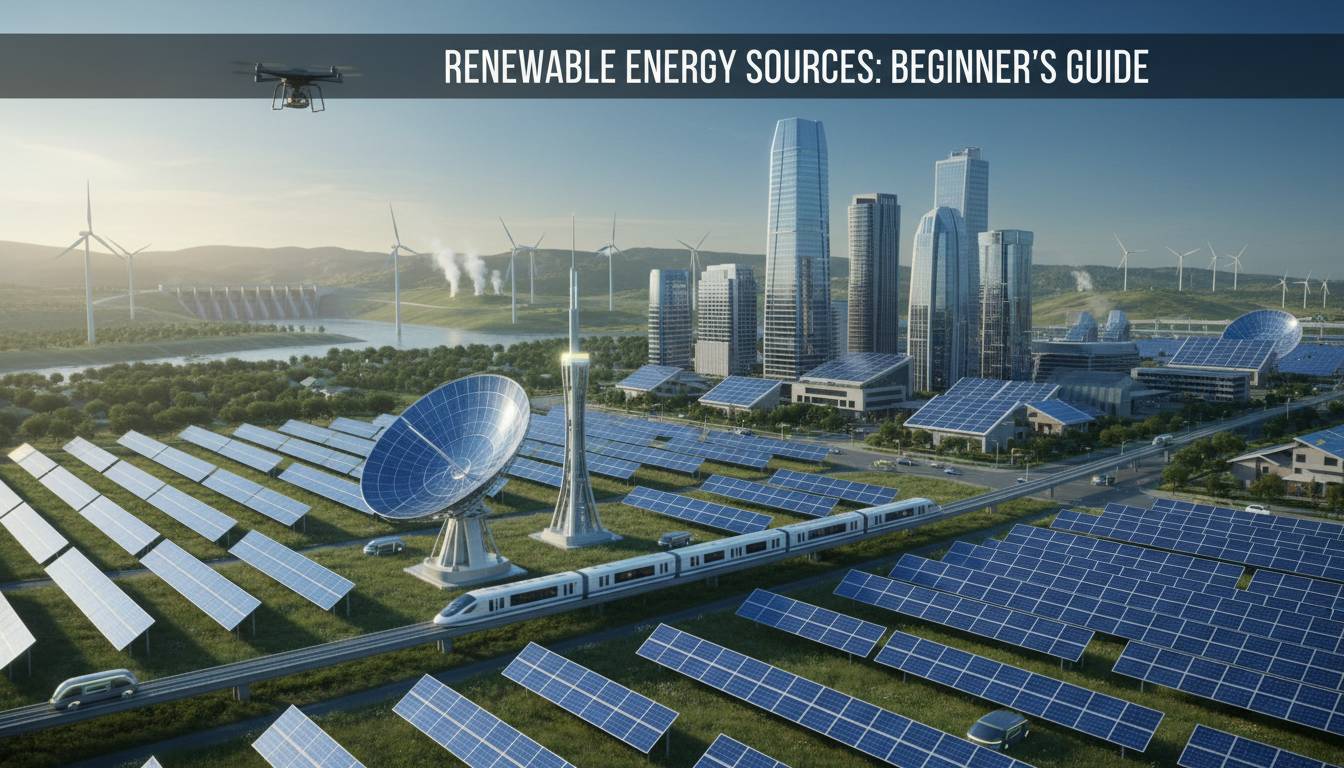
Renewable energy now accounts for approximately 23% of the United States’ electricity generation, marking a transformative shift in how Americans power their homes, businesses, and communities. This comprehensive guide explores every major renewable energy source available today, explaining how each technology works, where it excels, and why it matters for your energy future.
Whether you’re a homeowner considering solar panels, a business owner exploring sustainability options, or simply someone wanting to understand the energy landscape, this beginner’s guide breaks down complex renewable technologies into clear, actionable information.
Understanding Renewable Energy Fundamentals
Renewable energy derives from natural sources that replenish themselves faster than they are consumed. Unlike fossil fuels—which take millions of years to form and release stored carbon when burned—renewable energy sources produce minimal greenhouse gas emissions during operation and can provide sustainable power indefinitely.
Key Insights
– The U.S. renewable energy sector grew 4.2% in 2023, adding approximately 30 gigawatts of new capacity
– Solar and wind combined now represent over 14% of total U.S. electricity generation
– Renewable energy jobs now exceed 3 million in the United States, outnumbering fossil fuel sector employment
– The Levelized Cost of Energy (LCOE) for solar dropped 89% between 2010 and 2022
The fundamental advantage of renewable energy lies in abundance and sustainability. The sun provides enough energy in one hour to power global electricity needs for a year. Wind energy draws from atmospheric circulation patterns that constantly regenerate. These sources don’t deplete over time and produce electricity without the environmental costs associated with coal, oil, or natural gas extraction and combustion.
Understanding renewable energy also requires recognizing its two primary categories: distributed generation and utility-scale generation. Distributed generation involves smaller installations—like residential solar panels—that produce power at or near the point of consumption. Utility-scale generation uses large facilities, such as massive solar farms or offshore wind installations, that feed electricity into the grid for widespread distribution.
Solar Energy: Power from the Sun
Solar energy harnesses sunlight and converts it into electricity through photovoltaic (PV) technology or concentrated solar power (CSP) systems. This renewable source has experienced explosive growth, with the U.S. adding over 32 gigawatts of solar capacity in 2023 alone—the largest annual addition of any energy technology.
How Solar Technology Works
Photovoltaic cells contain semiconductor materials (typically silicon) that release electrons when photons from sunlight strike them. This electron movement creates direct current (DC) electricity, which inverters then convert to alternating current (AC) for home and grid use. A single residential solar panel typically produces 300-400 watts under optimal conditions, while commercial installations can span acres of land.
Concentrated solar power operates differently, using mirrors or lenses to focus sunlight onto a receiver that heats a fluid—usually water or molten salt. This heated fluid produces steam that drives traditional turbine generators, similar to fossil fuel power plants but without the combustion.
| Solar Type | Best Application | Efficiency | Cost Range |
|---|---|---|---|
| Residential PV | Homes, small businesses | 15-22% | $15,000-$25,000 |
| Commercial PV | Warehouses, offices | 16-20% | $50,000-$500,000+ |
| Utility-Scale | Solar farms | 14-18% | $0.80-$1.50/watt |
| CSP | Large grid storage | 25-35% | $5-$10 billion/projects |
Top Advantages of Solar Energy
– Scalability: From tiny chargers to gigawatt-scale farms, solar adapts to any need
– Declining costs: Solar panel prices dropped 90% over the past decade, making residential solar increasingly affordable
– Low maintenance: Most systems require only occasional cleaning and inverter replacement every 10-15 years
– Energy independence: Net metering programs allow homeowners to sell excess power back to utilities
– Silent operation: Unlike wind turbines, solar panels produce electricity without mechanical noise
Residential solar adoption accelerated dramatically after the Inflation Reduction Act of 2022, which extended and expanded the 30% federal tax credit for solar installations. Many states offer additional incentives, including rebate programs and property tax exemptions for solar-equipped homes.
Wind Energy: Capturing Air Currents
Wind energy converts the kinetic energy of air currents into electricity using turbines. Onshore wind now provides over 8% of U.S. electricity, while offshore wind—still emerging—promises substantial additional capacity along coastal regions.
Wind Turbine Technology
Modern wind turbines consist of blades, a rotor, a generator, and control systems. When wind causes the blades to rotate, the rotor spins a generator that produces electricity. Large utility-scale turbines can exceed 260 feet in height with blade spans approaching 400 feet—larger than football fields.
Wind energy capacity varies dramatically by location. The Great Plains states—Texas, Kansas, Iowa, and Oklahoma—host the nation’s largest wind farms due to consistent, strong wind patterns. Offshore wind along the Atlantic coast and Gulf of Mexico offers even higher capacity factors because marine winds tend to blow more consistently than terrestrial ones.
| Wind Category | Capacity Factor | Typical Size | Best Locations |
|---|---|---|---|
| Onshore | 25-45% | 2-5 MW turbines | Plains, ridgelines |
| Offshore | 40-55% | 8-15 MW turbines | Coastal waters |
| Distributed | 15-30% | 10-100 kW | Rural, agricultural |
The American Wind Energy Association reports that wind power now supplies enough electricity to power over 40 million homes annually. Texas alone generates more wind power than any other state, exceeding 30,000 megawatts of installed capacity.
CASE: The Roscoe Wind Farm in Texas, one of the world’s largest onshore wind installations, produces 781 megawatts—enough to power approximately 250,000 homes while displacing over 1.5 million tons of carbon dioxide annually.
Hydropower: Energy from Flowing Water
Hydropower generates electricity by using the force of flowing or falling water to spin turbines. It represents the oldest and largest source of renewable electricity in the United States, providing approximately 6.2% of total U.S. energy generation and nearly 40% of all renewable electricity.
Types of Hydroelectric Systems
Conventional hydroelectric facilities use dams to store water at elevated positions, releasing it through turbines when power is needed. This approach provides reliable baseload power and valuable grid stability services, including frequency regulation and spinning reserves.
Run-of-river installations channel portion of a river’s flow through turbines without large storage reservoirs, minimizing environmental impact while generating continuous power. Pumped storage facilities—accounting for over 95% of U.S. energy storage capacity—pump water uphill during low-demand periods and release it through turbines during peak demand, effectively functioning as massive batteries.
| Hydro Type | Capacity Factor | Storage | Environmental Impact |
|---|---|---|---|
| Reservoir | 40-60% | Hours-months | Moderate-high |
| Run-of-river | 30-50% | Limited | Low-moderate |
| Pumped storage | 80-95% | Hours-days | Low (closed-loop) |
The Hoover Dam, completed in 1936, remains one of the largest hydroelectric facilities in the Western Hemisphere, generating approximately 2,080 megawatts—enough to power over 700,000 homes. Modern projects like the Grand Coulee Dam expansion demonstrated hydropower’s capacity for continuous, reliable generation.
Top Advantages of Hydropower
– Reliability: Unlike solar and wind, hydropower provides consistent baseload generation regardless of weather conditions
– Grid stability: Hydro facilities can ramp output up or down within seconds, supporting grid frequency regulation
– Storage capability: Reservoirs store energy as potential energy, available on demand
– Longevity: Many hydro facilities operate for 50-100 years with proper maintenance
Geothermal Energy: Earth’s Internal Heat
Geothermal energy taps into heat stored beneath the Earth’s surface, providing consistent, round-the-clock electricity generation regardless of weather or time of day. The U.S. leads global geothermal power production, with facilities primarily located in the western states where underground heat resources concentrate near tectonic plate boundaries.
Geothermal Technology Applications
Dry steam plants—the oldest geothermal technology—directly use steam from underground reservoirs to drive turbines. Flash plants heat water extracted from deep wells, converting it to steam as pressure decreases. Binary cycle systems transfer heat from geothermally heated water to a secondary fluid with a lower boiling point, which vaporizes and drives turbines without emitting geothermal gases.
Enhanced geothermal systems represent the technology’s future, creating artificial reservoirs in hot rock formations where natural permeability is insufficient. This approach could expand geothermal potential to nearly every region of the United States.
| Geothermal Type | Temperature Required | Capacity Factor | Best Applications |
|---|---|---|---|
| Dry steam | 150°C+ | 90-95% | Base load power |
| Flash | 180°C+ | 85-95% | Base load power |
| Binary | 85°C+ | 95-99% | Continuous generation |
| Enhanced | Variable | 90%+ | Widespread deployment |
The Geysers in California remains the world’s largest geothermal complex, with over 1,500 megawatts of installed capacity. According to the Geothermal Resources Council, enhanced geothermal systems could potentially provide 100 gigawatts of additional U.S. capacity—equivalent to roughly 100 coal plants.
Key Insights
– Geothermal plants operate at capacity factors exceeding 90%, significantly higher than other renewable sources
– Binary cycle technology enables power generation from lower-temperature resources, expanding viable locations
– Direct-use applications provide heating for homes, greenhouses, aquaculture, and industrial processes
Biomass Energy: Organic Matter as Fuel
Biomass energy derives from organic materials—plant matter, agricultural waste, forestry residues, and dedicated energy crops—converted into heat, electricity, or biofuels. Unlike other renewables, biomass can provide dispatchable power that utilities can call upon when needed, complementing variable solar and wind generation.
Biomass Conversion Pathways
Combustion burns biomass directly to produce heat for electricity generation or industrial processes. Gasification converts biomass into synthesis gas (syngas) containing hydrogen and carbon monoxide, which turbines or engines can then convert to electricity with higher efficiency than direct combustion.
Anaerobic digestion breaks down organic waste in oxygen-free environments, producing biogas (primarily methane) that can power engines or fuel cells. This process commonly treats wastewater sludge, food waste, and agricultural manure while capturing methane that would otherwise escape into the atmosphere as a potent greenhouse gas.
| Biomass Type | Feedstock | Energy Form | Efficiency |
|---|---|---|---|
| Combustion | Wood, agricultural residues | Heat, electricity | 25-40% |
| Gasification | Various biomass | Syngas | 35-50% |
| Anaerobic digestion | Waste, manure | Biogas | 35-45% |
| Biofuels | Crops, waste oils | Liquid fuels | Varies |
The U.S. DOE’s Bioenergy Technologies Office reports that biomass currently provides approximately 5% of primary energy consumption, with potential for substantial growth through advanced conversion technologies. The ethanol and biodiesel industries consume significant agricultural production, creating ongoing debates about food-versus-fuel tradeoffs.
Top Advantages of Biomass Energy
– Dispatchability: Unlike solar and wind, biomass facilities can generate power on demand
– Carbon neutrality: Plants absorb CO2 during growth, offsetting emissions when burned
– Waste utilization: Agricultural residues and waste materials find productive use
– Rural economic benefits: Biomass facilities often locate in agricultural regions, supporting local economies
Ocean Energy: Tidal and Wave Power
Ocean energy harnesses the immense, predictable energy contained in ocean tides, waves, and currents. While less developed than other renewable technologies, ocean energy offers exceptionally high energy density and predictable generation patterns tied to lunar cycles.
Emerging Ocean Technologies
Tidal range technologies—similar to hydropower but using ocean tides—employ barrages or tidal fences to capture energy from rising and falling tides. The La Rance tidal power plant in France, operational since 1966, demonstrates this technology’s proven reliability, generating approximately 500 megawatts for over half a century.
Wave energy converters capture the energy in ocean surface waves through various mechanisms: oscillating water columns, attenuators that ride waves like floating snakes, and point absorbers that bob independently. Current projects off the coasts of Oregon, Scotland, and Portugal are advancing these technologies toward commercial viability.
| Ocean Technology | Capacity Factor | Development Stage | Potential |
|---|---|---|---|
| Tidal range | 25-40% | Commercial | Regional |
| Tidal stream | 35-50% | Pilot/demo | High |
| Wave energy | 20-35% | Pilot/demo | Very high |
| Ocean thermal | 50-65% | Demonstration | Moderate |
The European Marine Energy Centre reports that wave and tidal stream technologies could theoretically supply 10-15% of current European electricity demand. U.S. potential remains substantial, particularly along the Pacific Northwest, Northeast, and Gulf coasts.
Hydrogen: The Versatile Energy Carrier
Green hydrogen—produced by splitting water molecules using renewable electricity—represents a promising pathway for decarbonizing sectors where direct electrification proves difficult, including heavy industry, long-haul transportation, and chemical production.
Hydrogen Production Methods
Electrolysis uses electricity to split water molecules into hydrogen and oxygen. When powered by renewable electricity, this process produces “green hydrogen” with zero carbon emissions. Proton exchange membrane (PEM) electrolyzers offer rapid response times suited to variable renewable generation, while alkaline electrolyzers represent more mature, cost-effective technology.
Blue hydrogen combines natural gas steam reforming with carbon capture and storage, producing hydrogen with lower—though not zero—emissions. This approach provides transitional capacity while green hydrogen scales, though debates continue about true lifecycle emissions.
| Hydrogen Type | Production Method | Emissions | Cost Range |
|---|---|---|---|
| Gray | Natural gas reforming | High | $1-$2/kg |
| Blue | Steam reforming + CCS | Moderate | $2-$3/kg |
| Green | Electrolysis (renewable) | Zero | $4-$8/kg |
| Pink | Electrolysis (nuclear) | Zero | $3-$5/kg |
The U.S. Department of Energy targets green hydrogen costs below $1 per kilogram by 2031—equivalent to natural gas on an energy-equivalent basis—through manufacturing scale-up, technology innovation, and renewable electricity cost reductions.
Making the Transition: Practical Considerations
Transitioning to renewable energy involves evaluating multiple factors based on your situation—residential, commercial, or industrial. Understanding the economics, technical requirements, and available incentives helps inform decision-making.
For Homeowners:
Residential solar typically pays for itself within 6-12 years through electricity bill savings, with system lifespans exceeding 25 years. Federal tax credits cover 30% of installation costs through 2032, with additional state incentives often available. Battery storage systems—priced between $10,000 and $20,000—provide backup power and enable time-of-use optimization.
For Businesses:
Commercial renewable installations offer faster payback through accelerated depreciation deductions and potential sustainability certification benefits. Power purchase agreements (PPAs) allow businesses to host solar or wind installations without upfront capital, paying only for generated electricity at negotiated rates.
For Utilities and Large Organizations:
Utility-scale renewable procurement involves complex negotiations, grid interconnection processes, and long-term price certainty considerations. Many corporations now commit to 100% renewable goals, driving substantial corporate PPA market growth exceeding 40 gigawatts in 2023.
❌ MYTH: Renewable energy is too expensive for reliable grid operation
✅ REALITY: The Levelized Cost of Energy for new solar and wind now undercuts fossil fuels in most U.S. regions. Battery storage costs dropped 80% since 2012, enabling reliable renewable integration.
❌ MYTH: Renewables require too much land
✅ REALITY: Utility-scale solar requires approximately 5-10 acres per megawatt—less than 1% of comparable coal plant land requirements. Dual-use agrivoltaic systems combine solar generation with agricultural production on the same land.
The Future of Renewable Energy
The renewable energy trajectory points toward continued rapid growth driven by economics, policy support, and climate imperatives. The International Energy Agency projects renewables could supply 70% of global electricity by 2050, with solar alone providing nearly half.
Technology innovation continues across all renewable sectors. Perovskite solar cells promise higher efficiency at lower costs than traditional silicon. Longer wind turbine blades capture more energy at lower wind speeds. Advanced geothermal techniques unlock resources previously inaccessible. Floating offshore wind opens vast ocean areas for development.
Energy storage—the historic weakness of renewable energy—is experiencing rapid advancement. Lithium-ion battery costs dropped 90% over the past decade, while next-generation technologies including solid-state batteries, flow batteries, and compressed air storage approach commercial viability.
On the Industry Outlook:
– Sarah Ladislaw, Senior Fellow, Center for Strategic and International Studies: “The economics have shifted decisively. Renewables are now the default choice for new generation in most contexts.”
– John B. D. term, Chief Economist, Energy Information Administration: “We’re seeing structural transformation in electricity generation, with renewable capacity additions consistently exceeding expectations.”
– Denise R. Singleton, Executive Director, American Solar Energy Society: “The workforce transformation is profound—renewable energy now employs more Americans than traditional fossil fuel extraction combined.”
Conclusion
Renewable energy has evolved from niche alternative to dominant force in electricity generation. Solar, wind, hydropower, geothermal, biomass, ocean energy, and emerging green hydrogen each offer unique advantages suited to different applications, geographies, and needs.
For individuals and organizations considering renewable energy transitions, the current environment offers unprecedented incentives, declining costs, and proven technologies. The path forward involves evaluating specific requirements, understanding available resources, and taking advantage of federal and state support programs.
The renewable energy revolution represents more than an engineering transition—it reflects a fundamental shift in how humanity powers civilization. Understanding the options available today positions you to participate meaningfully in this historic transformation.
Frequently Asked Questions
What is the cheapest renewable energy source in 2024?
Onshore wind and utility-scale solar currently represent the cheapest new electricity generation sources in most U.S. regions. The Levelized Cost of Energy for solar dropped to approximately $25-40 per megawatt-hour, while onshore wind averages $25-50 per megawatt-hour—below natural gas and substantially below new coal or nuclear installations.
How long do renewable energy systems last?
Solar panels typically maintain efficiency for 25-30 years, with gradual degradation of approximately 0.5-1% annually. Wind turbines are designed for 20-25 year operational lifespans with regular maintenance. Hydroelectric facilities can operate for 50-100 years, as demonstrated by facilities like Hoover Dam. Geothermal plants routinely operate for 30-50 years with proper resource management.
Can I power my entire home with renewable energy?
Yes, many homeowners achieve complete energy independence through solar panels combined with battery storage systems. However, feasibility depends on your location, energy consumption patterns, available roof or land space, and budget. Most residential solar installations offset 60-100% of typical household electricity usage, with battery storage providing backup during non-generating periods.
What are the main disadvantages of renewable energy?
The primary challenges include intermittency (solar and wind don’t generate continuously), energy storage costs for backup, land requirements for large installations, and geographic limitations. However, grid integration improvements, declining storage costs, and technological advances continuously address these limitations. Hydropower and geothermal provide reliable baseload generation that complements variable renewable sources.
How much does it cost to install residential solar?
A typical residential solar system costs between $15,000 and $25,000 after federal tax credits, depending on system size, location, roof characteristics, and equipment quality. With the 30% federal tax credit (available through 2032), a $20,000 system costs approximately $14,000 after credit. Most homeowners recover their investment within 6-12 years through electricity savings.
Will renewable energy lower my electricity bills?
In most cases, yes. Solar and wind generate electricity without fuel costs, protecting against utility rate increases over the system’s lifetime. Net metering programs credit excess generation to your account, while time-of-use rate optimization through battery storage maximizes savings. However, actual savings depend on your current utility rates, available sunlight, system orientation, and local net metering policies.